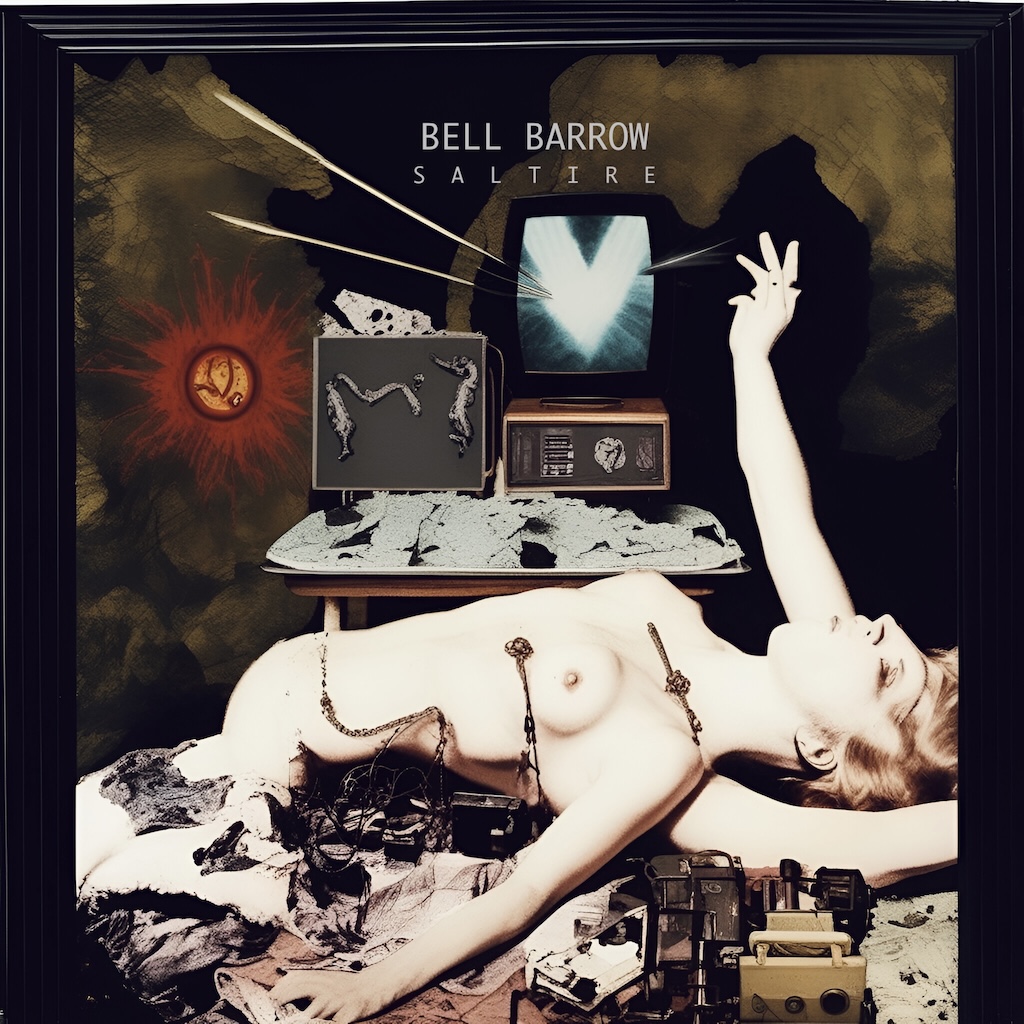
When we were introduced to Washington D.C. based artist Jeremy Moore (A.K.A. Bell Barrow) last year via CoreCore Pulp, we were blown away by the sonic depth of the album. An intense yet abstract experience that drew together elements of Sonic Youth, Skullflower, Miles Davis, and Swans, it existed in an otherworldly realm of its own, and it remains a treasured, if difficult album in our collection.
Surprisingly, given the magnitude of its forebear, Jeremy Moore is back with a new opus. Titled Saltire, the album “examines the concept of generational curses, and their impact on the human psyche, mortality, and providence.” Stretched out over the course of seventy-minutes, the album finds the prolific Moore exploring a wider range of influences still, adding the melodrama of Dead Can Dance and the eerie atmosphere of latter-day Earth to the mix. Needless to say, it is no easy ride.
It opens on a psychedelic note, with Death Lullaby improbably taking its cues from the freeform experimentation of Pink Floyd’s Saucerful Of Secrets. With feedback and eerie noise piercing the gloom, you are almost waiting for Nick Mason’s thunderous toms to come crashing down. Instead, however, the track swells as groaning banks of synth are added to the mix, the end result both slow paced and deeply unsettling. When the drums do arrive, it’s to drive the jazz-inflected Breath Of An Acrobat into the light. Once again, there’s a hint of early Pink Floyd but this time it’s filtered through the Mahavishnu Orchestra and early King Crimson, the inchoate guitar noise slowly building into a wall of sound. This time, the track dies out, ending in a swirl of amp noise, allowing the lengthier Beyond The Labyrinth to exist in its own space. It’s as well. The soundtrack to some unseen and grimy exploitation flick from the 60s, it wheezes and groans under its own weight, with spectral bass lines slowly taking form as the piece progresses. Make no mistake, this is a sonic nightmare and not for the faint of heart, the creeping dread exacerbated by bouts of tinnitus-inducing feedback.
Of particular note is the epic-length Sybian Interval. Look beneath the surface and you’ll find an ethereal ambience that evokes images of otherworldly beauty. However, to reach it, you have to endure savage levels of ear-raping feedback. Persevere and you’ll find a haunting, synth piece that mixes Wendy Carlos with early Eno, but beware – the sheet metal sound of an overloaded guitar is never far behind, with the overall track emerging as an unholy combination of Aphex Twin and Lou Reed’s Metal Machine Music.
Having comprehensively damaged the hearing of anyone within range, Jeremy finally takes pity, as he heads back into free jazz territory with Cor Orans. A dense maze of a track, it appears to have neither beginning nor end, but at least it offers a moment to recover from the skull-scraping frequencies of Sybian Interval. However, such relief is short lived, and the opening moments of We Reek Of Utopia will leave all but the hardiest of sonic adventurers reaching for the volume control. Once again, however, it’s a case of peeling back the layers for, underneath the imposing façade, there’s a gentleness that is worth seeking out.
The short title track arguably finds the album at its most accessible. A straight up jazz explosion, it trades volume for rhythmic chaos, providing a bridge to the eerie ambience of Bölvun Arfleifðar, which evokes the cold emptiness of Iceland’s uninhabited interior. It’s almost a relief when the temperature is raised once more via the scattershot noise of Mercenary Fetishism – a track that harks back to when Sonic Youth rebranded themselves Ciccone Youth, chopping up loops and dealing in blank-faced skits and ambient noise white outs.
Opening to the sound of echoing noise filtered through what sounds like an 8-bit noise generator, Fourth Stream nods once more to Kubrick via his daughter’s soundtrack to Full Metal Jacket. In contrast, the savage A Carrion Call Rings Outdistils the primal ethos of extreme music, relentlessly clawing at the listener’s sanity. It leaves only the collapsed jazz of Ripping Hearts Out Of Hell to round the album out, leaving the listener to return, somewhat shaken, to a daylight that was all but eclipsed by Bell Barrow’s elliptic noise.
As we noted with CoreCore Pulp, Bell Barrow is neither simplistic nor easily accessible. For those willing to stay the course that Saltire represents, there is darkness, there is dread and even, on rare occasions, moments of hidden beauty. However, it takes perseverance and time on the listener’s part, with all too few willing to lose themselves in such a sonic hall of mirrors.
Honestly, Saltire exists so far outside of what the majority would accept as music (and certainly popular music) in its conventional sense, that scoring it seems almost redundant. Genuinely extreme, genuinely unsettling, and genuinely unique, it is an album for those who worship at the altar of no wave, experimental post-punk, and free jazz. If you meet the above conditions, we wholeheartedly recommend Saltire. Just don’t expect an easy ride. 9/10