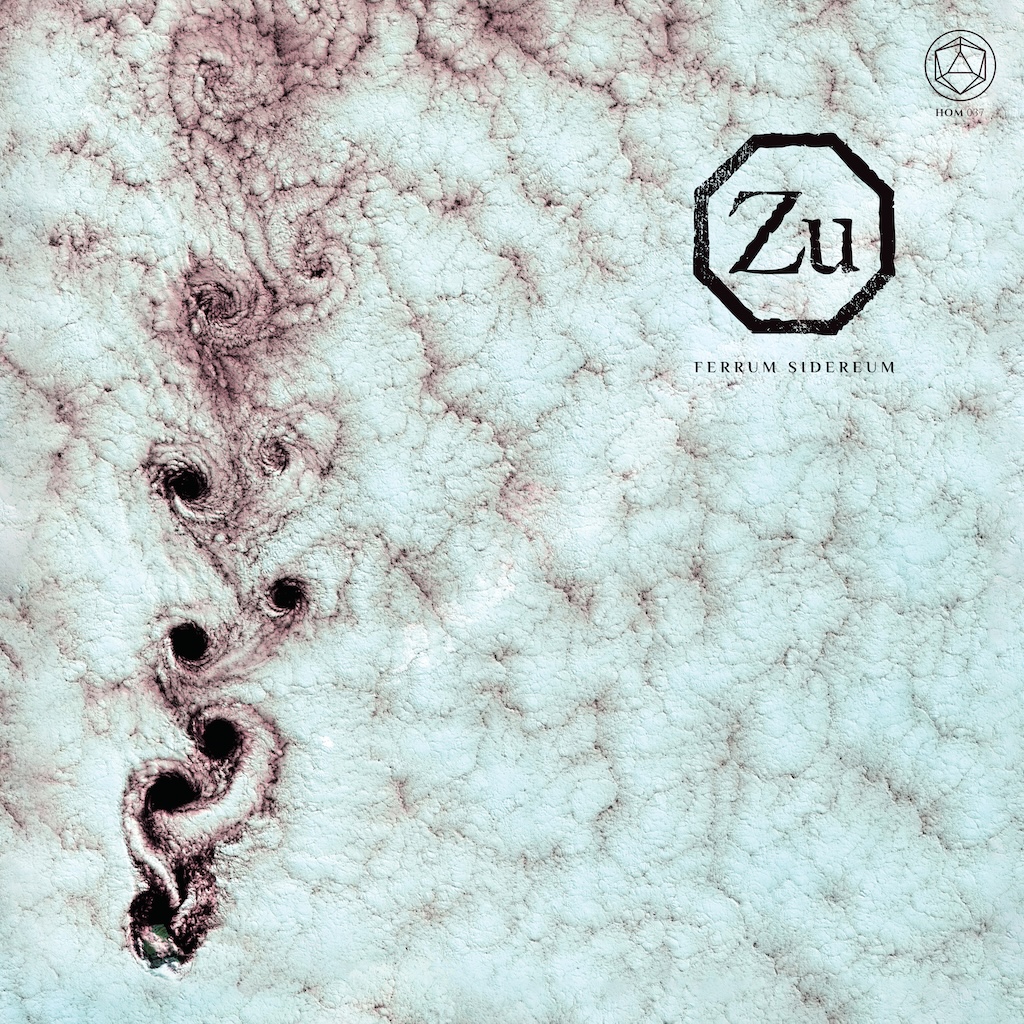
Italian instrumentalists Zu, last reviewed here at SonicAbuse via the collaborative RuinsZu project, are back with Ferrum Sidereum, the latest epic outpouring in a prolific career that began in 1999 with Bromio. An unusual trio who defy any easy attempt at categorisation, Zu comprises Luca T. Mai (baritone saxophone / electronics), Massimo Pupillo (bass), and Paolo Mongardi (drums), whose intuitive understanding of one another’s skills and abilities is such as to ensure that Zu’s music has a spontaneous, loose-limbed quality that cleaves close to the spirit of jazz, even if the band’s influences range from the horror aesthetics of (Dario Argento collaborator) Goblin to Meshuggah.
It opens with a burst of dissonant noise, not unlike the birth of the universe captured on tape, before giving way to a stuttering, industro-jazz maelstrom that sounds like Fear Factory and Meshuggah collaborating on Miles Davis covers in Nitzer Ebb’s basement. Titled Charagma, it’s a genuinely unique assault on the senses and the first thought, once the sonic novocaine wears off, is that no one makes music like this. The second, which follows hot on the heels of the first, is gratitude that someone does – especially in an era where conformity seems to increasingly be the perceived pathway to success (or, at least, commercial success).
Where the opening track did its best to reduce the listener to a quivering mass, Golgotha is rather more subtle. It opens with horror-movie ambience, a series of descending strings running fingers up and down the spine, before Massimo and Paolo introduce slinky, late-night jazz rhythms, over which Luca daubs his saxophone. When the piece finally explodes, as explode it must, it fires off in unexpected directions, the strings coalescing to provide a rather beautiful melody that acts as a counter to the sweat-drenched exertions of the band.
Paolo’s inventive percussion leads the nimble Kether, an eerie piece that once again dips into soundtrack territory, at least during its tension-inducing build up. Once the rhythms do snap into focus, it’s for a surprisingly forthright blast of metal that finds Massimo’s churning bass so riven with distortion you start to fear for the integrity of your speakers. It’s followed by the stuttering A.I. Hive Mind, which takes a skewed, post-hardcore dynamic, interpolating it with freeform jazz, and the polyrhythmic intensity of Meshuggah for a jagged track that saws away at the listener’s increasingly frayed nerve endings. Like many of the tracks here, however, this is only a part of the story and, as it progresses, Middle Eastern melodies slip into the mix, once again drawing the listener far from where they started and baffling the poor reviewer trying to come up with an easy simile.
The album’s longest track (albeit by a hair), La Donna Vestita Di Sole provides a certain respite after the cruelly distorted outpourings of its predecessor. It emerges from a lush, symphonic backdrop and, while the band re-emerge to deliver a weighty, awkwardly timed series of riffs, the strings remain, carrying significant emotional weight along the way. Eventually, they too are obliterated, torn out of existence by Paolo’s increasingly frantic exertions behind the kit, finally paving the way for Luca’s sax to tear through the mix.
The pace slows once more for the windswept opening to Pleroma. An ambient mix of Peter Gabriel synths and creeping, early-Nirvana basslines, it drifts in the aether, only for dirty, post-industrial elements circa Year Zero to slowly disrupt the waters of this sonic oasis. It’s Massimo’s chance to shine next, as he delivers the rippling introduction to Fuoco Saturnio. A gritty combination of System Of A Down, Primus, and Tool, it’s a crunchy, bass-led track that finds the percussion circling the instruments like a shark that has scented blood. That same rhythmic sensibility carries through into The Celestial Bull And The White Lady. A dark piece that seeks to obscure its melody through a series of increasingly violent riffs, at times it nods to Tool, at others King Crimson. It’s a standout track on this always inventive album
Opening on a quieter note, the subtle Hymn Of The Pearl finds layers of shimmering synth gently clothing a tribal rhythm played across the toms, the band repeating and augmenting a simple melody, before allowing the bass to take charge once more. The brief Perseidi, barely a minute long, provides an ambient segue to closing track, Ferrum Sidereum. A final outpouring – a creative clearing of the closet if you will – it opens with the darkest, heaviest bass imaginable, the tense percussion marking time until, at some unseen signal, the band close ranks, the music a solid metallic wedge that allows unseen choirs, the massive tones of a gothic organ, and unsettling ambience to all make their way into your consciousness.
Ferrum Sidereum is not an easy ride, nor is it meant to be. Darkly imaginative, it will take your mind to unexpected places, with the only limit being your own imagination. However, to get there, you need to experience the album in stages. The first listen will leave you devastated. It’s almost too much to take, and you’ll re-emerge into the world wondering where the time went. On the second listen, you’ll still find yourself caught out by the band’s unerring ability to ignore the conventional pathways, but you’ll be more open to the experience. And, from there, each subsequent listen becomes more rewarding as you invest more of yourself in the experience.
Genuinely unique, Zu are prolific, imaginative, and intelligent artists whose works exist largely outside the pantheon of what might broadly be termed popular music. They are sonic explorers and, for those willing to journey alongside them, their work is endlessly rewarding. 10/10