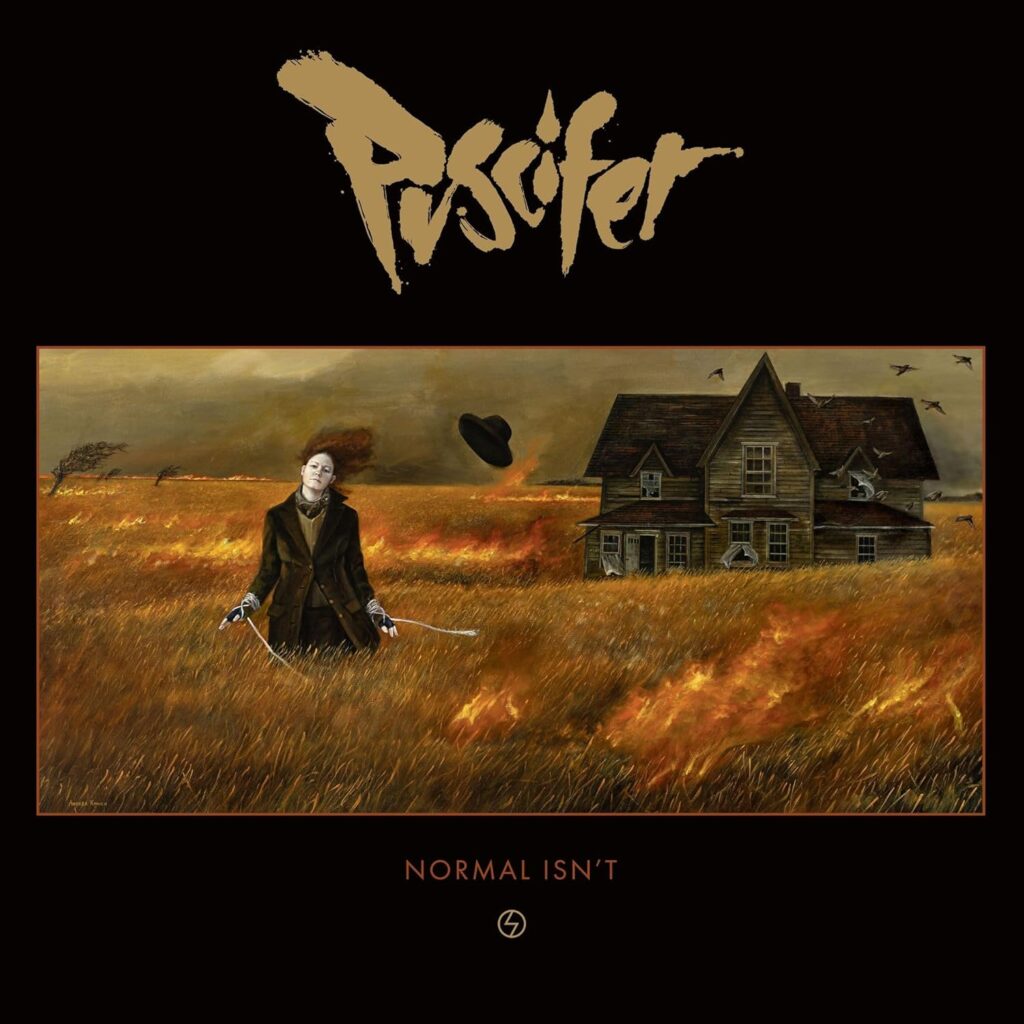
Formed in 2003 and surprisingly prolific when you consider Maynard’s commitments in Tool and A Perfect Circle, Puscifer have released four albums (with Normal Isn’t being their fifth), seven remix albums, seven live albums, and four EPs. Conceived as something of a playground for the sounds in Maynard’s head, the band (completed, since 2007, by permanent members Mat Mitchell and Carina Round) deal in a mix of industrial, trip-hop, post-rock, and alt rock that is frequently at odds with the gloriously puerile titles, artwork, and in-jokes with which the albums are adorned, and the band have quietly refined their sound over the years to become one of the most essential acts currently out there on the fringes of rock’s consciousness.
In the six years since Existential Reckoning Puscifer have hardly been idle. Touring, festival bills, a remix album, four live offerings, and an EP – it’s a lot of activity for a band that some have erroneously dismissed as a lesser project in Maynard’s creative canon and, as Normal Isn’t consistently demonstrates, Puscifer have only gotten better in the process.
The album opens with the awkwardly timed, stop-start pulse of Thrust. The production sounds amazing (of course), the split vocals of Maynard and Carina are as beguiling as ever and, with the whole thing wreathed in reverb and adorned by slashes of guitar, it nods to the enigmatic atmosphere of Massive Attack circa Mezzanine with hints of How To Destroy Angels thrown in for good measure. As a creative gauntlet, it lands on the floor with a sound like thunder and, on this sort of form, there will be few brave enough to pick it up.
The dark post-punk motif of Thrust remains on the skittering title track, which even finds Maynard lifting a vocal melody or two from Duran Duran in between the stuttering guitars and off-kilter beats. When the atmosphere finally subsides and the beats coalesce, the track that emerges is surprisingly danceable – a common thread found across the album and a mark of the band’s increasing confidence when it comes to bridging the atmospheric and the accessible. Honestly, with its falsetto vocals and funky underpinnings, you could easily imagine this sitting on one of Beck’s more recent, pop-fuelled offerings, and damned if you won’t find yourself utterly hooked.
Having established a sonic template for Normal Isn’t, Puscifer spend Bad Wolf imagining an alternate universe where Prince fronted NIN. A dark electro-funk that sounds like Year Zero being drowned under a deluge of Purple Rain, it’s lean, muscular, and memorable. It leaves the listener left to ponder the fact that no one makes music like Puscifer and they are a band you ignore at your peril.
Things take a heavier turn with the coruscating single Self Evident, which pairs a lyrical attack reminiscent of Tool’s Hooker with a Penis with the grinding, post-industrial assault of APC’s Counting Bodies Like Sheep to the Rhythm of the War Drums. With the deft juxtaposition of Maynard’s contemptuous snarl and Carina Round’s more ethereal tones, the track is given weight courtesy of a powerfully distorted bass line, even if it does take the form of a monstrous groove that aims more for the crotch than the cranium.
Puscifer head into darker territory with Public Stoning. Unnerving, bass-led, and schizophrenic, it slips between moody atmosphere and white-hot rage, leaving the listener off-balance and disoriented – a feeling that only intensifies when it suddenly takes a left-step into Depeche Mode territory for its final third.
That Depeche Mode vibe remains, albeit early Depeche Mode, on The Quiet Parts. With its layered vocals and vintage synth motif, it’s possessed of a lovely melody, while the guitars remain in the background, emerging only to add texture when required. Rather more direct is Mantastic, which returns to the post-industrial vibe of the opening track, the crushing bass underpinning an antagonistic vocal from Maynard. However, it’s when Carina slowly takes over that the track really hits its peak, her performance recalling Elizabeth Frazer’s peerless work on Teardrop.
The pace slows once again on the eerie Pendulum, which opens with just vocal and synth before evolving into something that wouldn’t sound out of place on a Sisters Of Mercy album. Dense and dynamic, it finds Maynard exploring a very different vocal tone, and the whole track has an unexpectedly claustrophobic feel to it. It’s a feeling that carries over into ImpetuoUs, which pairs pummelling tribal percussion and grimy, analogue synths with the experimentation of Kid A-era Radiohead as Maynard intones “they’re always afraid of what they don’t understand”. With Matt Mitchell’s wonderfully understated guitars once again adding texture rather than driving the piece, the emphasis is placed on the vocals and the rhythms, metallic fervour traded for something rather less immediate and yet infinitely more satisfying.
Maynard indulges his love of numerology on Seven One, which sets a series of spoken-word passages to a steely mix of post-industrial and funk that finds Puscifer wiring up the remnants of Prince Robocop-style and sending him out on to the stage as gleaming banks of synths click and whir in the background. This flawless gem of an album then wraps up with The Algorithm (Sessanta Live Mix). A toughened, post-industrial rocker in the vein of Self-Evident, it finds the band unleashing a taut, dynamic performance in front of a cheering crowd.
It is arguable that Puscifer have been something of a victim of their own wayward sense of humour over the years. Who, for example, could have guessed that “V” Is For Vagina would contain the heartbreaking beauty of Mama Sed? For the unadventurous, the cartoon imagery and off-kilter liver performances were simply a step too far from the perceived seriousness of Tool’s output (despite Maynard’s recent revelation that at least one track was basically a butt-sex joke), with the result that Puscifer’s excellent musicianship has flown largely under the radar in comparison to the aforementioned Tool or A Perfect Circle.
This, as the band’s albums have so consistently highlighted, is a mistake and, on Normal Isn’t Puscifer have once again shown themselves to be unparalleled when it comes to combining post-industrial, trip-hop, alt rock, and post punk into something truly otherworldly. Normal it may not be but thank goodness it’s not – this is the sound of a fiercely creative, independent band firing on all cylinders, and it might just be the most essential Puscifer release yet. 9.5/10