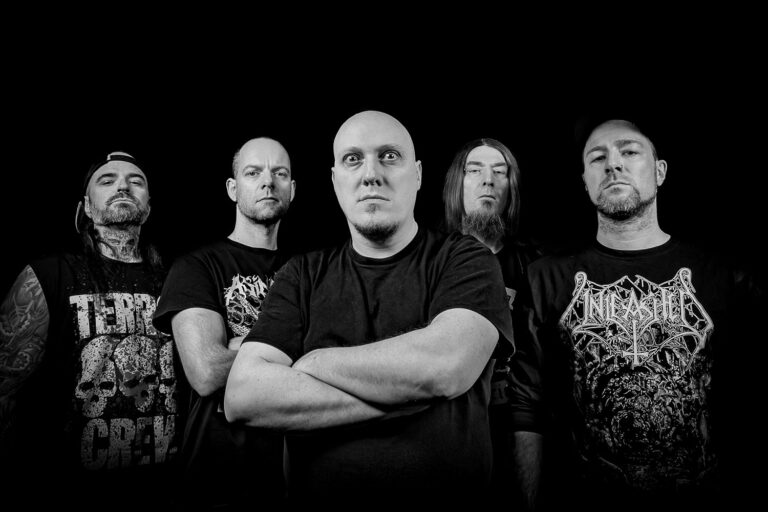
Hailing from Leeds, Cryptic Shift formed in 2013, quickly carving out a name for themselves with their dense, imaginative works. Now the band have returned back with an astounding sophomore effort, Overspace & Supertime, which is a masterpiece of carefully plotted death metal, infused with elements of jazz, post hardcore, and heaven knows what else. It is, quite simply, one of the most exciting extreme metal albums to have emerged in some time, taking the listener on an immensely imaginative journey into a unique sci-fi realm.
We caught up with Xander Bradley (guitars / vocals) and Ryan Sheperson (drums) to discuss the challenges of being in a band, the inspiration behind the album and its expansive artwork, and much more. Read on and journey into the world of Cryptic Shift

The first thing I wanted to ask is that, when you get a lot of bands coming into a genre that’s well established, they tend to pick an element and run with it, which is how a genre tends to get a bit… boxed in. But, in the case of Cryptic Shift, it feels like you have a very diverse range of influences well beyond just death metal. What was your introduction to music that gave you that breadth?
Ryan: Growing up in the time that we did. Myself especially, I got into heavy metal at a young age – like eight-years-old, something like that. So, by the time I was old enough to conceptualise the genre as a whole – I was sixteen when I first started playing in bands – I’d already explored a lot of genres. I was well into some of the more… sure, the more obvious bands, but also a lot of underground death metal and thrash bands. But then, also, I had a general awareness of general metal, especially around that time, growing up. Heavy metal was still somewhat popular, with regards to how it is now, there aren’t too many bands… you know, the groove metal / Lamb of God, NWOAHM was coming around at that time, so, even like influences from popular bands back then was still pretty cool, like Machine Head, Mastodon, Lamb of God, and Fear Factory.
So, as a teenager, the accessible metal was still pretty cool metal and, by the time I started playing in bands and jamming with Xander and stuff like that, we were both already; whilst having a special interest in thrash metal and death metal; we still had a pretty big interest in the genre as a whole, I guess. Whereas, say, in times before the internet and, you know, stuff like YouTube, you kind of found your niche and stuck with it because resources and money were both to be considered. At least in the times we grew up, it was easy. Even now, there are loads of metal genres that I’ve heard that I think are total garbage, but I still know a lot about them, just because I see them all the time, I hear them all the time. It’s one of those things.
Xander: For me, I think… between the four of us, as a collective, we’ve got a pretty unique handful of influences, which is pretty cool. I think a lot of it, personally, comes from the idea of getting into metal… you know, in your early years, you discover Metallica and then, maybe some people just stick with Metallica and want to stay in that ballpark. But me, as soon as I heard that Megadeth was a thing… and you hear “oh, Dave Mustaine used to be in Metallica, but then he created this better band that was faster, heavier, and had more solos, better riffs.” That idea of jumping up to Megadeth, it feels like the next level.
Then you want to find the heavier stuff. You find death metal, and you find Death and, as you get more of their albums, they get more technical and progressive and strange and way more interesting and creative. Then, that bleeds into discovering Cynic, Atheist, Atrocity, Pestilence, you know, all those lot.
It seems like it’s always the idea – what’s next? What’s more? What’s faster? What’s heavier? What’s got the better musicianship? And that idea fed into the life cycle of Cryptic Shift. It’s got to the point, in the last few years, of looking back at what influenced Cynic while they were recording Focus.They were listening to like jazz fusion and stuff, you know. They were super into Allan Holdsworth stuff and that idea of the musicianship. He was a big influence at that point.
And then even further, you can go back to the classical composers of the last couple of hundred years. They’re masters. I haven’t quite deciphered all of them, but that may be next.
One of the things I really enjoyed is that you have this incredible technicality, but you’ve managed to ensure it’s always in service in the song. From a writing perspective, especially with such lengthy songs, do you have to have discussions about how to stay on track with the themes of the songs.
Ryan: I think it comes naturally because, at the end of the day, we still want to write a great song and, in doing that, it needs to be cohesive; like tonally with what chords are going on, the speeds that we play, the dynamic, the intensity, the loudness, how quiet it is. Yeah, I think it comes pretty naturally.
As much as I might start writing a song and think I want it to be the most brutal, horrific shit ever, there’s something natural within is that veers it into songwriting territory. Especially in Overspace & Supertime… from Visitations, I think we were always seeking out that quality of a well-written song, even though there may be a lot of explorations into our stranger influences and into pushing our musicianship and the compositions.
Dynamic is so important and, again, it’s something that can be left out – if you have a band that smashes around you the face consistently for forty-fifty minutes, you become numb to it. If you have that ebb and flow, the brutal bits have much more impact.
Ryan: I think with the long songs, if you watch the Lord of the Rings trilogy, you want the extended cuts because it’s worthy of that. But, if you go watch a super-quick, brutal action film, it only needs to be 90-minutes or whatever, because that’s all it deserves through what it’s presenting to the listener or the viewer.
Is it a challenge… I grew up with physical media, so long songs were really not something that I considered beyond whether I enjoyed them or not… but is it more of a challenge, in this era of streaming, putting out songs of 30-minutes in length? Have you had any pushback from the label about that?
Ryan: The support has generally been quite felt throughout the process, but to answer the question, I think the music finds its own audience anyway. I don’t really think… I don’t think long songs are for everyone anyway. They’re for a particular niche of people who enjoy and appreciate those kind of compositions and that’s generally who the music is there for.
Like fans of the whole album as one piece – like you said, growing up with physical media, you don’t necessarily consider the length of things, especially when checking out a full album. And that’s what we’re like as people and fans of music. We often do consider the overall album as one particular item of art. So, that’s how we see it with our records. It’s cool, you know.
Xander: With art, you have to take it for what it is, not what you wish it was or hoped it would be before you’ve even checked it out.
How much time did you spend on the world-building aspects of the themes in the lyrics.
Ryan: A lot of the basic narrative structure was dreamt up years ago as part of Visitations and the Cosmic Dreams sort of stuff. That’s where the foundation was done and then, as we’re writing the music, little bits here and there are constantly being written. I’d say maybe 40% of the lyrics were being done in the last year or so of the writing. So, as we’re creating the music, it follows along with the story the lyrics have already established. Across the whole process, there are little bits of the lyrics being worked on. So, it’s quite back and forth.
I’ve always loved the idea of the concept album, and I know they sort of became quite unfashionable for a time, but I’ve always felt there’s something about having a strong concept that can really help drive the music in a particular direction.
Xander: Yeah, I mean, I don’t listen to that many concept albums. Off the top of my head, I can think of the recent Gorguts’ albums, which are based on a theme – like Nepal and Tibet on The Coloured Sands – but that was more of a theme than a narrative. When it came out, I really liked it how he talked about buying a bunch of books on the topic and becoming really well-read on the subject. Yeah.
You had a bunch of bands who have done a comic to go with their work – Kiss, Megadeth, Aryon, and more recently Bruce Dickinson – that seems like something that would really go with your work.
Xander: It would be cool, but it’s a lot of money, man! That’s why Megadeth could do it, like, eight albums in! Go pick up the record and we might be able to do a comic for you.
I think there are more artists talking about this than ever before but trying to exist as an artist financially is increasingly challenging. Is it a struggle to keep Cryptic Shift moving forward?
Ryan: Right now, the band just lives by its means. Generally speaking, everybody does work, but we’re also completely available to do band stuff. So, it’s quite relaxed in that way.
The band does alright but, like you say, it is a struggle. Especially with how expensive things are these days.
Xander: The aim is to get to the point where you can dedicate more of your brain power and brain time to the band. Yeah, we all think about Cryptic Shift non-stop and we’re in this very room rehearsing most days of the week.
Do you find you kind of have to fall into the role of marketers as well, or have Metal Blade taken some of that work away from you now?
Ryan: I think, at least with Cryptic Shift, our approach isaalways to be more organic. We try to make sure the merchandise is something that’s designed in-house and it’s often delivered by us and stuff like that, because we like to be very hands-on with all those sorts of elements. Especially when it comes to business because you do hear a lot of horror stories and that’s usually because someone’s trusted someone that they shouldn’t have done. So, it’s always favourable for us to try to keep an eye on as much of what’s going on as possible.
Metal Blade have done an incredible job of promoting the album and stuff like that and it’s great to know the record’s in great hands and also one of the great benefits is the trust that comes with that.
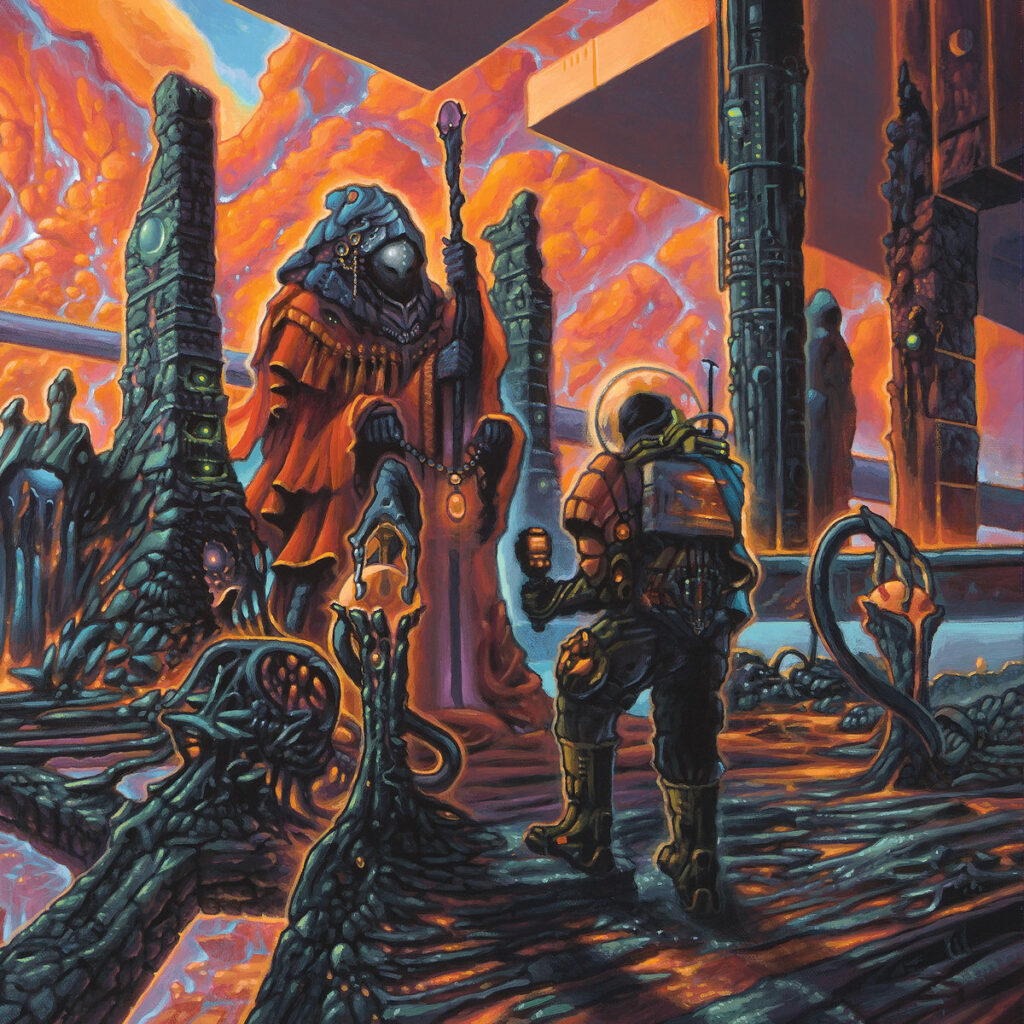
You mentioned that the artwork is done in-house and it’s always been such an important part of the album experience in extreme metal to have great art. Who does it and how involved are you guys?
Ryan: Well, the artwork for this album was done by Jesse Jacobi, who used to go by the name of Pale_bones, but now he goes by the name of Green_Heron. Jesse was great to collaborate with because his artwork is always very striking and imaginative. He has a unique approach to his world. So, it was kind of nice to collaborate and trust him.
But, for our involvement in that, we gave a very specific brief of our imagination of how the album should look and what it should display. He did an incredible job, even adding to that. There wasn’t anything where it was like… Sometimes we’ve worked with artists, and it just hasn’t gone where we saw it going. But with this album everything was perfect, it was just great.
Xander: To be able to work with an artists and get them to visualise your idea to that extent is super-cool. To put that much work into our art, as well as the amount of work we put into the music, is really cool. I think you mentioned earlier, a lot of the old school death metal bands back in the day. Like the cover for Obituary’s Cause of Death, that was originally intended for… um
Ryan: Sepultura
Xander: Sepultura, yeah. And the cover for Demolition Hammer Epidemic of Chaos, that’s been used like multiple times. So, it must have been quite weird back in the day when you’d written a bunch of songs, you didn’t have any idea for the artwork, and you just got assigned one. And then that piece of art, the way it looks and the emotion it gives you, the colours it’s based on, it now represents your work for decades. What if the cover of Cause of Death was completely different? I wonder if it would have had a completely different impact.
We worked with Jesse to do this art in, I think, 2024. So, we had the artwork complete like a year in advance of recording. That’s really cool. We did the same thing for Visitations as well. We were working on the songs with the artwork in mind, which was really, really cool. To know that that’s what you’re aiming for – that that’s what’s going to be representing the songs.
It is a really good point – I used to buy records based on their artwork and it’s so important that albums and art go hand in hand, especially in the extreme metal world.
Ryan: We’re trying to like lean into a bit of that. The album cover doesn’t have our logo on it. We’re using the strikingness of the art to catch your eye in the record store. If there’s anyone into sci-fi and they see that, they’ll be like “that’s super-cool art, I wonder what that is…” and it’s in the metal section, there’s going to be some people who really gel with it on that level. Yeah, the idea of no logo on the front, it’s just a testament to the power of Jesse’s artwork. It’s meant to mirror Visitations as well. Our character is approaching this tall, strange figure on both albums, amidst this strange, alien, kind of unnatural looking landscape, with the clouds. The idea of that structure of the painting is as much the front cover as our actual logo.
It’s a cool testament to the community and the people you build around you – the metal community really lends itself to that.
Xander: And a lot of people in this industry have to work their way up from the bottom. I’m sure it’s hard to believe that, at one point in time, Jesse was a really bad painter, maybe – decades ago. He put his work in and now he’s phenomenal. He’s worked his way up and same here.