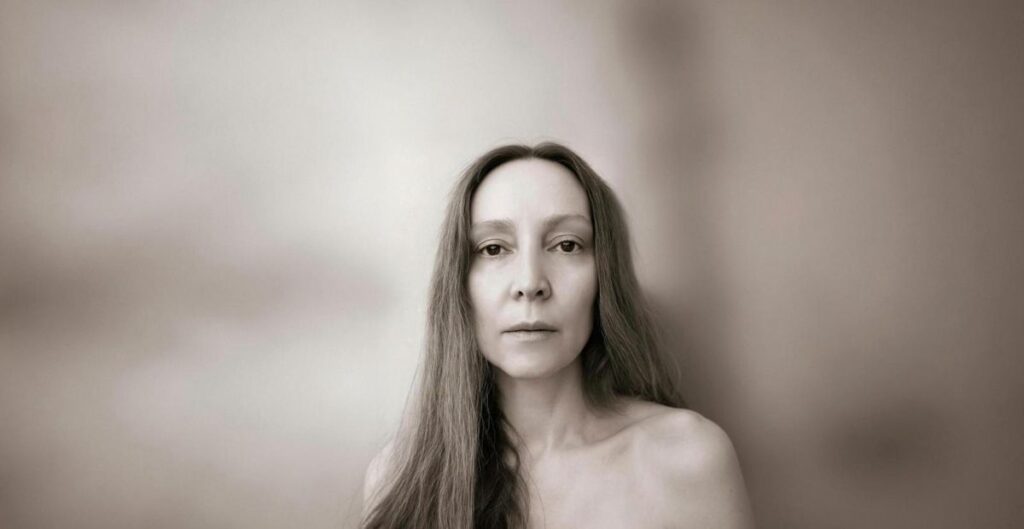
Jarboe needs very little introduction. A prolific artist who came to prominence in Swans and who has carved out a unique career thereafter, Jarboe defies easy categorisation and just is, with each album exploring a different facet of her wildly diverse influences.
Incidentally, Jarboe has also been a huge part of my own musical journey over the years, and I open the interview confessing to a slight case of nerves (something of an understatement), but Jarboe is a gracious host and we soon fall into a discussion that covers a great deal of ground, from the wonderful new album – Sightings – to literature, the formative years of the internet, and the importance of exploring the fringes of your own ability.
Throughout it all, Jarboe is welcoming, generous, and laughs a surprising amount, always exploring the question sin depth and detail, and providing some fascinating context for the new record.
It’s very interesting to me, the way that you conceive albums, because (as I understand it) this album is rooted in nature, the earth, and finding the sounds in the real world that then inspire the music, is that correct?
That’s exactly right. Absolutely.
So, this is something, I think, that has typified your career – because I first encountered your work via Soundtracks for The Blind, which had a lot of found sounds as well.
That’s correct.
So, could you talk me through the process. Is there something you’re particularly looking for in sounds, or you hear something, race off and grab a recorded having been inspired?
I would say it’s the second one. Yeah, I did an album… I’ve always, from the very beginning in Swans, we always used field recordings and old cassette tapes and old recordings from our past, from relatives, and family members. And I did an album called Illusory, and that’s notable because so much of it is field recordings. And the field recordings were primarily made throughout Europe on a tour that I did. Just when I heard something interesting, I thought it was an interesting environment, I would just record.
So, for instance, there’s a track called Cathedral, where I was in a cathedral and a tour group came in. I was singing in there just to record the ambience, very quietly, of my voice. And this tour group came in, with their phones, and the tour guide with an electronic, you know, means of talking to his group. And I just let it go, but then I was told that I couldn’t do that or whatever, and you hear me say “OK!” [Laughs] ‘Uh OK” very innocently, and then I kept on going, kept on walking.
So, on Sightings, it is nature. The fox outside where I live at night. It’s called the Vixen Scream. And then the Vireo, the Red-Eyed Vireo, which I had a relationship with over the summer. He appeared to me; he’d get closer and closer. They’re noteworthy because you can’t see them because their green blends into the leaves. So, I started running out to hear him and we got to the point where he revealed himself to me. And he got closer and closer on the branch to the point where I saw him, and I was amazed. He didn’t run away. In my opinion, he saw me as an audience member, a supportive audience member. And it got to the point where every single day, I would go out and he got my undivided attention for a good forty-five minutes or more.
And then it occurred to me that I should record it. So, I went out there, and there are these other, atmospheric sounds of birds, but I was primarily focused on getting close to him, to record him.
I talk about it in the artwork of Sightings and it’s true, what happened is this whole art relationship with this beautiful bird and his whole vocabulary, like twenty-one thousand songs over a ten-hour period they’ve been noted to do. So, I loved him and I felt a lot of love for him in the same way that you might feel love for your dog or your cat. I just felt love, as much as you can for a non-human. So, after this long serenade form this beautiful bird, he disappeared, and I was heartbroken. And then, he came back, and he had another Vireo with him, who I assumed was his mate, and they briefly showed themselves, and then flew up into the sky together.
Then, a couple of weeks passed and then they came back and the way I interpreted it was that they came back to say goodbye – “I remember you, and now I’m leaving”. They were there for a while, singing, and then they circled up in the sky and flew away. And I stood there and watched with tears running down my face. And this was remarkable, I’ll never forget.
Now Vireos will come through in the summertime. There’s even one here now, but it’s not the same. This one was a particularly talented one and the way that I’ve described it is like free jazz. Just like Ornette Coleman. It was extremely diverse, what he was doing. And never repeatable. And he also had an interesting phrase breaker, which is melodies, and I’ve not heard one doing that phrase breaker since then. They’ll come by and do little melodies, but it’s nowhere near as magnificent as this one.
So, this one is the honorary Vireo. And that’s why I asked Phil to paint the Vireo for me. And that’s a painting he made, a beautiful painting, that we used on the cover. So, this whole project was inspired by that relationship, that incident, with this Red-Eyed Vireo and it’s not something I’ve experienced before.
When I was a teenager, I had a kind of a relationship with two swans, believe it or not, on a lake in a park. And I would go and I would sit near to them and feed them and stuff. Other than that, that’s the only thing I’ve had with wild nature.
It’s remarkable, the relationship you develop with wildlife that’s not a pet, but which makes repeated trips to your home. We have a small garden out back and, last year, we had a number of blackbirds that came every day. And I would feed them and put water out and they were nesting. And then two of them died from avian ‘flu, and I was bereft. So, these relationships are amazing and one of the things I love about this album is you’ve given voice to that emotional journey you go on – and that’s something special, I think.
Well, you have just reminded me with the story about the blackbirds of the place where I lived before. The place was called Mother Crow and when we recorded there, we called it Mother Crow studios. And the whole thing started because the Crows in that area would come. And we started feeding them as well and they would go crazy [laughs]. Then, it got to the point where the band, the Swans band, were staying there and rehearsing to go on tour, and Phil actually was the one that counted the number of crows in the yard. He couldn’t believe it. I’ve forgotten now, but it was like 70-something. And I had this idea that we’d use my mother’s China, which wasn’t used anymore. So, I’d put food on the China plates outside and then they would come and stand on it. And they had testers and scouts. First comes the scouts, who say it’s OK. Then come the testers, who test the food to see if it’s safe or not. They’re very, very advanced. So, they came down and then, pretty soon, the others came down – the elders, I guess – and they stood around this China plate, and you could hear their beaks tapping on it [laughs].
So, that was another. But I didn’t have a bond with a specific one. They were like a group. But that was an interesting episode during that too, so I know what you mean. I think if you’re open to this and if you’re in an environment where you can have this happen… although I think in cities there’s still a possibility, but it’s not as advanced as where I am now, which is basically wild kingdom. It’s woods, it’s wildlife, it’s very different to where I lived on the Lower East Side [laughs]. It’s very different.
It’s a really eclectic album and a number of songs stand out, but as you mentioned the Night Fox, it’s a piece that stands out because it’s both beautiful but ominous – is the inspiration that you take also from the instincts of the animals you’re referencing?
Yeah, I wanted that one to be rather ominous because that is what the thing sounds like at night. If you hear it in the dead of night, it sounds like a person screaming. It can sound quite chilling. So, to me, it was – yeah – to find the tone of that atmosphere. Which is to me, quite fearful and predatorial sounding. But actually, because it’s called the Vixen Scream, I had always thought it was the female, right? Well, it’s a male that does that screaming [laughs]. And then, again, it’s some kind of mating ritual thing, which is kind of weird. And, if they’re doing it, you’ll hear different ones who are not in the area are doing it too. So, at certain times of the year, you’ll hear them out there doing it [laughs] which I enjoy, you know. I enjoy living in an area where there are horses, foxes, a huge variety of birds, rabbits, hawks. There are all kind of things around here.
When I first came here, I was a little frightened because I’m not used to being around so many snakes. So, yeah, I think there’s a trade-off with the environment, but it’s something I’ve really enjoyed and it’s not that far from the city, so it’s just an unusual area. There’s a lake and kind of a river that becomes a stream, so that attracts a lot of nature.
It sounds really lovely!
Yeah, people have come here to visit. I’ve had a couple of friends come here who are musicians and they’ve stayed and they’re always impressed. You know, I just am surrounded by areas where building doesn’t encroach. So, the area right behind is, I believe, unbuildable. The terrain is too rocky and there’s too much going on. I think it would require a massive investment to upgrade the land and build something, so I’m hopeful. But you never know – some developer may get their hands on it.
I hope not! I remember reading an interview with you, years ago, and you were talking about recording In My Garden, and you talked about how you recorded it using a “solid breath” and it was a technique outside of formal teaching. And the reason that caught my attention is because, for me, one of the most exciting things about making music is learning to do things outside of your comfort zone.
Right. Yeah, I think so. And what I’ve learned is that it’s very important to put yourself outside of your comfort zone with your voice and with your music. And I went from being in choirs in school and having a vocal coach, a singing coach. And they were very strict about controlling the breath and how you approach singing and it was difficult and it felt very unnatural to me. You know. It felt very restrained and severe. But it became part of the way I approached things.
So, then I started hearing the music on college radio that really inspired me – it opened up my mind as to what music could be. And that’s what led to hearing Swans and that’s what led to moving to New York and the famous noteworthy thing there, as I’m sure you already know, is that Michael was very important in telling me to throw out everything that I had ever learned and to approach vocalising in a different way. And he was a very… he pushed really hard on me to… he would say “that was great, but it’s not your best, do it again.”
And he would keep on, keep on, keep on, whether it was a scream or, on In My Garden, the breath, or any number of tracks. I mean, When She Breathes comes to mind, Mother / Father, these are all, you know, pushing, pushing, pushing to unlearn that formal training.
One good thing about the formal training was learning about singing not form the chest but from below, so you don’t blow your voice. And that was something that I taught Michael to do. And also, to extend his notes instead of just shouting, which is what he would do when I first went up there. But these are techniques and what that’s leaning to is becoming a character instead of what you call a traditional singer. You’re embodying what the song requires. So, you learn the phrase “what serves the song”.
So, if you look at our cover of Nick Drake’s Black-Eyed Dog, that was me opening up as much as I could the so-called Southern Vernacular. And that’s a style of singing from the Appalachia or the Deep South. So, you know, these are techniques where it’s not like you’re acting, but it’s like you’re embodying that kind of idea in your head, and that affects how you approach it.
And I’m very, very happy that I have that kind of training and that kind of, you know discipline. Because that unleashed an entire world for me, where I could do pretty much any character I think now [laughs]. And that all came about through working with him.
And, believe me, it was not an easy path. But I think it’s good. It’s like the director of a film will pushing the actors to do it again, do it again, do it again. Yeah, so, in this case, this was about letting nature take the lead – the Verio was definitely a lead vocalist on this project – and that’s a new thing for me, I guess. And if somebody understand it, that’s cool. And if they don’t, that’s OK.
It’s really interesting, the idea of formalism. I always feel that a formal education, if it’s done right, should be the start of a journey. It gives you tools, for sure, but you shouldn’t rely on it exclusively. But, particularly now, it feels like there are a lot of bands – for a variety of reasons, including YouTube videos telling you how to be successful – who feel drawn into these formalist boxes and find it very hard to find their way back out again to a more creative space. So, yeah, formal education can help, but only if it’s seen as the beginning, not an end.
Yeah, I would never in a million years tell anybody to look at anything on the internet [laughs] for developing themselves as an artist. I avoid all that stuff and things have changed now with AI generated content. So, you never really know what’s authentic. And so, I think, there’s a big change coming to all these platforms. It’s like enough is enough, to the point where everything is created in that dimension – that’s a whole new frontier. So, I think that ultimately, I’m glad I came from an era before all that. I think that it’s better just to listen to your inner voice and not be swayed by someone else says, whether it’s me or some “expert” with a million followers on Instagram [laughs]. It doesn’t matter. You just have to follow your inner guide and think about your life and how you want to make your voice come forward… or voices!
It seems to me that people have mistaken the purpose of art as being about the end result and not the process and journey that you go on. AI is the embodiment of that, because it’s all about what you get. But that’s not the point of making music. I find it quite scary at the moment – I worked in education for a long time and watching students slip away from creating something and learning something by doing to focus only on the end result… it feels that the whole paradigm has shifted away from art to commerce.
One thing I’m doing right now is to revisit things that, I don’t know, struck a match in me before. So, I revisit them through my “eyes” as they are now. And this involves my massive consumption of books, and I guess, I think that, if I can advocate for anything at all it is to read books and to read them as books instead of… And, of course, I do have digital books as well, but I primarily have actual books. And you can buy them from places, like bookshop.org, that are not too corporate if you’re interested in supporting independent booksellers.
Right now, I’m revisiting The Viennese actionist era – Hermann Nitsch and that whole school from Vienna. Because, that kind of robust exploration of visceral life is very inspiring. I think that it’s, you know, it’s kind of like it’s good to get a punch in the gut, once in a while. So, if you go back and look at what that movement did and what Hermann Nitsch did, it’s really, it’s so fresh. It’s still fresh now. And it’s still bold now. And that kind of energy, I think, is very important.
Great literature never dates. Funnily enough, I’ve returned to the books I read at university, but as a fan, not as a critic, and it’s been such a joy. It’s interesting, because I find that literature is really inspiring as well for writing – you’re reading some intense passage, and it can really strike a chord in you. It’s the emotion and I find I get lost in books, to the point that the outside world disappears. I love it, it’s amazing.
Yeah, yeah! Aside from nature and meditation and just kind of going into your life and experiences, the number one, if you were to say of every single thing that I’ve ever done, the number one would be that it came from reading books. Reading something and it just opened up something in your brain, where you’re writing a song and doing some music. English literature has always been huge for me. As a kid I was winning prizes for the number of books I could read, and I was very good at doing book reports and standing up in front of the class and reading passages. And, of course, all the kids hated me [laughs] They did! Because being a nerd is not an easy path [laughs]. But yeah books, I completely agree with you, you just go into that world.
And my father, when I was growing up, my father said that it was like talking to a very intelligent person. You’re having a conversation with this author, you know, and it’s very stimulating for your brain and it’s very good to have these interactions with the writer.
Going back to the album, The Holy Waters – I’m really interested in the manipulation of sounds, and you’ve got all these backwards masked (I think) effects. And what I found, emotionally, was it felt like a kind of rebirth – a regeneration of nature – something like that. All those sounds going back into the ground. It’s a lovely, hopeful, piece of music, and it’s something very different, so what inspired those elements?
So, that track in particular, as well as Francesca Sun, those were – I had the privilege and the opportunity to work with Thor and his friend. And I just had the idea that, you know, to incorporate their skill set. Andrea, as you may know, is a great violinist. She did such a beautiful job. And, on The Holy Water, he did a lot of percussion and he’s playing a lot of horns there. A lot of those sounds are probably his horns. So, the atmospheres were heightened by that they contributed.
And I invited, these are primarily friends that I invited. I didn’t know Andrea before she played the Violin on Shallows. But I had worked with Father Murphy before – that’s Chiara and Freddie Murphy, so they… you know, they did interesting things too. Chiara added a lot of electronics and synthesiser. Then, the track, Breath, that’s actually Freddie breathing through a processing unit. So, that created a very interesting effect. Then I added my own breath [laughs] breathing a few times to it.
So, ultimately, Holy Water is meant to embody a joyful celebrating of Buddhist community. So, that’s why the last track – well, actually, the second-to-last track, the Sangha Mix, that’s the community and you can hear them celebrating a little bit at the end.
So, that’s always going to be on every single album, a little nod to my interest in Tibetan Buddhism. So, that’s why that opens with that.
Then it moves into Francesca Sun, and that is a song about Francesca Sun. She’s a wonderful, she was a wonderful artist, she has done album covers for bands like King Crimson. Her husband was Bill Rieflin and Bill was an “honorary Swan”, as Michael called him. And they were both very dear, dear friends, and they’re both gone. And so, she was an incredible painter, a very mystical painter, so that was meant to be an homage to her.
Emotionally, to move through a community to the song remembering her, to The Night Fox, then The Breath, and to the beloved Vireo [laughs]… but it ends on something I’m going to be doing every time now, whether it’s on a record label or just a digital release (because I have a lot of those without a label) – that is revisiting an older song.
So, on Illusory, I did it with Man of Hate, which I originally did on Thirteen Masks. So, on Illusory, the version you hear there is the version I prefer. It’s very theatrical, which shows the idea – it’s a play. And so, and then I have these little angelic voices that I did going “love, love, love, true love”. And then, at the end, you hear the sound of a guillotine, so that comes down [imitates sound and laughs]. Then you hear the supposed “real me” coming back for the encore.
So, on this one is Of Ancient Memory, and I called it the “oblivion mix” because it’s rather sombre. I had someone tell me it’s sad – well, it’s not meant to be sad. If you listen to it, it’s saying that the bomb has sunk into the sea and hasn’t damaged the country that’s been invaded [laughs]. And we did that live, P. Emerson Williams and I, we did that live on the 2022 European tour – it was a co-tour with Jozef Van Wissem – so, we did a version of that then. And some of the people in some of the countries got what I was doing there. They kind of cheered when I said the last line: “it sank into the black sea, into a bed of ancient memory.” So that’s, you know [laughs], that’s an anti-war song.
So, I ended it with that, and every album now is going to end with a revisit of something I’ve done before. It’ll end with a radical reinterpretation. And there’s so much there to choose from, it’s always going to be a complete reworking of something old as the very last track.
It’s really exciting to take inspiration from things that you have done in the past and filter it through the experience of who you are now. it’s amazing how much it changes and something that was maybe just angry can become more cathartic and something that was joyful carries an air of nostalgia to it. So, it’s a really interesting process, how your persona plays into it… and, of course, your skills and experience as well.
Yeah, and it’s, I think, I’ve done things where I was just completely alone with no one contributing, like Illusory. But, on this one there are a lot of contributors – including the Vireo and the Fox – but I think [laughs] I have selected contributors to the next thing I’m doing, which I’ve already started.
But the process of the music business is interesting too. I only like special places – the Circle in Athens, Greece is a wonderful label. Consouling Sounds is a wonderful label, and I think they care about the music itself, which is why I’ve worked with both of them. I’m really happy that the tour is going to Athens because I haven’t been there in quite a few years, so it’ll be good to go there and actually meet the people who work at The Circle.
It’s so rare, but so cool when you find a label that cares. And you can see it in everything in the packaging and the liner notes. Like, for me growing up, the way that I found Swans was through Sonic Youth liner notes – they had old posters and that was how I found music, because there was no internet in the early 90s. It was such a cool way to learn about the bands that were out there – I found so much music that way and I still love that process, so I always look for bands and labels that do stuff like that.
Have you read The Uncool, Cameron Crowe’s book?
No, I haven’t.
You should read it! It’s going back to when he first started as a teenager and how he met the bands and started interviewing them. Before he started writing for Rolling Stone. And he talks about the early publications and it’s really, really cool. It’s bringing back some great memories for me, with how you discovered music. But you have to read that, you’re going to love it!
I will!
You’ll love it, I know you’re going to love it.
Yeah, for me, it was radio – College Radio – FM College Radio WREK Georgia Tech, which was a diversified station where you could hear Billie Halliday, punk rock, something classical. It was completely diverse instead of this one, you know, slant or style of music. So, I listened to that. Then there was a radio show on Sunday evenings that opened up the door to all this incredible stuff like SPK, like all this incredible stuff – my god, so many bands. Cabaret Voltaire – everyone you could think of – Throbbing Gristle – all these groups came into my hearing portal [laughs] from the station WREK. And that was also where I first heard songs. That was how I learned about music, I was constantly listening to this station because you never knew what would come up next. They had carts that they would load and play and then, once in a while a voice would come on and say, “that was…” [Laughs].
So, that was way before the internet or any computer. I didn’t have a computer until ’96 and that was when I started a… well, there was this guy who had created a fan Swans site. And we were communicating with each other and that was the original Swans.pair.com, which is gone (although I think you can still look it up on the Wayback Machine). So, that’s how that started and that went on for quite a while. Then I started my own site with some developers and then Michael wanted me to register YoungGodRecords.Com, which was then changed over to him because he was going to sell other bands on there, other than Swans.
So, what’s notable there was that I was actually, which is kind of weird now, a pioneer with distribution and artist websites. Because, in those days, no one had an artist website [laughs]. So, yeah, first it was Swans.Pair.com and then, when I started my site, selling things from my site and also from the Swans Site. For some reason when I did the C & J I don’t know if you know what that is. I did that in New York, it’s a group for College Music and anyway it’s a big Music Bis thing and you can play live at that, which I did, and they also had panels and they invited me onto this panel with A&R reps from big labels. And they were talking about distribution, and I mentioned that I had done this site. And nobody on that panel… they didn’t like it. They said “well, nobody can find a Swans record”.
And I said, “well actually…” and I gave them the URL, “it’s global!” [Laughs]
And that just silenced the room. You know, and so, then with my own site, I think I was one of the first to DIY. In those days, it was all CD before the vinyl resurgence. So, I DIY, and self-packaging, and it was extreme, extreme packaging. And I sold them from the site. So, that was the pioneering thing we did – the Swans site as well as my site, where you’re direct to the fan, direct to the customer, direct, direct, direct. And this is before everything – Facebook, Instagram – this was before all of that stuff.
Yeah, the dark days of the internet where you had to wait ten minutes to download a picture and you had to send a cheque because there were no digital payment options.
Do you remember the dial-up?
Oh yeah – unplugging the phone and waiting to connect. And you’re right. So, few bands had sites. I think someone interested me to eBay in like 99 and that was the first time you could pay digitally. But I remember writing out cheques and waiting a month for some record I’d never heard because, of course, no YouTube and no downloads (or very few, because it was so slow) – it was so exciting. Instant service is just not so cool.
Yeah, most people now don’t know what that means. There was no Spotify, no Apple Music, there wasn’t any of that stuff. But you can say that about the entire system now – the internet and the media… everything.
But yeah, you’re right, the thrill of waiting for something to show up. A thing I did, just before I moved to New York, I was part of the whole mail art culture and tape project culture. This was a very exciting, very avant garde time, where you’d record and buy stuff that was primarily electronic with voice manipulation. And you would package it in a really extreme way and then there was a distributor in Colorado, I think it was called AEON, or something like that… so these things would ship all over the world and it was not unusual to exchange tape projects in Japan and there was just this very exciting underground movement. And that also, besides the tape projects, was mail art, where you’d do something really crazy and send it to someone else. And we’d send those back-and-forth [laughs]. I found one of those about a year ago and I was talking to someone, like, “remember when we did mail art?”
And he said, “let’s start it up again” …. I don’t want to start that up again, it’s OK.
But yeah, those were all really cool things that were all about exchange and communication with people online.
The hope that the internet had at that time… and it’s nice to reminisce. I still have a lot of the cassettes and hand-made CDs from that era. I think my cassette player is up there [nodding to the shelf of books and knick-knacks behind me], so it doesn’t get connected too often, but it’s cool to have the option.
I have a We Are Rewind Cassette Player that I love. It’s meant to look vintage. It’s from France, it’s a French company. It’s meant to look retro. It’s really cool and it’s high end, but it doesn’t record. You have to hook up a mic and a pre-amp to record to it. But you can play tapes. Yeah, it’s really neat, I love it. We Are Rewind.
So, really the last question I had prepared for you is about the importance of collaboration. You do a lot of different projects with a lot of different artists. In the same way that nature inspires you, when you find a collaborator, is there anything particular you’re looking for, or looking to find in them?
The whole concept of collaboration has changed for me through time. I think at first it was just a personal growth thing. Just seeing how you would be stretched and could go out of your “comfort zone” through collaboration. But I think now I don’t have that kind of attitude. Y attitude to collaboration is it’s only with people that I personally know, or it’s through a personal introduction. And so… because collaboration ultimately means you’re in on it together. You’re equally part of the process. Because, when you’re just recording on somebody else’s project, to me, that’s a job, that’s work. You are doing what fits into their song, their album, their music That’s different to collaborating.
Collaborating, whoever’s involved, whether it’s 2, 5, or whatever, you’re taking equal responsibility, you know. There’s a trust thing there. So, for example, the collaborators on Sightings, it was carte blanche. It was – “here’s the framework, here’s me doing this on synth or keyboard or whatever, now interpret that wildly, do your thing!” So, you give them a framework, and you just trust them to do whatever they feel like doing.
Then you can send a rough mix or whatever and ask if it’s cool and they’ll say if it works. That’s what I call collaborating. It’s a trust thing and also working with people that you know.
Yeah, that’s really cool. And it is exciting, but also challenging, opening up a palette for people to work with as opposed to telling them to do X, Y, and Z – which is usually not as rewarding in the end, unless you’re really kind of didactic about your sound.
Yeah, because otherwise, it’s just improvisation. You have to have a framework, unless it’s an improvisational foundation, which is a completely different animal.
But I get pieces from people that I know, to add on to. What I’ve been doing lately, I just did one for Thor and a friend of his in Australia, is the idea of revisiting working with vintage instruments. Particularly vintage vocal processing units, which you can’t even find any more. As long as they still work, and you can EQ it enough to get rid of any buzzing or weirdness, you can still use it. So, I sent him two projects recently. And the one I did for Thor, I used this ancient, ElectroHarmonix 16-second digital delay unit. It still works because I’ve treasured it forever. I think it’s the second generation of all the ones they ever made. And if you’re not careful with grounding, it can have this buzz sound. But what it does is it doubles up tracks and it’s constantly bouncing those tracks as you record in real time. And you can’t separate those tracks, so you’ll hear the last two things you did louder, but it keeps generating over and over. It’s really amazing.
Fortunately, what I did… I was listening to some stuff that I’d done on this thing, and I heard something where my ears immediately said that it was in the same key and it would work. So, I sent it to him, and it came out beautifully. But, again, I had to know that it was in the right key, you know.
That’s so cool – happy accidents that come from using old gear and analogue. You get these moments where something slips out of sync but sounds all the better for it. It’s so cool!
I love the idea of happy accidents. And yeah, that’s what I was talking about with the tour group who came into the cathedral, it was a happy accident, you know? You’re in this supposedly pristine environment with beautiful acoustics, and here come electronics with people coming in. So, that’s a happy accident, and I support it! You should embrace happy accidents [laughs]. Otherwise, it’s very dull! It’s too perfect. I’m all about the happy accidents.
Thank you so much for spending so much time with me, for sharing such interesting stories, and for tolerating my rambling questions!
And with a final farewell, I take my leave, having spent a fascinating hour exploring Jarboe’s love of music, art, and creation.
Learn more about Jarboe, Sightings, and the forthcoming tour here: https://thelivingjarboe.com