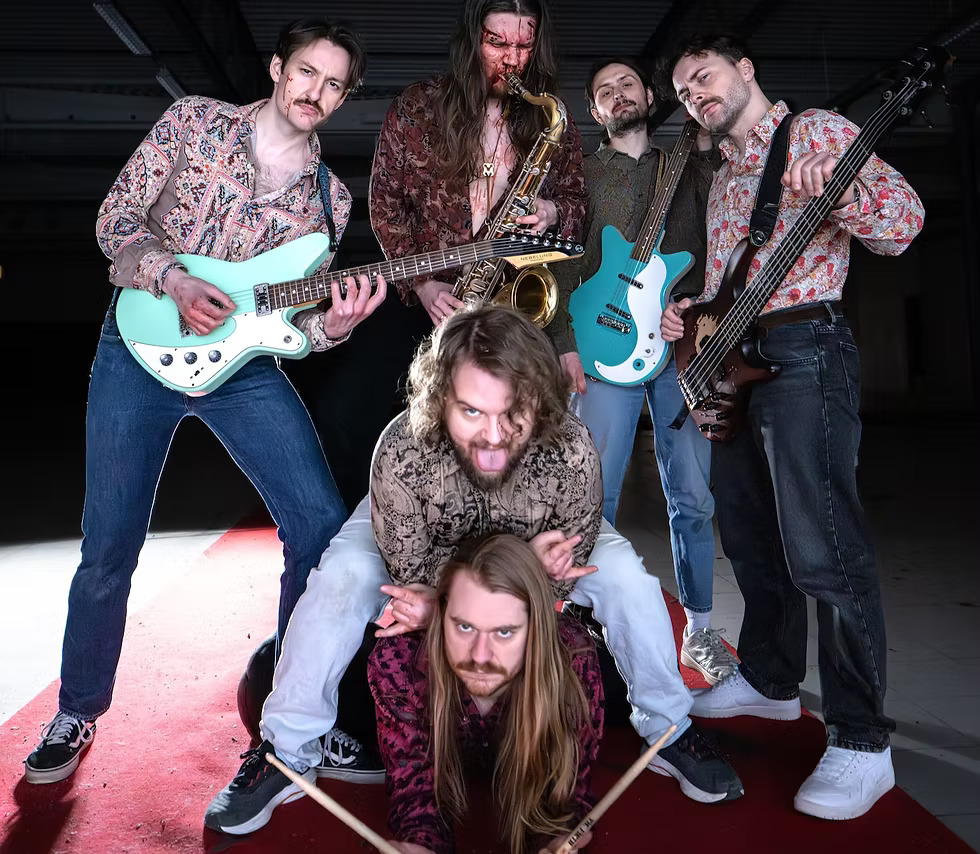
With Norwegian Jazz-metallers Agabas having signed to Mascot, their excellent album, Hard Anger, is being re-released in deluxe form with three bonus tracks in tow and the chance to ensnare a whole new audience.
The album is… well, it’s frankly immense (read our perma-baffled review here), so we were pleased to catch up with guitarists Jarand Aga Baas and Oskar Myrseth to find out more about the writing process, the development of the band’s sound, and the artwork that adorns this excellent new release.
Thank you both for taking the trouble for coming to talk to us.
Jarand: Oh no problem at all,
One of the reasons I’m talking to you today is that you’ve joined forces with Mascot Records to re-release Hard Anger. How did you come to connect with Mascot?
Oskar: As is the case with most of the people we’ve gotten in touch with, they saw us online, because we are chronically online. So, someone from Mascot saw an Instagram post we’d made and thought we were a cool band. He reached out and told us a little bit about the label and told us that they are trying to go back to focusing on heavier music. They used to be a heavy label, then they started to focus more on blues and start, but now they want to go back to their roots. So, we had a little bit of back and forth with them and it didn’t take long, really, until we realised they seemed like really cool guys. We had been looking for a label, if the fit seemed right, so we went ahead and signed.
Your music is really unique – I’ve spent a very happy few days trying to review it and not simply throw superlatives at it (ah well), but what’s really interesting to me is that, unlike a lot of bands that flirt with jazz as a sub-genre, the elements in this are very organic. At some points they take over altogether, and other times they sit within the heavy sections. So, I’m very interested about the writing process. Is it all mapped out in advance, or do you jam to get the pieces in their final form?
Oskar: Well, here’s the fun part about playing in this band. We do not live in the same city. We’re like eight hours apart from one another, so we don’t get to do band rehearsals at all, except for like right before a show or a tour. Then we’ll gather to run through the songs. But we never get to jam or anything like that. I wish we could, but we can’t. So, we can’t write songs like that.
Usually, it’s people writing demos – they’re quite complete pieces and then, when we get together, we work out the last 10% of how it goes through the Agobas meat grinder, and we put a little bit of everyone into the song.
For the next album, we do want to work a little bit more together. So, right now, we’re writing more little pieces of ideas – like riffs, and sounds, and things we think sound cool – and we want to get together for like a week or so before we actually go to the studio to actually write the whole thing together. But, until now, it’s just been demos and we’ve tended to keep the sound that we think we’re collectively going for in the back of our minds while we’re writing, and it sort of comes together when we’re together in the studio.
But I think part of the reason that it naturally turns into an organic blend is that our sax player is a pretty jazzy guy. He’s doing his master’s in jazz performance right now. That stuff just feels natural to him. But he also loves heavy shit, so putting a saxophone on top of the demos that we write is something that he can do anything that feels natural to him.
Our drummer is also someone with a jazz performance degree, but he obviously loves metal, so his style of playing also comes very naturally, with those two worlds combined. And, for the rest of us, we’re just a bunch of people who are either leaning toward the heavier stuff, the jazzier stuff, or other stuff. Then it just happens like that because it’s the kind of stuff we dig, I guess.
Jarand: I agree with everything you said. When we recorded the last album, especially the drums, that was, I think, the first time we were all gathered in a space for so long, for like a week straight, and we could actually give input to what was recorded and make decisions together. But yeah, as you said, I think we’re going to lean more towards putting our ideas out there and then seeing what comes out of it.
But yeah, I think this genre lends itself to being such a diverse group of people. If we were aiming for something within very strict frames, we would be challenged quite heavily.
Oskar: I hope we can disagree more on the next one [laughs]. I hope we can have even fights about what we want to do! It’s been too easy so far. Everyone’s very agreeable.
What makes it sound so organic, for me, is that you don’t try to shoehorn jazz elements directly in. Sometimes it’s full-on jazz and the sax takes over, other times, it’s following the guitar. But yeah, I’m surprised to hear you are so separated because it doesn’t sound like that at all!
Oskar: It’s cool to hear that, because that’s exactly what we’re going for and it’s nice to hear that it translates. I think a lot of it falls on [dellll], our sax played because he is a huge jazz guy and a huge metal guy, so he just understands where his energy is needed and when, and how, which is a really valuable thing to have in a band.
When I started out this site, it was about fifteen years ago, I’d just come back from Poland and one of the things that inspired me to start the site was to write about the cool bands I heard over there. And one of the challenges a number of those bands seemed to face was that, because they were singing in Polish rather than English, it was harder to get that international audience. In fact, some bands even did two versions of albums – one in English, one in Polish. Is that something you’ve had to consider or, as the internet has opened up the audience, is it not something you’ve had to think about?
Jarand: I think it hasn’t been a huge problem lately because, as you said, the internet has opened things up. I’ve always left it up to Sondre, our vocalist, to write what he prefers. And we did have songs in English before, but his way of writing and his lyrics just fit very well the way he does it now. We haven’t closed off the door to making songs in English but, unless the song really calls for it, I don’t see the motivation to do it.
Oskar: I think also, being Norwegian and in a heavy genre is a bit of a luxury, because there’s a big market for that. People like Norwegian extreme metal and there’re people in Argentina learning Norwegian because of black metal, right? So, I think you can get away with people not understanding a word of what you’re saying, if you’re a heavy band that sings Norwegian. That’s lucky for us, I guess. But we’ve tried to write some things in English before and, like Jarand said, it’s not a conscious decision really, we just sort of go with the flow.
It’s always interesting because quite often there’s a poetry that lends itself to whatever your native language happens to be and if you write in one language and then try to translate, as some of these bands did, you lose some of the flow. And they did a great job, to be fair, but I preferred the Polish versions when listening.
Oskar: I think Tokyo Hotel also was doing that, releasing an album in German and then the same in English. It seems like a tricky translation job to do, because you’ve got to make the rhythms work and everything. I don’t know.
Another thing, though, is that in Norway, we start learning English from a very young age, so I think that most of us – at least in our generation – it feels like a second language. I find myself thinking in English all the time, not because I’m trying to, but because it’s such an easy switch. Which is also why, writing in Norwegian or English, it’s whatever feels right in the moment.
Another interesting observation, I guess, is that, compared to twenty years ago, bands have to (for financial considerations more than anything else) write to the format of an album and there are far fewer b-sides and outtakes in consequence. Now, you’re doing Hard Anger as a deluxe version. Was there anything left from the sessions, or are these all-new pieces?
Oskar: We had them around. We did actually have two songs that we recorded for Hard Anger that we didn’t put on the original release, because we just didn’t think they fit that well. Then, with the last one, it’s a Black Sabbath cover that we had started working on later but, by the time Mascot had contacted us, we were already doing that song. So, we just finished that one, mixed it, and sent it to them.
I’m surprised you had anything left over because normally that sort of thing seems to be ironed out in pre-production. How did they stand out so late in the day?
Oskar: The same issue, really. We don’t have the time to meet for pre-production. We had one week in the summer of 2024, and we had to get all our songs out and record them. So, that’s what we did and then we decided later which ones we wanted to keep, or if there were any we didn’t want on the album. It was a good opportunity to get them out there anyway. We liked the songs. They’re not bad songs. We just didn’t think they fit in with the vibe of the other songs, but as bonus tracks…
I think it’s because I’m such a sequencing geek, I really enjoy the process of gathering songs and turning them into an album. And the final track – or what was the final track before the bonus cuts – it’s a perfect ending. Um, I’m going to embarrass myself here – Pa Apent Hav?
Oskar: So, the a with the little circle above it is a Norwegian letter than is pronounced O [he then repeats the title with the correct pronunciation].
Ah, OK. So, it’s like the perfect finishing song – do you have people in the band who are particularly into the sequencing of the album and, if so, did you have to argue as to how the album came together, or did you agree on how it should flow together?
Oskar: I remember the whole time as a bit of a blur because we were sort of rushing. Maybe you remember, Jarand?
Jarand: I also don’t really remember, but I think it was decided in the moment. I think it just felt right from the get-go. But I do think that several of us… we do pay attention to those kind of details, from the sequencing to the cover art. Everything has to blend together in a way. But, if you do listen to the songs in a sequence, you sort of get used to it anyway. But definitely, I think about how someone else perceives the album. What is the energy like, how does it fit together.
So, yeah, not as conscious a decision as it could have been, this time around, but maybe for next time.
Well, Oskar was hoping for a conflict – maybe that’s where it will come!
Oskar: Maybe! [Laughs] We’ve been too good friends. All the big bands have some sort of falling out. We need something to happen soon, because we’ve almost been a band for ten years now, so we need to throw some fists! [Laughs]
In terms of doing the demos, how detailed is the demoing process?
Jarand: Ah, it’s sort of… guitars are the most detailed thing that just stay how they are. Drums stay open because we have an amazing drummer and I don’t want to write his parts for him, because I’d ruin it. He’s also a very, like… if you write him a part and tell him to play it like that, he’ll do it, because he’s also an amazing sessions drummer. So, I try to keep the drum parts as open as possible because I know he’ll do something amazing.
Saxophone, there is no good Sax VST, so you just have to imagine it on top of there, and then we tell our player what we want him to do. Sometimes he does that, sometimes he does something different. And vocals, usually just go on top at the very end. Except for the second bonus track – Morke Daga. That was an experiment we did where our vocalist wrote a whole song that was just word. Then he recorded just the vocal and sent it to me and I tried to write the music around it. Which was fun, but that’s not how we usually do it.
That’s really cool though – I love it when you feel like you’re pushing against the edges of what you can do. It sounds like swapping around the writing process like that was both challenging and, perhaps more importantly, really fun to do.
Jarand: Yeah! It was fun. It was a cool challenge. And like the worst thing that can happen if you try something weird is that you just don’t use it.
Oskar: I think we differ slightly there. If I’m making a demo at home, I get very detail oriented and I sort of have to explore all the options before I show it to someone else. But I think recently we’ve shifted a bit to where we’re open to “here’s what I have, what do you want to add to it?” Even on tour, we were showing each other riffs and things backstage – little snippets – and that’s so much more fun than sitting at home and tweaking things that I know won’t matter. That’s definitely a habit that changes slowly.
That’s part of becoming more comfortable with one another, I guess, because it can be quite vulnerable sharing a composition with people for the first time and there is a temptation to make it as perfect as possible. The problem with that is, as soon as someone has a better idea, you’re even more likely to be annoyed by it!
Jarand: Yeah, I’m scared to get too married to the idea early, But I often do! Just being able to hand it over to someone… some things you write with a certain intention you have the energy in mind. Some things sound cool, sound finished, and you’re more open to sharing. But yeah, it’s something I think we’re still all learning.
Oskar: Yeah, especially when we’re in this situation where we can’t meet as often, it probably takes a bit more time to get comfortable with sharing ideas with one another, because we can’t just meet in a room and jam it out. And I think that’s why being backstage when we’re on tour becomes a special thing because it’s so rare that we get to do that.
But I think some of the things we wrote on tour now turned out really cool, so maybe we’ll start some writing sessions on the next run.
Jarand: I hope so.
Oskar: Me and Bjorn are actually going to meet the day after tomorrow to do a writing session and we have a very particular plan – we’re going to write a Meshuggah song and then throw saxophone on top of it and see how it turns out. Like you said, what we’ve been going for so far has been to try to incorporate the saxophone as much as possible into the whole flow of things. Now we want to see what happens if we write a Meshuggah song and throw a saxophone on top of it. Maybe it’ll sound good, probably not so much, but at least we’ll definitely learn something from it and maybe it can inspire something else down the line, so I’m excited to see how that turns out.
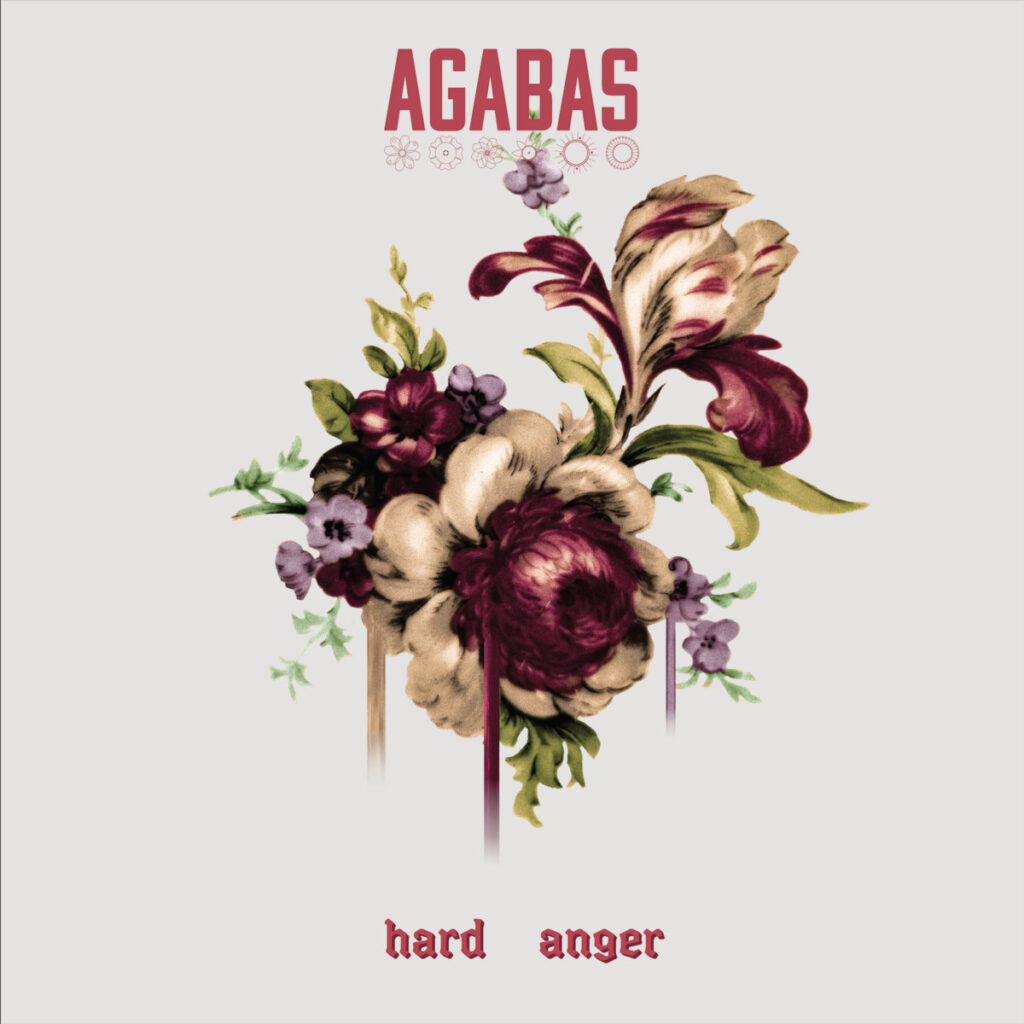
You mentioned the artwork, who does it and how involved are you?
Jarand: That’s changed from record to record but this last one, Hard Anger was my design. And we’ve done it in-house for all three records, the merch too. For this one, we recorded most of it where I’m from in a small cabin and I wanted to bring something else from that place into the record, just to make it into a concept. So, it’s inspired by my grandmother’s old porcelain dishes. She has a wall of them in her kitchen, and they all have this beautiful floral artwork. So, I took inspiration from those and tweaked the colours to the extreme to make them more vibrant, more in tune with the music.
So, that was really the whole idea. It’s the same thing with the single covers and the record covers. I can tweak them endlessly if I have a big idea for them. Yeah, I think, that’s the whole story.
I love the fact that it’s connected to where you recorded and it’s a very striking image that doesn’t look like much you see in extreme genres. But it’s so cool it’s connected and has that resonance and thought behind it. And having that is possibly more important than ever in the era of streaming…
Jarand: Yeah, I think that’s also important with a lot of the messaging in the music and us being an inclusive band. We want to be a band for everyone and that sort of echoes in the artwork as well. It’s something beautiful that people can appreciate, even if the music is still quite dissonant and aggressive from time to time, there’s still some beauty to be found there. Even the latest single cover, Kill, is just photos that I’ve taken around the farm where I’m from and I’ve added in the flowers. I wanted it to be rooted in reality.
That’s one of the great things about extreme music – there’s a perception that it’s angry and aggressive. And you know, music can be violent, but it’s not aggressive – it’s not trying to hurt people. So, it’s understanding the distinction between a violent energy and an aggressive intent.
Oskar: That’s one thing, and also the things that’s always, to me, beautiful about extreme music is that it doesn’t necessarily feel angry, it’s just extreme. It’s just an extreme expression of some kind of feeling. Sometimes it’s anger, sometimes it’s aggression. At other times, it can be feelings of ecstasy or happiness or love, but it’s always cranked to ten and that’s what I think is so beautiful about extreme music. You get to feel so much from it. And sometimes we want to express anger or love or whatever it is, but you get to do it in such an oversaturated way, making music like this. That’s what’s most fun about playing this style of music to me.
My final question is about the Sabbath cover. How did you choose to cover the song and was it before or after Ozzy’s untimely passing and how did you make it your own?
Oskar: It was post. After Ozzy died, we felt we wanted to honour him in some way, and we wanted to do a Sabbath cover. I really wanted to do War Pigs because I love that song and, you know, the state of the world. But the other guys sobered me up and reminded me that everyone does War Pigs. So, Jarran suggested The Wizard because the melody would be really cool on the sax. But yeah, the death of Ozzy Osbourne shocked the whole metal world because everyone is influenced by him and Black Sabbath in some kind of way, and we just wanted to do something to show our love of everything that he’s done for heavy music.
Even though his death was tragic for everyone, you get to re-appreciate everything he’s done and doing a cover is a great way to pay tribute.
Jarran: What a legacy.
Oskar: Yeah
Jarran: Crazy!
And it’s unique to you – your cover pays tribute, but it’s not a carbon copy.
Oskar: Thanks man, appreciate that!