
Originally recorded in 1973, Gentle Giant’s In A Glass House is the legendary album that, while popular with fans, saw the band being dropped by then-label Columbia Records, who saw the record as “unmarketable”. For this edition, it has been remixed by Eber Pinheiro, using AI stem separation, and mastered by Fred Kevorkian (Sonic Youth, The White Stripes, Dream Theater), with Derek Shulman co-credited as producer. Available as both a single (stereo) disc and as a double disc edition with surround sound mix, this review covers the stereo version only.
The Package
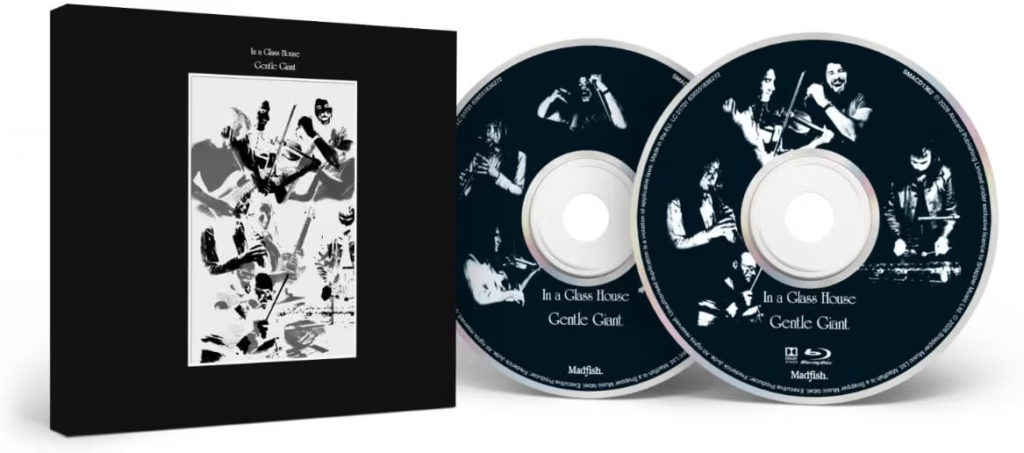
Housed in a standard plastic case with a die-cut sleeve, this new edition is surprisingly light on content. Rather than pad out the runtime with bonus cuts, the powers that be decided to leave the original 7-song sequence intact, which is by no means a bad decision (certainly, I prefer to hear the original album as intended without demos or B-sides cluttering things up), although it is odd that the bonus live tracks included in previous editions have been shelved.
Rather more disappointing is the total absence of contextual liner notes. Given that the band’s Derek Shulman was actively involved in the project, not to mention the time and effort that went into revisiting this troubled record, this seems like a missed opportunity. Whether the omission was to save money (the booklet is a simple, four-page affair), time, or whether the label simply doesn’t believe people go to the trouble of reading such things in the internet era is impossible to know. Nevertheless, given the band’s own relationship with the record, you’d have thought some effort might have been made.
There is also a double disc edition available, which includes a blu ray that features (according to the accompanying press notes) Stereo, 5.1 Surround Sound & Dolby Atmos mixes.
The Album
Appropriately enough, opening track The Runaway emerges from the sound of breaking glass. From the initial point of impact, it soon builds into a rhythm that drives the track forward into King Crimson territory, all twitchy shifts in rhythm and style, while nailed to the central melodic conceit, with a remarkable glockenspiel part that must surely have had a young Peter Gabriel taking notes.
It makes for a fascinating start, underscoring the rampant ambition that lay at the heart of Gentle Giant, and the new mix helps to bring out elements that were hitherto buried. That said, while AI may have helped with separation, it has left some parts feeling strangely flat, the layers present but artificially distinct to a degree that feels a little unnatural. This, coupled with the questionable decision to boost the bass and the kick drum, makes it difficult to assert that this is an unqualified improvement.
Nevertheless, there are moments where the mix shines. As the opening track segues into An Inmates Lullaby, the glorious glockenspiel / timpani intro is rendered with crystalline precision, the vocals tripping over one another, with each line given its own space. A strange, neo-classical workout, it makes its way towards third track, Way of Life, which is the sort of gloriously OTT progressive workout that Genesis so enjoyed on the likes of Foxtrot and Nursery Cryme. Here, we find the band gleefully throwing in a pulsing four-to-the-floor beat that drives the elastic guitar riffs relentlessly forward towards lengthy passages of instrumental and rhythmic chaos.
Perhaps inevitably, given the experience of the first track, it’s when Way of Life is at its most complex that the mix again starts to show its flaws. It’s as if, in separating out the different elements, the AI process overcompensated by stripping out any potential for bleed between instruments, and the result is the sonic equivalent of laminate, each layer plainly visible but entirely distinct. Perhaps on laptop speakers or via streaming this works better for the listener, it’s difficult to say. However, on good headphones or on a hi-fi, it all feels a little brittle, as if one little tap could cause the whole thing to cave in on itself.
One of the album’s most skittish pieces, the lengthy Experience finds the band wilfully pushing boundaries at every opportunity. From jazz-infused passages to moments of baroque beauty, it’s a genuine musical journey and hardly for the faint of heart. It’s almost a relief when, at around the four-minute mark, the band take a step back to simply rock out (rocking out, of course, being somewhat relative in this instance) and, while this might be somewhat short-lived, it does offer one of the album’s most memorable vocal lines. It’s followed by the brief and rather whimsical piece titled A Reunion. A lovely, folksy segue, it provides the necessary space for the listener to process Experience before the band pick up the pace once more on the title track.
The culmination of everything that has preceded it, In A Glass House is a gloriously vibrant piece of music that finds the band once again chopping and changing at will. Folky, jazzy, occasionally even heavy in a Starless and Bible Black kind of way, it’s easy to imagine a young Tool pricking up their ears. As with Experience, however, for all of the genre hopping, there are moments, especially towards the track’s conclusion, where the band locate a riff of awesome power and follow it to its conclusion. It makes for one of those pieces of music where you find your mind wandering, only to be snapped back to the present by the unexpected urgency of the band’s delivery. It leaves only the few seconds of noise that is Index (essentially a return to the album’s introduction) to bring this diverse album to a close.
In A Glass House is a prog masterpiece and there are few, I suspect, who would care to dispute the fact with any force. A kaleidoscopic album that seems to bring something new to the table every time you hear it, it still feels innovative today. However, the relative strengths of this new, AI-assisted remix are much more open to debate. It is possible that the process has proven more effective for the surround mix that comes packaged with the special edition – on this I cannot comment – but the stereo version, while undoubtedly crisper and brighter, lacks the cohesion of the original mix and it also feels strangely inert in places. Where it excels is on those quiet moments where each element has a little more room to manoeuvre. However, as soon as the full band comes in, the clarity comes at the expense of dynamic, and the results quickly become fatiguing – something that could never be said of the original.
Overall, while the album gets a strong recommendation, this stereo remix would not be my chosen version and, given the strength of the original, it begs the question as to whether we’re now going to see a lot more of AI-assisted work for the sake of it, rather than out of necessity, in the future. While I hope this will not be the case, such is the nature of record company greed that I can see this becoming the new digital remastering where, for every record that genuinely benefits from the process, many more are tarnished.
So, yeah, while there are moments where this new version shines, unless you’re a super-fan who wants to hear an alternative take on a much-loved album, I’d be hard-pressed to recommend this as an upgrade. 7/10