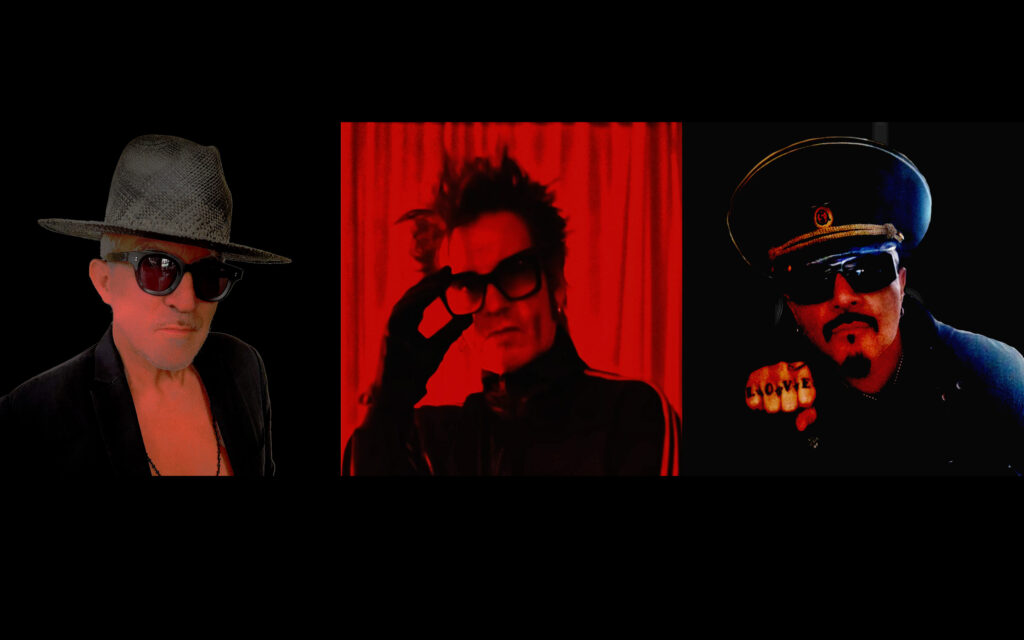
Daniel Ash has seen it all and done it all. With Bauhaus, Love and Rockets, and Tones on Tail he’s carved out a unique space in the post-punk firmament. To this, he’s now added the stunning Ashes and Diamonds. A unique project featuring the combined talents of Daniel, Paul Spencer Denman (Sade, Sweetback), and Bruce Smith (PiL, the Pop Group), the band’s debut, Are Forever, earned a rave review here at SonicAbuse and justifiably so. A raw, engaging, and dynamic record, it has an intensity to it that is irresistible.
We were fortunate enough to secure some time with Daniel, who joined us via Zoom to discuss the development of the album. A charming host, he’s full of cool stories, often diving off on fun tangents to dig into the making of this amazing album. We hope you enjoy this look beneath the hood of Are Forever.
Thank you so much for taking this time to speak to me – I’ve been spending a lot of time with the album and I’m really looking forward to hearing more about how it was created.
I’m so thrilled. Honestly, we’re all really over the moon with the reviews we’ve been getting. Hopefully it transfers into a wide audience buying the album and hearing this stuff because, you know… well, you probably know, but it was made over a seven-year period and then, at the eleventh hour, we decided that it wasn’t right, because we’d been working independently a lot.
I mean, there’s nothing like working in the same room so, you know, at the eleventh hour we decided to scrap it and re-record it in a ten-day period in a studio in Hollywood. Luckily, we knew the songs and everything, so we went in and played it all the way through as a proper record, rather than sending files to each other.
It’s a really different experience, isn’t it? I guess the lockdowns pushed a lot of people into that sort of remote recording thing, and it was a great way of keeping things going, but you just don’t get the same chemistry.
Yeah. I don’t think at the time we could put our finger on it; or maybe we could, I can’t remember; but it sounded, as it was, as bits put together. You can’t replace playing in the same room or at least being in the same building while people are doing their bits, because you bounce off of each other, or the vibe that’s in the room.
The studio we were in was fantastic because it was more like somebody’s living room than a sterile recording studio. It’s Johnny Depp’s place.
Wow!
Yeah. And this guy called Robert Stephenson, who actually co-produced and mixed it with us – he’s a Brit, Robert is – we got on like a house on fire. He was very positive on, you know; I’ve worked with people in the studio where you ask them to try something and they just don’t want to engage with it. I’ve had that attitude in England at Rumfield studios… man, what was that guy’s name? He must have retired now. Everything was like [adopts weary voice] “Oh… OK…”
So, it was never that enthusiastic, whereas Robert was fantastic and we got it all down in ten days.
I don’t think people outside of a band realise how important the chemistry between the band and the engineer is when it comes to getting the sound the way you want it to be.
Oh yeah, chemistry is everything when you’re working with an engineer or… well, I was going to say a producer but most of the time we work with engineers in the bands I’ve been in. But sometimes they’re so good we give them producer credits as well, which is definitely the case on his record.
You can’t… you know, I’ve been in places where there is no connection, there’s no chemistry, and the session turns to shit, and you end up cutting it short and leaving. All sorts of scenarios like that. But yeah, we were very lucky to get this guy. Luckily, our management had contacts with him, and we were able to get in there just for ten days, during some down time if I remember right, and so that’s all we had to get this thing in the can… and it worked out perfectly!
I think at about 9 – 10pm on the final night we had everything, we were finalising the mix on the final track! So, you know, as I said before, it was a very expensive mistake because we had spent all this time and effort going to studios and everything else, whenever we had free time, and yeah… but, we had seven years to reflect and perfect everything.
We’re all perfectionists in the band, as far as the music goes, and we’re all completely satisfied with the music now and it seems like it’s paying off because people like you are giving us fantastic reviews, so thank you.
My pleasure, truly. The production is amazing and it’s really timeless – it has power it has dynamic, and that’s not always the case in modern productions – it’s really impressive how it’s all come together.
The dynamic… and it is diverse too. It is eclectic and that’s because we were recording songs stretched over those seven years, so obviously we’d be in different moods at different times. So, it is eclectic and I love the fact that it goes all over the place.
It’s terrible when you get an album and you hear the first song and then the rest of it, and you can tell that they recorded it all together over the same period of time. It’s boring.
Diversity, I love it – we all do, in the band.
There’s a lovely ebb and flow to it and it feels like you spent a lot of time, not just working on the songs individually, but on an album that you can listen to front to back… which is comparatively rare, I think.
Yeah, well, who sits down and listens to a whole album anyway? I don’t! I haven’t done that in years. But, if you’ve got an album’s worth of material, you might as well put it in the right order!
Another thing with this whole thing – it really, really is important what track you put where for somebody who is going to listen to it that way because certain tracks flatter the next song and some tracks most definitely don’t. If you get two tracks that are similar to one another, it can really backfire.
Luckily, we got an order, and it came about pretty quick as well, where we knew that 2020 was going to be the last track – it’s obvious, you can’t have anything after that. It really helps to get the tracks in the right order on an album and it’s amazing how… it’s night and day how a track can sound better if it’s next to the right piece.
As you said, though, I guess it’s not really important these days because people just pick the tracks they want on any given thing, make up an order and that’s it. It’s fair enough.
But you know what, let’s hope it’s another Dark Side of The Moon [laughs]. That would be rather fabulous.
I don’t know. When was the last time we had something that epic as an album? And I’m not being sarcastic, but maybe the last Taylor Swift album because it was mega-successful. I mean, oh I really hate this word… I can’t [makes retching sound] “alternative rock”. I mean, alternative to what? To crap? [Laughs]
But, I mean, can you name an album in the last five years that you can put into the category of the success of Dark Side of The Moon?
Commercially? No, not really.
There isn’t one. I mean, OK Computer.
That was round about 1997, I think
When was that?
Around 1997, I think.
I was going to say, that was the 90’s Dark Side of The Moon to me. It’s incredible. But yeah, ah – OK – I was going to say one of the Oasis albums, because they sold mega, but I don’t know if they sold that well in the States.
[Pauses] I don’t know why I’m going off on this tangent. Ah yeah, I know what it is, I’ve being doing loads of interviews, and I’ve been getting asked the same questions and I haven’t said anything about the order of the album so, to me, it’s new territory. It breaks the mould of “what inspired you to make the album?” [pauses] You weren’t going to ask that, were you? [Laughs]
Um, no! It’s slightly embarrassing to ask that question to someone who’s been making music for any sort of period of time. “What are your favourite bands?” “What’s your favourite colour?”
Yeah! I’ve had that on these written interviews: “what was your favourite band in the 80s?” [Laughs] I mean seriously. I didn’t answer that one. Because there isn’t one album in the 80s that was a favourite, how could there be?
Well, as you probably guessed, I’ve very much a production geek and going back to the record, I think it’s incredible – there’s a dynamic to it, but it’s never too loud, and there’s a rawness to it as well, and that’s what drew me in from the start.
I think it’s because we recorded it all in the same room at the same time. It’s that simple. With Robert as well, the way he dialled it in, but we were playing… you know, we did a few overdubs. I did put a lot more guitar on the album the second time round. It was pretty bare, guitar-wise, on the first round because I get really bored with guitar. I’m honestly not really into guitars as such; I’m into the whole song being good and I just happen to play guitar a bit. I often do songs where I don’t put guitar in because I’m sick of the sound of it!
On reflection, after five or six years and coming back to the record again… Well actually, I remember now. I found this amp in a rehearsal studio when we very first started. It was a Fender amp (I’m not going to get all boring and technical, don’t worry).
There was this Fender amp in the corner of the room which was a Hot Rod amp – a valve amp. I’ve always used solid state with a Telecaster, so I get this piercing sound. Well, this one had that, but it also had the bottom end, so it was very inspiring for me to pick up the guitar again and actually start playing over these tracks that were already recorded.
So, at the eleventh hour again, I did put a bunch of guitars on most of the tracks and, again, I’m glad I did because it wasn’t fully realised before that happened.
I think your approach to guitar playing is interesting because it’s very textural and it serves the song whereas there can be a lot of ego in guitar playing, making one of the challenges to actually tone it down…
Yeah, I think you can count probably on one hand how many guitar solos I’ve done in my life on anything!
I don’t really do guitar solos, or they’re very minimal, and there are two reasons: one, I can’t really do that stuff – I’m much too lazy to learn how to do it; and two, I find it embarrassing.
That’s why I really like Mick Ronson. To this day, my favourite guitar solo is (and this is on record, although the live versions are great) the end of Moonage Daydream, that section at the end – he howls on two or three notes, but they say everything. It still gets me every time I hear it. You know, rather than sixteen billion notes in a three second passage…
I’m an anti-shredder! [Laughs]
It becomes very technical, and music is about emotion not technicality.
Well, I’m not very technical, as you’ve probably noticed by how I play, but I make the most out of stuff like echo units. I use a few different echoes and a fuzz box – it’s pretty simple – but yeah, I’m not… I don’t practice. I’m not one of those guys. The only time I pick it up is to play a song or when we go on tour. I don’t go to guitar shops and stuff, quite the opposite.
I think that approach kind of lends itself to being interested in synths and electronics as well.
Bruce was doing some keyboard stuff on this that was very interesting and also, I used the ebow a lot on this record. A lot of people would think it’s a keyboard, but it’s this ebow thing and I would just put that through a decent echo and, usually a pure sound. Not fuzz, but maybe a chorus on it, but it’s orchestral. That little ebow thing is wonderful. I’ve used it for donkey’s years, and it’s orchestral. You get a massive sound out of it if you put an echo on it.
Going back to the process of this album, especially as you were sending files back and forth, how much of it was led by one person kicking things off?
It always would start with a beat. I’d get loops from Bruce and then a bassline from Paul. And the whole, thing, if I didn’t get off on the bassline or the groove, then I’d pass on it. They’d send me sometimes four or five things and then, usually, out of that I’d pick one or possibly two that I got, and which turned me on.
If you haven’t got that foundation, then you’ve got nothing to build on but, if you’ve got a sexy bassline, you’re on your way and, with the right loops, you’re on your way and it’s almost half written once you have that bassline and that beat – once that mood is there.
Sometimes Bruce would send me maybe a keyboard line to set the mood. Once the groove is there, the song’s half written and then I’d add the guitars and vocals.
Ah, OK, so you build it up in layers?
Yeah, to answer your question, it always started with bass and drums, like 99% of it, yeah.
And then, obviously, once you started to build up the track, did you then kick it back to them and get feedback on how long it was getting, or did you have the final word?
OK, yeah, most of the time, thinking about it, I’d ask them to give me at least five minutes because songs are usually not longer than that. That would be enough for me to get all the lyrics in, the melody – the vocal melody – and the guitar lines. Then send it back and Bruce would sometimes he would cut it up severely and me and Paul would be like “what the fuck, this is a different song!”
But we’d hold on, suppress our egos and our pride and keep an open mind on it, and then he’d bring it back and we’d listen and realise that it made sense to shorten that passage to a quarter of what it was or whatever.
So, I know for myself (and I think to a degree with Paul) there was a lot of controlling your ego on this because I’d send something back thinking it was done and Bruce would turn it upside-down and cut a whole verse out – like, “what?” So, yeah, there was a lot of that going on, but my instinct told me to hold off on that – maybe this guy knows what he’s talking about.
And you know, the three of us have been doing this for a long time, so we all think we know what we’re talking about, and, to a degree, we do.
But there were certain bits… I remember once on a track, Bruce sent me back what he thought was this finished thing but there was this guitar line on it, and I thought “that guitar sounds crap! What is that? I don’t remember playing that!”
So, I go back and I say, “this guitar, I’m sorry, but it sucks – when did I put that down?”
And then Paul would turn around and say, “you didn’t play that one, it was Bruce!”
And I’d be like, “oh that explains a lot, I’d never do such a cliché line as that! Can you please get that out of here!”
So, there was some of that – you just reminded me when you asked the question.
There was some of that going on – sometimes I’d get a guitar line back and it sounded so bad to me, and I’d be trying to figure out what I was thinking to put that down, because it was such an obvious thing in my head that was put down, it was so generic. Anyway, we nipped that in the bud.
So, yeah, we went all over the place, but I don’t think I ever criticised Paul’s bass playing, thinking about it. But then, he would criticise himself. So, there’d be times when he’d say, “you know what, that bassline sucks, I’m going to play something else.”
And then he’d give us something even better.
So, yeah, there was a lot of, you know, banter. Screaming. I didn’t know… I knew Paul to a degree, but I didn’t know Bruce at all, so I didn’t know where he was coming from most of the time, like where his head was at.
So, that was a challenge at a times and we would misunderstand each other, thinking about it. Because sometimes I’d send a text and he’d say, “you can’t talk to me like that, it’s just not fair!”
I haven’t said this in any other interviews, it’s just all coming up now. I’d say to him, “Bruce, you’re misunderstanding what I’m saying – I’m saying that doesn’t work, but you can try this way by all means!” You know this sort of stuff – it’s like working with token strangers.
So, there were some misunderstandings and, you know what it’s like working via email or text – how you safeguard yourself is you put a smiley face at the end of it (that little trick that we all do). You’re English but you do that as well, right? [Laughs]
I’m afraid so, yes.
You have to put the smiley face at the end when you’re saying something specific or it can be taken the wrong way. Again, I just remembered that there was some of that going on where we misunderstood each other completely. Like I’d criticise or dismiss something, and he’d go “what are you talking about?”
So, we’d get all that stuff going on.
We know each other a little bit better now but, you know, he lives on the East Coast in New York. It’s not like I see him every day. I’ve hardly ever seen him, apart from when we very first started out. Then Covid hit. Then we went back into Hollywood – the studio there – and that’s where we were actually in the same room working ten days straight. So, it flowed a lot quicker, plus we knew the songs. Then it was just a matter, most of the time, getting the best performance that we could. I think I’ve answered your question!
You have and it is an interesting thing because, in any band there’s a clash of egos as you try to get the material together, but working remotely (and with the baggage of history) …
The history baggage didn’t exist. We’re not like that. We’re not egocentric like that at all. I mean, Paul has been in one of the biggest bands in the world. If you knew how many records that guy had been on… holy moly! I think the last compilation CD they put out sold 125,000,000 copies! That’s on CD and nobody buys CDs anymore!
It’s funny because he’s a Leo like me and he’s not got an ego problem and it’s fantastic. It’s incredible. He’s very modest, which is surprising considering he’s a Leo. You know, we were born within three days of each other in the same year, so we get each other. And I knew him from years ago because he married a girl who was at art school with me in the 70s – she was in fashion. I knew Kim, his wife, way back. So, I know Paul a lot more than Bruce, obviously, for many years. We’ve seen each other a lot. I know Paul,
Whereas Bruce was a complete stranger who I met for the first time in the car park when we went for rehearsal – that’s the first time I met him. It’s odd, right? Can you imagine meeting in a carpark a complete stranger, three quarters of an hour later you’re setting up the gear and making a song together… with a complete stranger. But it worked!
I think we got a song on the first day. I think it was Teenage Robots actually. There were a lot of words, anyway, because at the end of the day… I use the cut-up method, like William Burroughs and Bowie used, most of the time actually. So, I get a lot of headlines out of tacky magazines like The Sun, The National Enquirer, Viz Magazine – stuff like that because they have the best headlines.
So, I remember on the first day there were bits of paper all over the floor so, I think that was one of the songs that was lyric-heavy if you like. Probably Teenage Robots.
I don’t know how much it’s to do with treatment and how much it’s actual electronics, but it sounds like there’s a lot of electronic percussion on there. Working with Bruce, how did you decide what would be live drums and what would be programmed?
Totally left it up to Bruce. I can’t tell which is real and which is electronic because it’s a mix of the two. But I do know that on almost all the tracks there’s a real drum kit with a real human playing them, and then he would add other percussive things and also little keyboard stabs and stuff like that that I didn’t even know he was doing. All I knew is that it sounded great, so I never questioned it and I never… we don’t look at each other’s wobble-boxes if you know what I mean.
I call them wobble boxes; I always have. I’m not interested in how he’s getting those sounds and he doesn’t give a shit how I’ve got my sounds. We just keep in our own little corners, and we get what we need. That’s what being in a band is. And, I don’t know about you, but do you still have that situation in the room where you’re setting up your gear and, without fail, someone says “does anyone have any batteries? My pedal’s gone!”
And nobody answers and nobody has a battery. No one has one of those… oh what are they?
9v square batteries.
9v square thingamajigs. Do you still get that?
Batteries, strings, and plectrums!
Yeah! Picks. Plectrums, that’s right. And they don’t even answer. It’s a funny, weird thing of being in a band.
And why is it, well you’re too young for this, but back when we started (we’re talking late 70s, early 80s) we’d be doing tours in West Germany in January, and the fucking heater doesn’t work in the van. Why is it that the heater never worked? We’d go for Northampton to London, freezing our balls off. We broke down. We’d go to John Peel sessions, we’d break down… we were stuck on the side of the road in January freezing! We were all hovering (this is Bauhaus days) around one cigarette trying to keep warm. I’m not kidding. Spinal Tap eat your heart out. The fucking heater never worked.
I bought a £50 Ford Cortina mark II form my maths teacher and he said, “after 20 miles, man, that thing’s going to break down.”
And it did! From Northampton to London on the M1, boom – gone! Forget about it. And the AA had to come out, and we had to wait until seven or eight in the morning after a Peel session. We were frozen in there.
It’s supposed to be this glamourous life of libertines and super models. Nope, it’s breaking down on the M1 in a Ford Cortina. [Laughs]
…Until you get to a certain level and then it does change. Otherwise, you wouldn’t do it!
The album seems to be getting really good feedback – are you taking this out on the road?
It all depends on if it catches fire as far as actual sales and we can actually make money with it. If we can’t then it’s kaput. So, it’s all… I’ve said this on every interview, and I’ll say it here, it’s in the lap of the gods. It’s got to catch fire. People have to stream it. They’ve got to buy it on CD or vinyl, otherwise nothing moves. You can’t do anything without an amount of money. We’ve got high hopes for it. I’ve just seen an interview that Paul was doing, and they were asking him about touring and he said “yeah, I want to tour with Lady Gaga!”
He said, “I think she’s incredible.”
And I’m in total agreement. If we got offered a support slot with Lady Gaga, I think we would say yes immediately. Of course. Somebody of that calibre – absolutely. But we aren’t going back to playing little pubs and clubs. We’re, you know, a bit too long in the tooth for that.
I’m not going back to playing pubs in England. I’m not doing it.
Would you consider… the musical chemistry is so obviously present, would you consider doing another record if the touring didn’t work out?
It all depends on if people buy the album. If they don’t then we have no finances to do the next one and, to be honest, if this one bombs, no one would sign us anyway because, at the end of the day, the only people who really came to the table… we sent this everywhere, or at least our management did (we have the same management as Jane’s Addiction), and they’re great guys and they’re English as well, which is great, so we have that connection.
So, we sent it everywhere, and lots of the big companies said it was great, it had great song writing, great production, but they just didn’t know what to do with it. And, you know, I don’t know why… so, at the end of the day Cleopatra came to the table. They offered us a decent advance etc. etc. If this one bombs, we’re not going to get another deal anyway. But I know I can speak for Paul on this, probably Bruce, but definitely me, if this one doesn’t do anything in some sort of commercial sense, then we’re done, finito.
There would be absolutely no point. But we are hoping, and I do still get placements for Love and Rockets, Bauhaus, and Tones on Tail for film and TV, thank God, so that’s healthy. And I would love to think; because it’s very cinematic this album; I’d love to think we’d get picked up and get some placements, because that would send us on our way big time. So, that’s a dream come true if that happens. It is another avenue where, if the live thing doesn’t work out.
I remember John Lydon saying this back in the 80s – he said PiL wasn’t a band, it was an incorporation. It’s a business. And I get what he was talking about. You don’t have to be a rock ‘n’ roll band, go on the road and rock out. That’s limited, hence the name – PiL. That was his whole thing. And all these years later I know exactly what he’s talking about. You can be a corporation that plays great music that can be delivered for a film. You can score a film.
So, that would be a dream come true to get involved in that side of things. But the competition on that is incredible. I mean Tim Burton uses the same guy, Danny Elfman, and t’s so funny that particular story because Danny didn’t want to do it – he didn’t think he was good enough. Tim Burton encouraged him and look where he is now. It’s incredible.
It’s such a right time / right place kind of thing, isn’t it?
Yeah, well they were friends. But it would be incredible to get involved, at our age, in something like that rather than slogging it on the road, absolutely. But, again, with Love and Rockets, I was doing the Jane’s Addiction tour, and it was the best tour ever. It was very, very civilised because we were doing one day on and one day off. Because Perry flying screws his vocals up, so he doesn’t do two gigs in a row when you have to do long distance. So, it worked out perfectly because we’d do one gig and then we’d have a whole day off to get to the next gig. So, there were only a couple of times where we did two gigs in a row, and it was a dream come true because you don’t get burnt out on the road when you do it like that. You have a whole day off and it’s night and day.
So, again, if we did go out, I’ve been spoilt now with this one day on, one day off. And I don’t know if I’d be able to go back to the three days on, one day off. It’s not the gigs that wear you out, it’s the travelling. That gets you. That hasn’t got easier, really, as time goes on. Apart from, you know, the heater works! But, joking aside, planes, trains, and automobiles – it has always been the same.
I remember Iggy Pop said the same thing. He said he’d much rather do a residency in Vegas because then you cut out all the travelling. You’re in your hotel; you walk down to the gig and do the gig. For a musician it’s a dream. And the tour bus thing, I can’t do it because I can’t sleep. Going through the night, I can’t sleep. I tried taking pills and it was a nightmare, I don’t believe int hose chemicals. And drinking myself to sleep used to work 30 years ago, but not anymore. What we used to do in Love and Rockets is we would use commercial airlines. We’d just use commercial flights, so we’d stay in the same town overnight, get up at midday and then jump on a normal commercial flight to the next gig. We didn’t understand why other. Bands wouldn’t do that; they’d get on the tour bus. I don’t know if you know, but it’s a nightmare, you’re rocking around all over the place. And it’s not expensive getting commercial flights for the band.
The crew would travel with the gear, but we would fly, because America is big. So, from gig to gig is a lot, lot more than anywhere in the UK or Europe. It’s a three-to-five-hundred-mile trip every day and we would fly it, and we never understand why other bands wouldn’t. Back in the 80s we used to do that – much more civilised than on a tour bus!
And with that, our time is up. We bid Daniel farewell and he leaves us with a cheery thank you.
Don’t sleep on Diamonds and Ashes Are Forever. The album is out now via Cleopatra Records.