Introduction
How do you quantify the influence of an artist like B.B. King, whose entire personality was so given over to the blues that they became synonymous with the genre?
Born in 1925 in the Mississippi Delta, King first picked up a guitar under the auspices of his local minister and, from these humble beginnings, established himself as one of the most important guitar players of the 20th century. His influence, not only on the blues, but on rock, hard rock, and even metal, can be found in the work of everyone from Eric Clapton and Jimi Hendrix to Joe Bonamassa and Slash, his emphasis on feeling over technicality a vital part in what might be considered the soul of the blues.
Passionate about the blues and in love with the power of live music, B.B. toured relentlessly throughout his career, bringing his music to fans all around the world and it was only a few months before his tragic passing that he finally laid his guitar, Lucille, aside, following a show at the House of Blues in Chicago. He passed away in 2015 at the age of 89.
The Blues Summit
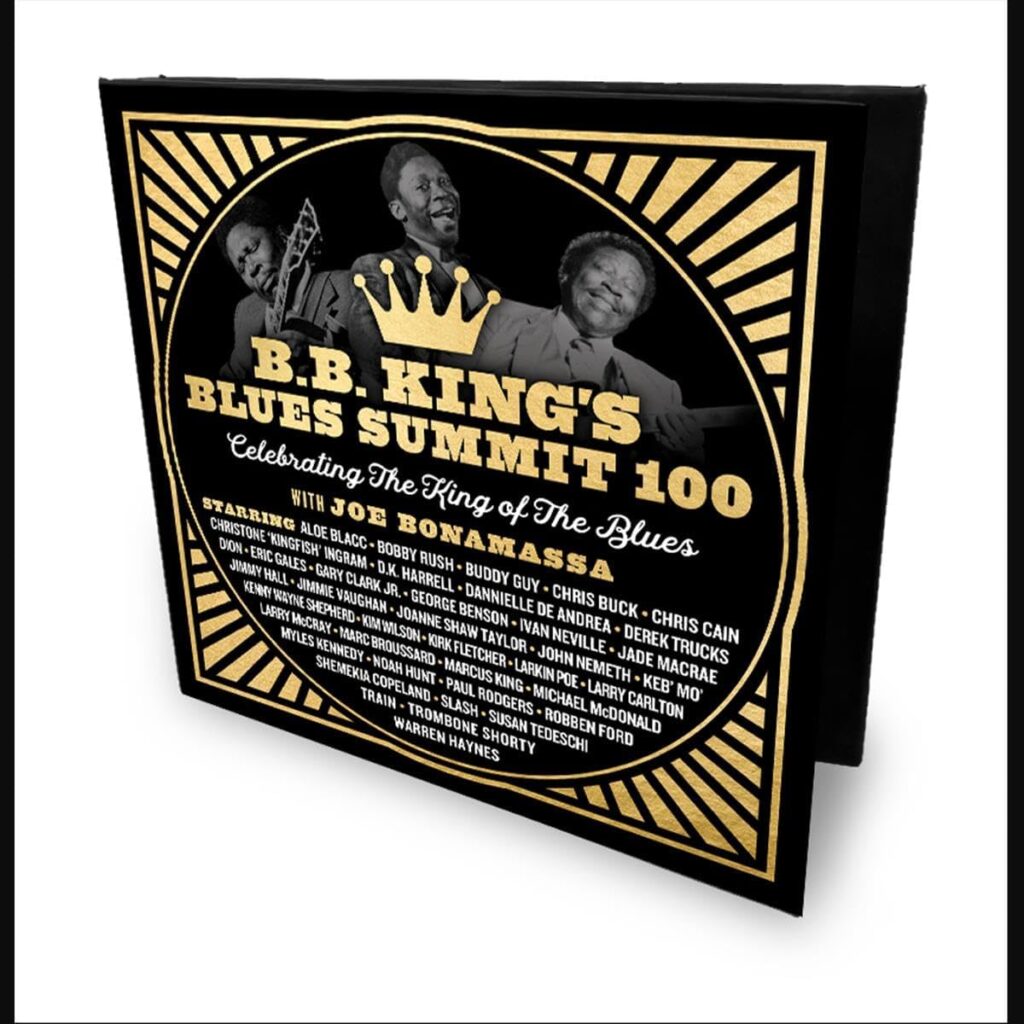
This was always in the running to be one of the albums of the year – even at this early juncture – and, now that it’s finally here, Joe Bonamassa’s Blues Summit (held in honour of what would have been B.B.’s 100th birthday) is nothing less than a treasure trove of great performances, featuring some of the most talented exponents of the genre currently treading the boards.
Just look at the guest list. Christone Kingfish Ingram, Marcus King, Michael McDonald, Susan Tedeschi and Derek Trucks, Kenny Wayne Shepherd and Noah Hunt, Buddy Guy, Jimmy Vaughan, Eric Clapton, Keb’ Mo’, Gary Clarke Jr – it goes on and on. It’s essentially a who’s who of the blues, gathered together in one place and with one purpose: to celebrate the life of an artist whose influence will be felt for all time.
And it is a glorious thing to behold.
With Joe Bonamassa and Josh Smith at the helm, Blues Summit 100 not only has an impressive cast, but it also sounds amazing. Joe and Josh have long demonstrated an intuitive understanding of how to bridge the raw authenticity of the blues with the demands of modern production techniques, and the result is an album that pays tribute to B.B.’s legacy and the enduring power of the blues, while looking to the future of the genre. It’s a true labour of love, with each collaboration bringing out the best in the performers.
The album
As might be expected from a summit, this is no breezy, surface-level overview of B.B. King’s work. Spread over thirty-two tracks and clocking in at two hours and thirty-two minutes, it’s an exhaustive look at the life of a man who gave so much to so many. As such, while you can dim the lights and let the memories flood over you, it’s also an album to dip into, taking your time in reacquainting yourself with the songs and enjoying the nuances these new interpretations bring. In whatever way you choose to approach the album, it’s a pleasure to spend time in the company of these great artists and the crisp, clear production truly makes it feel like you’ve wandered into the studio mid-session.
Disc One
It seems inevitable that the album would open with the evergreen classic, Paying The Cost to Be the Boss, which finds Christone “Kingfish” Ingram tackling the track with aplomb. With a gleaming horn section in tow and the rhythm section laying down a slinky backing, it’s a soulful, swinging opening number and it’s impossible to listen without picturing B.B.’s cheeky smile. One of the younger performers on the bill, Kingfish is a revelation and the decision to place him first underscores the fact that the blues is in safe hands.
The second track finds Joe and his band dipping the lights down low as Marcus King warns us, Don’t Answer the Door. Another relatively young performer, Marcus has a remarkable sense of presence and, with a powerful vocal, rippling organ, and subtle stabs of lead guitar peppering the track, it’s an immersive piece.
Next up, we have another slow burner in the form of To Know You Is To Love You. With Susan Tedeschi, Derek Trucks, and Michael McDonald adding their unique talents to the mix, it’s a wonderful tribute, and the vocal duet between Susan and Michael simply drips soul.
It’s time for a change of gears, next, as Kenny Wayne Shepherd and Noah Hunt enter the fray to demand that “we have some fun” on Let The Good Times Roll. A track that could have been written for Kenny, whose horn-soaked take on the blues is always an absolute joy to behold, it’s guaranteed to have every toe in the house tapping away.
It’s time for everyone to make way next as the incomparable Buddy Guy takes the lead on Sweet Little Angel. As might be expected, Buddy brings love, loss, and (of course) humour to the mix and, beautifully captured here, we can feel the raw force of his personality blazing through the speakers. Buddy is artist who can light up the room with the briefest of appearances, and his spot here is an early highlighton the album.
As so many artists have found to their cost, Buddy Guy is not to be outgunned but Larry McCray does a damn good job, bringing his smoky, soulful tones to a lovely take on When It All Comes Down. It contrasts nicely with a striking When Loves Come To Town, which finds Shemekia Copeland duetting with Myles Kennedy over a crunchy backdrop that threatens to spill over into hard rock territory. With Slash delivering a fiery solo, it’s a powerful reminder that B.B.’s influence spreads way beyond the blues, while the chemistry between Shemekia and Myles is palpable.
Arguably the song most intrinsically connected with B.B. King, The Thrill Is Gone is handled with deft skill by Chaka Khan and Eric Clapton. With the former delivering a wonderfully understated and deeply soulful vocal and the latter digging deep to provide the fretboard magic, it’s a special moment indeed. It’s followed by a slinky Watch Yourself from the Jimmy Vaughan, who brings a sweet rock ‘n’ roll vibe (complete with horn section) to the party. One of those artists who has quietly made the blues his own, Jimmy brings a wonderfully positive energy to any event lucky enough to have him, and his performance here is no exception.
Bobby Rush maintains the vibe with a fabulous Why I Sing The Blues, which benefits from a taut beat, gritty vocal, and a harmonica coda that makes you want to leap from your seat. Surely this is how you pay tribute to a much-missed legend – with love and joy – and Why I Sing The Blues is a perfect example of which B.B. would surely have approved.
Following this rambunctious pair of tracks, Sweet Sixteen finds Jimmy Hill and Larry Carlton slowing the pace for a languid blues number that effortlessly evokes some whiskey-soaked speakeasy from the 50s. Yet it doesn’t pay to relax too much because, over the course of its six-and-a-half-minute runtime, it builds up quite the head of steam. It’s followed by the slinky Don’t You Want A Man Like Me, with Rebecca and Megan Lovell (Larkin Poe) bringing a touch of class to the track.
Following the short, soulful I’ll Survive, led by Keb Mo, Heartbreaker positively explodes onto the scene. With the brass to the fore, it’s a showcase for Trombone Shorty and Eric Gales, and they have one hell of a good time with the track. George Benson lends a hand on sweet, simple There Must Be A Better World Somewhere before a string-soaked Chains And Things (featuring an uncharacteristically chilled Gary Clark Jr) concludes a first disc so packed with wonders, you’ll be absorbing it for weeks to come before you even think about disc two.
Disc Two
Kicking off the second disc, Warren Haynes brings his magic to a sultry How Blue Can You Get, his gritty vocal and understated lead work making for one hell of an opening number. In stark contrast, the blazing horns of an up tempo You Upset Me Baby provides a suitably rockin’ backdrop for Chris Cain who doesn’t so much sing the lead as roar it in the vein of Muddy Waters. Close your eyes and you’ll picture a black-tie orchestra presiding over a heaving dancefloor, tables swept aside and bodies moving as one – it’s just that kind of track. If its successor, Ghetto Woman, is slower, it’s no less evocative thanks to the brilliantly arranged strings and a strong performance from Ivan Neville.
Next up, the iron-lunged Paul Rodgers makes an appearance, lending his voice to the slow-paced Night Life. It’s a cracking track and, with Paul ad libbing over Joe’s epic lead, it nicely evokes B.B.’s mischievous spirit. With a squally saxophone perfectly complementing Paul’s silky-smooth vocals, it builds to a thrilling climax, Paul calmly noting that “the thrill lives on”.
It’s no less a pleasure to hear the marvellous Jade MacRae joining Robben Ford on Ain’t Nobody Home. A longstanding member of Joe’s band, Jade always scintillates and it’s great to hear her take the lead on a soulful number that is simply filled with joy.
If you’re looking for a swinging number to pack the dance floor, then look no further than Joanne Shaw Taylor’s spot on a sparkling Bad Case Of Love. Joanne just seems to get better with every passing year, and it sounds like she’s having a ball as she takes Joe’s band through their paces. No less fun is Never Make A Move Too Soon, which finds the ever-impressive Dion inhabiting a crowded bar, the band nailing the beat and providing the perfect backdrop for his smooth vocals and creamy guitar lines.
Producer (and long-time Bonamassa collaborator) Josh Smith joins forces with Marc Broussard on the restrained Three O’ Clock Blues only for Train and Chris Buck to drive things over the top with an absolutely stunning, big band rendition of Think It Over. One of those songs that inevitably raises an irrepressible grin, it’s the sound of superlative musicians relaxing in their element.
Slowing things way back down, Kim Wilson leads a reflective It’s My Own Fault before D.K. Harrell does a damn good job of making it sound like having the blues 24/7 is nothing less than a joy on a jazzy Everyday I Have The Blues. Similarly, John Nemeth puts all his energy into a heartfelt Please Accept My Love, which has a strong fifties pulse to it.
With the album racing toward its conclusion, Aloe Blacc is happy to be So Excited and it shows on a funky number that just won’t quit. With some great leads and plenty of brass, it keeps the party rocking. Then there’s When My Heart Beats Like A Hammer, which finds Danielle De Andrea draped across the piano, delivering a charismatic vocal that simply dominates the piece.
Having spent much of the record quietly playing in the wings, Joe Bonamassa finally steps into the spotlight for the aptly titled, Playin’ With My Friends, which feels like the unofficial subtitle of the album. Clearly in his element, Joe is an expressive host and, as he launches himself into the track, you catch a glimpse of the thirteen-year-old who was so enthralled by B.B. and the blues all those years ago. It’s a wonderful heartfelt tribute and the five minutes he spends here are worth more than any number of interviews in explaining why he had to bring this album to fruition.
Joe leaves it to Kirk Fletcher to wrap things up on the expansive finale, Better Not Look Down. An emotional final tribute to B.B. it finds the artists involved in the project sharing their memories of B.B. King over a funky little number that boasts a ridiculously addictive chorus.
Final thoughts
Honestly, you didn’t really need the above to tell you that B.B. King’s Blues Summit 100 is a truly wonderful album. Here there is joy, there is heartbreak, there is catharsis… here there is the blues, over which the larger-than-life character of B.B. looms large.
A generous and heartfelt tribute, it’s notable that every player gives a little bit of themselves without ever once grandstanding or dominating the proceedings. There’s a sense of community that hangs over the whole thing that never fails to raise a smile, and it’s a simple pleasure to kick back, dime the volume, and conjure up your favourite memory of B.B. in action. Few artists get such a tribute, but then even fewer had such a significant influence on their peers. B.B. King’s Blues Summit 100 is basically perfect. 10/10