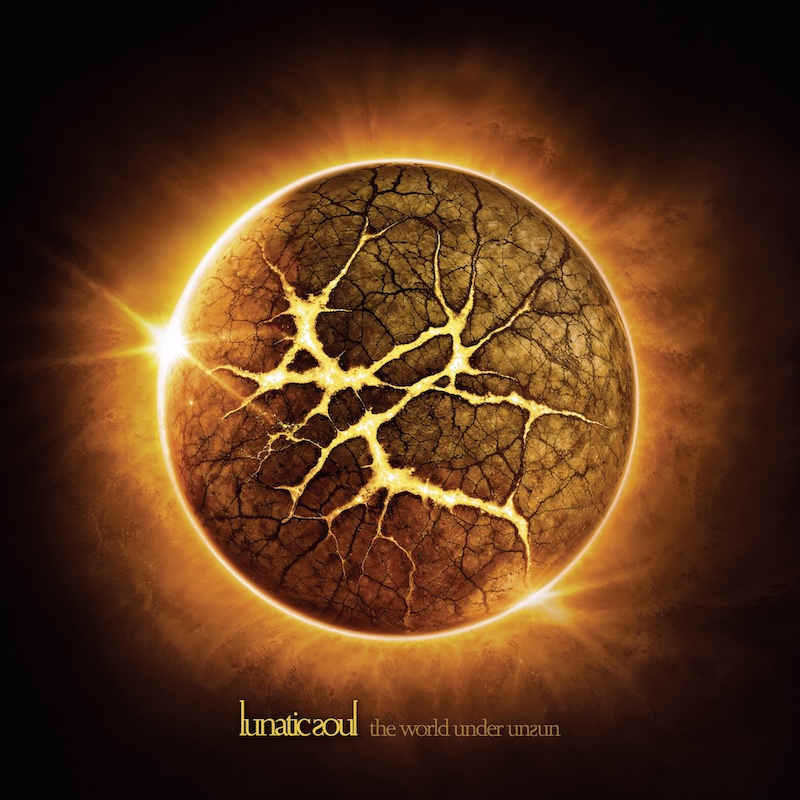
The eighth studio album from Polish progressive rockers Lunatic Soul, and the final chapter in the ambitious eight-album sequence The Circle Of Life And Death, The World Under Unsun is also the band’s first release via InsideOut. A sweeping and satisfyingly epic double concept album, it finds Mariusz Duda (the prolific force behind Riverside) pushing both narrative and musical boundaries as he explores the hinterland between life and death. It is a remarkable work, but not one that is easy to absorb all at once.
Clocking in at 90 minutes and spread over 14 tracks, The World Under Unsun is a typically diverse work that was recorded over a period of some four years. Although multi-instrumentalist Marisuz handles most of the music, he is joined by Wawrzyniec Dramowicz (Indukti, UnSun, Destruction) on drums, and Marcin Odyniec on saxophone, while Mateusz Owczarek (Lion Shepherd) drops in to offer a solo on Monsters and soundscapes on Parallels.
As we have come to expect from Lunatic Soul over the preceding seven albums, The World Under Unsun is a slow-burning and contemplative piece of music that ebbs and flows across its run time, taking in any number of influences along the way. Opening number, A World Under Unsun is a case in point. With a rippling synth line drawn from Harold Faltermyer, trip hop elements from Massive Attack, and eerie vocals that are one part Peter Gabriel to one-part Clannad, it’s a remarkable exercise in world building that is as cinematic as it is engaging. No less tense is Loop of Fate, which employs relentless looped percussion and dark drones to create a sense of lingering unease that nods to the likes of Tool, especially in the semi-whispered vocals.
Having set the scene, Mariusz changes tack with the haunted nostalgia of Good Memories Don’t Want to Die, which sits somewhere between Riverside and latter-day Anathema in terms of atmosphere. A beautiful and understated gem, it provides a moment of heart-breaking calm after the darker tracks that precede it, establishing a wider scope for the album that follows.
Another digression follows as the industrial-tinged Monsters offers a slinky, stuttering take on prog rock that is part Steven Wilson, part latter-day Gary Numan in delivery. With Mariusz adopting Peter Gabriel’s trick of eschewing cymbals altogether, it’s a strangely claustrophobic piece that in no way prepares the listener for the unutterably lovely The Prophecy. With sublime melodies slipping dreamily between an echoing piano, it’s a truly wonderous piece of music that sits at the heart of the first disc.
As pulsing synths bleed from the preceding track, Mind Obscured, Heart Eclipsed emerges as an instrumental piece that says all it needs to say through the deft interplay between instruments. A captivating piece, it holds you enthralled before eventually handing off to the piano-led coda that is Torn in Two. With Mariusz’s instantly familiar voice front and centre, it’s a beautiful closing piece that recalls the likes of Steve Thorne and Genesis at their most elegiac (think Afterglow), and it stays with you long after the disc has spun down.
Disc two opens with the lengthy, multi-faceted Hands Made Of Lead. An eerie instrumental (spoken-word prologue notwithstanding) that nods to Eno’s frosty collaborations with David Bowie circa Low, before edging into more metallic territory, it’s a surprising start to the second half that restates the feeling that anything can happen. It’s followed by Ardour, which combines folk elements with post-metal rhythms, the result a tense, dark track that sounds like Pink Floyd and Tool covering Clannad. Then there’s the epic Game Called Life which, clocking in at nearly ten-minutes, is a mini-masterpiece that gathers together elements of Tool, Riverside, Peter Gabriel, Depeche Mode and Massive Attack into one remarkable piece of music.
After so monumental an outpouring, the slow-burning Confession acts as something of a reset, once again leaning on a folky melody, before the album dips into the eerie trip-hop of Parallels – a track that, with its dense beats and rippling piano, could easily sit on Massive Attack’s feted Protection album.
With the album coming to its end, the vast drums of Self In Distorted Glass drive a track that’s riven with hope as Mariusz asks “what if you could love for another day?” before leading the listener by the hand through a series of sonic twists and turns that take in Eastern cadences, industrial elements, and orchestral manoeuvres in the dark. It’s yet another example of Mariusz’s rich imagination and, left unfettered here, it hauls the listener out of the everyday, transporting them to a fertile new landscape where anything is possible.
The World Under Unsun concludes with the poignant, piano-led piece The New End. After everything that has gone before, it appears as a subdued finale. However, the longer you spend with it, the more you realise this is the only way such an exhaustive album cycle could end and it draws the curtain gently down on a remarkable body of work.
I’ve been living with The World Under Unsun for some time. A sumptuous, expansive work, it may well just be Mariusz Duda’s masterpiece. One of those albums that you hear differently every time you place it in the player, it has the same ineffable quality that has made the likes of Wish You Were here so universally beloved and, at the risk of accusations of hyperbole, it sits in a similar realm in terms of quality. A mesmerising, beautiful, utterly engrossing album, The World Under Unsun is a remarkable album in every single way. 10/10