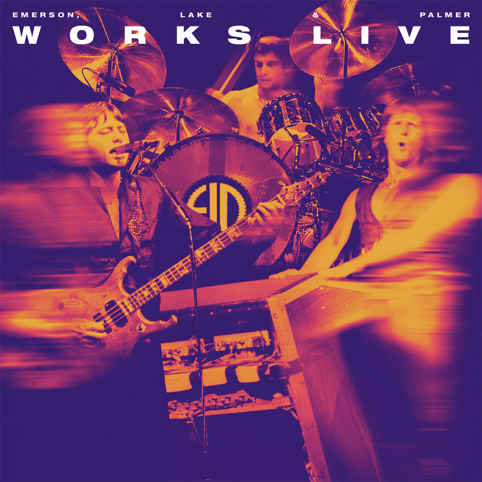
Emerson, Lake & Palmer’s Works Live has a troubled past. Recorded at the Olympic Stadium in Montreal, the 1977 show found the trio take to the stage with orchestra in tow, arguably providing the definitive overview of their ambitious fusion of classical music, hard rock, jazz, and electronica.
Unfortunately, the album was originally released in truncated form way back in 1979 under the misleadingly bland title In Concert. Although Keith Emerson had hoped that the release would be a double, their quiet dissolution in the same year crushed his hopes and it would not be until 1993 that fans would get an expanded, double-CD release which, while not the complete concert, captured to a much greater extent the wild-eyes flights of fancy in which the band were indulging at the time.
The package
Now reissued with new artwork and remastered audio, Works Live makes a most welcome return as a 2LP / 2CD set, with the former pressed on lustrous black vinyl. This review is of the vinyl edition, and readers may rest assured that it both looks and sounds phenomenal.
Housed in a gatefold sleeve with a hype sticker on the front, it includes a four-page, 12” booklet with credits and detailed new liner notes from Michael Heatley – a welcome touch that adds the necessary context to this landmark live event. The discs themselves are housed in white paper, poly-lined sleeves, and the inner gatefold has a picture of the trio on stage. Overall, it’s pretty much the definitive edition, the only oversight being a lack of additional photos to highlight the scale of the event and the staging.
The audio
Works Live sounds simply amazing. The mastering, credited to Andy Pearce and Matt Wortham, sounds fresh and open, maintaining the all-important dynamic of the original, while allowing the little details to flourish. This is by no means an easy feat – even modern recordings of a rock band with an orchestra can fall flat if not treated with the proper care – but Keith Emerson’s mix was a strong, sympathetic one, and it is clear that Andy and Matt have worked closely to the original blueprint to ensure that they have polished the work in a respectful way rather than boost it for the spurious demands of a modern audience.
Side 1
The opening side finds the band easing the listener in with a number of shorter pieces, so as not to overwhelm the senses. Thus, following a short Introductory Fanfare, EL&P launch into a raunchy cover of Henry Mancini’s Peter Gunn, Keith Emerson’s wonderfully squelchy keys replacing the brass section as Carl Palmer reduces his drums to matchwood in the background. Next up, the band’s own Tiger in a Spotlight ambles into view, Greg Lake imbuing his vocal with a touch of bluesy grit reminiscent of Rory Gallagher, although it’s Emerson, his fingers skipping across the keys, who steals the show.
The evening takes a more pastoral turn with C’est La Vie, which harks back to King Crimson’s Moon Child, the soaring strings adding real depth to the performance. The similarly gentle Watching Over You eschews high drama for human warmth. These moments of simple sincerity provide the perfect contrast to the bombast found elsewhere and, following a turbo charged take on Scott Joplin’s Maple Leaf Rag, the band unleash a giddy take on Prokofiev’s The Enemy God Dances with the Black Spirits that wouldn’t sound out of place amidst a modern film score. And with that, we’re sent spinning off to explore the wild terrain of Emerson, Lake & Palmer’s collective imagination.
Side 2
Side two opens with the trio’s opulent take on Aaron Copland’s Fanfare for the Common Man, which they deliver with rock ‘n’ roll class and a touch of Mancini-esque flamboyancy. And, if that splendid neo-classical odyssey isn’t enough, it’s followed by a scintillating Knife-Edge, with the band moving dextrously from the more ostentatious reworkings of well-known works to something of their own (albeit interpolating Leos Janacek along the way). It’s music to lose oneself in and it’s a mark of the band’s commitment and virtuosity that, for long passages of time, you simply forget this is a live recording and imagine you’re listening to a studio take. This is especially the case when the strings slowly weave their way in after an extended progressive work out worthy of King Crimson, and the mix just seems to swell as each new element comes into focus. It’s awe inspiring, ambitious stuff, the likes of which few have managed to effectively capture in subsequent years.
Then, providing something of a palette cleanser after the richness of this side’s main course, a delightfully bluesy Show Me The Way To Go Home (Jimmy Campbell, Reg Connelly) reminds the audience that Emerson, Lake & Palmer are nothing if not dynamic in their set arrangements and it wraps the side up with a surprisingly straight little boogie that presumably had the massive audience dancing in unison.
Side 3
Were you to go in search of dynamic, Abaddon’s Bolero is one of the most perfect examples in existence. With the aid of the orchestra, who initially take the lead, they deliver a rendering that seems to encircle the listener, the strings marching in time to Carl Palmer’s martial drums. When the entire band do enter the fray, it provides a sense of release after a long-built and adrenaline-charged period of tension.
The second piece on this side is a glorious, string washed Pictures At An Exhibition, which finds the band fusing Modest Mussorgsky’s stately, uniquely Russian take on classical music with art rock elements, pastoral progressive rock, and even folk. For something so opulent, it’s a remarkably nuanced work that takes its time in revealing its full intentions, although when it does explode, it’s with dizzying force.
Most notably (and aided only slightly by the excellent remaster), the music hasn’t dated at all, showing that Emerson, Lake & Palmer were dead right to follow their instincts – indeed, it feels more like the rest of the music world is still trying to play catch-up with what they achieved here.
Side 4
After the fifteen-minute Pictures… Closer To Believing provides something of a reset, the band weaving a gossamer basket for Greg Lake’s wonderfully sonorous vocals. In the wake of such dense material, it’s an affecting and rather beautiful piece of music that slowly swells towards its climax and, when Lake sings the line “it burns so brightly it blinds us all’, he allows his voice to fray just enough to give real depth to a powerful lyric.
One of the album’s most exciting moments, Piano Concerto, Third Movement: Toccata Con Fuoco has the darkly evocative overtones of a cinematic score, so much so that you can imagine James Horner (Star Trek II, III, Aliens, Titanic) taking notes, especially in the way the piano is delivered with a force that enables it to compete with the sanguine tones of the brass. Turn it up loud and while it’s not quite a match for being there in person, it is still enough to set the adrenaline racing through the veins as the music ebbs and flows across seven too-short minutes.
The album concludes with an epic, thirteen-minute rendering of the band’s own Tank, which has a lengthy percussive interlude that thunders from the speakers very much like the titular war machine, especially when Carl lets loose on his gongs. A dense, ambitious rhythmic assault that recalls, by turns, the 1812 Overture and Thus Spake Zarathustra, it is a testament both to his unparalleled skills behind the kit and to the wide range of influences that all three members shared. When the rest of the band return to conclude the piece, it’s with an almost whimsical turn as if to celebrate all that has gone before.
Final thoughts
It is remarkable to think that three skilled musicians not only had such a vision but that they were able to bring it to life. The nature of art is to take risks, to explore the limits of your own ability (and to risk failure in the process) and, in the process, to find out where those limits actually lie. It is this journey of exploration that is so important, making it so much more satisfying when it lands and, at the risk of segueing rather unsubtly into commentary, it is exactly this risk-taking that separates artists from those who would use AI to achieve an end without ever once risking something of themselves in the process.
Works Live is a testament to what can be achieved, how dreams can turn into reality for those willing to work hard and place all their talent and passion at the disposal of one clear project, and it is also – at the most fundamental level – simply a very enjoyable album. Grandiose, cinematic, magnificent, noble… Works Live embodies all these things and this vinyl reissue is not only a must for fans, but an invitation for a whole new generation to experience something they missed. Over the past few days of writing this review, I fell in love with this album and I hope that you do too. 9/10