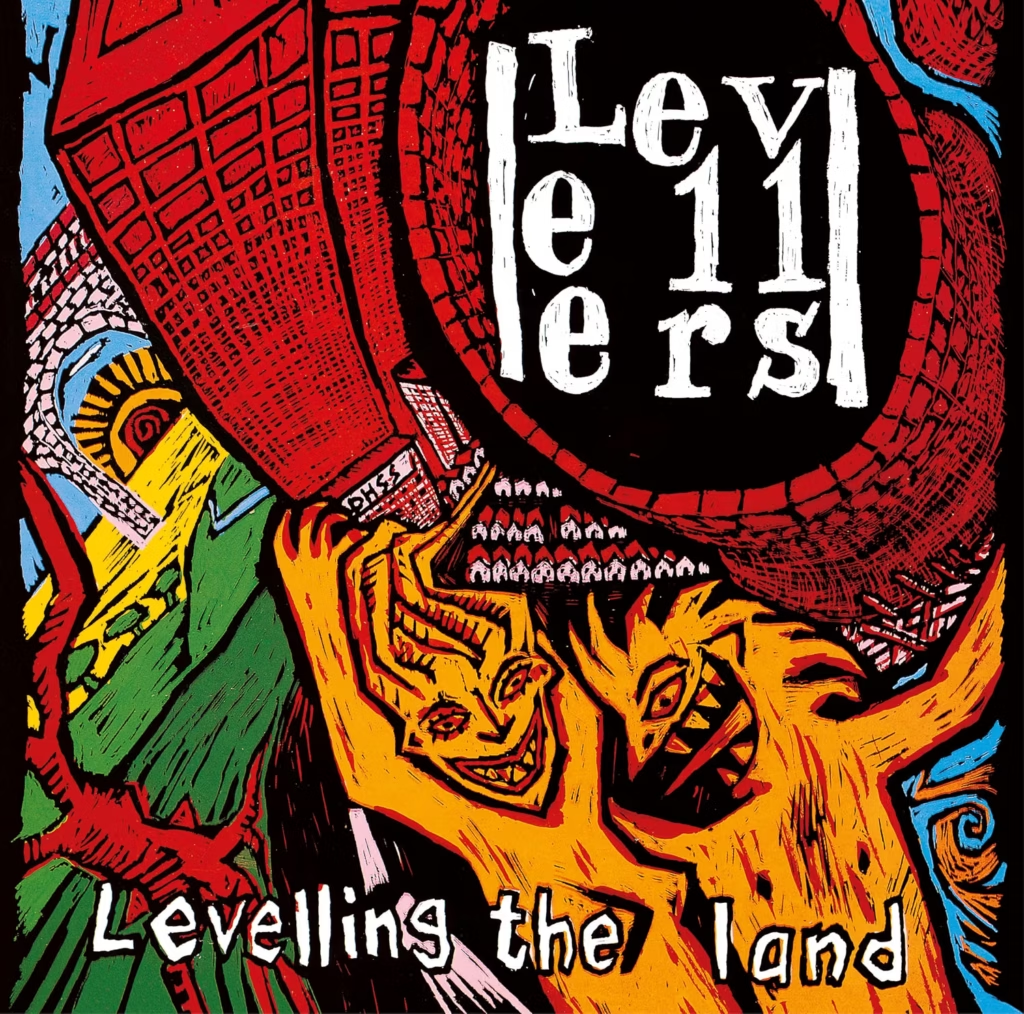
Released in 1991, the second album from the Levellers, Levelling The Land, saw the band pull together an alarmingly powerful set of songs, many of which remain live favourites today. While there’s a strong argument that it remains the band’s defining moment, the production simply failed to match the band’s live fire – largely thanks to label insistence that cheap stereos would be overwhelmed by all but the most minimal bass. The lacklustre production was brought even more sharply into focus with the release of Headlights, White Lines, Black Tar Rivers (Best Live), which allowed the snarling guitars of tracks like The Game to punch with the weight you always felt they should. Now, the band have decided to redress the balance.
The package
Following in the footsteps of the acclaimed Zeitgeist remix comes a three-disc reissue of Levelling The Land. Housed in a digipack, the set offers a tasteful remix of the original album overseen by original producer Al Scott on the first disc. The second disc provides B-sides and session outtakes, while the third disc packages up a selection of demos, many of which were long thought lost.
It’s a generous assortment to be sure, well curated by bassist Jeremy, and while the 1992 live set from Glastonbury (included with the 2016 On The Fiddle reissue) is sadly absent, the remix alone is frankly worth the price of entry.
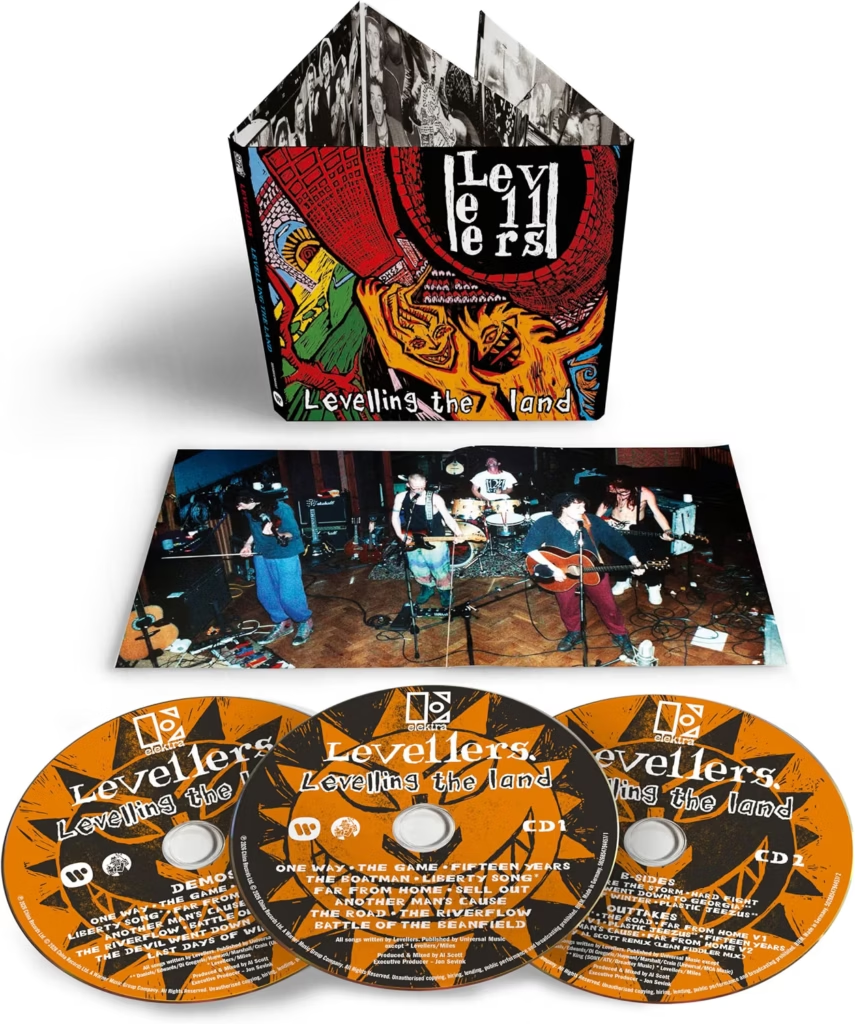
Disc one
God, what a track list. Few bands manage so many classic songs over the course of a career, let alone a single album. And everything aligns. It’s not just the amazing music, although the band truly perfected their gritty balance of hard-edged punk and bucolic folk here, it’s also the lyrics that tap into the spirit of freedom evinced by both genres. Even a track with a more contemporary narrative, Battle Of The Beanfield, is written with such deft accessibility that the horror of the bloodshed described could just as easily apply to any modern tale of state oppression. It is a masterclass in songwriting, storytelling, and attitude and, thanks to a brilliantly rendered remix, it has not dated one iota.
It kicks off, of course, with that indelible ode to personal freedom, One Way. One of those tracks that you fear may cloy over the course of repeated listens, some thirty-five years later it has yet to fail in setting the adrenaline coursing through the veins, and the remix only makes it punchier. Turn it up to enjoy the heavy, wah-inflected guitar, the multi-layered production and, best of all, Jeremy’s bass, now rendered with a clarity previously only hinted at on the original album.
It’s followed by The Game, a fiery track that positively explodes when the band air it live and which has gained considerable weight here. One of the band’s heaviest tracks (along with the likes of Belarus), it’s a riff fest with a melody to die for and a cracking lyric that conflates politics, religion, gambling, and the price that all three exact. It’s followed by 15 Years, that brilliantly realised and empathetic tale of alcoholism, here given a flaming kick up the backside with guitars and bass now landing on a crisp rhythm track that drives the whole thing relentlessly forward. Subtle but powerful, Al’s work here showcases just how important it is to approach the remixing of a beloved album with care, and he really does the band’s epic performance full justice here.
At the other end of the musical spectrum, The Boatman is almost pure folk and, once again, the remix finds Al picking out the details while keeping the atmosphere of this well-loved track intact. Almost pure folk, of course, because the outro is a full-on ambient/dance clash that now lands with the depth it always promised, making the segue into the barnstormingLiberty Song all the more exciting as a result.
The hits just keep on coming with Far From Home, an acoustic piece initially nailed by a solid kick drum (which now lands with real force), it expands into a full-blown hoedown, with the spontaneous cries and percussive elements placing you right at the heart of it all, more so than ever thanks to the immersive remix.
Then there’s the blazing might of Sell Out. With the title referencing a phrase that was once the cri de cœur of the 90s punk scene, the track is delivered like a fist to the face, Jeremy’s bass and the twin guitars of Mark and Simon stabbing out as the band work their way towards that oh-so-memorable chorus.
One of two tracks that pair heartbreak with utterly irresistible melodies, Another Man’s Cause is a tale of a family torn apart by unspeakable violence – as relevant in the era of the Russia–Ukraine conflict as it ever was in the early 90s. It’s followed by the lilting folk of The Road (from which the live album took its name).
The Road is, however, just a brief moment of calm in a surprisingly visceral outing from the band and it’s followed by the explosive folk-rock of The Riverflow, a giddy track that frequently closes the band’s sets even now, some thirty-five years on. You have to wonder if the band had an inkling that the cries of “hooray” that pepper the track would become a battle cry for thousands of fans across the years but, whether they knew or not, they penned an indelible anthem that day.
Considering the hope that has always lain at the heart of the Levellers’ oeuvre, the album ends on a surprisingly dark note, as if to really punch the song’s vital message home. Named for the brutal suppression of The Peace Convoy (a gathering of New Age travellers) by the Wiltshire police in 1985, The Battle Of The Beanfield is one of those tracks that just works its way under the skin, especially when John Sevink’s fiddle briefly resembles a police siren over a chugging riff; while the lyrics (ground out through gritted teeth by an enraged Simon) have lost none of their power to shock in the intervening years. It makes for one hell of an ending, especially with the remix ramping up those thunderous drums, and it leaves you needing a moment to process everything the band has shared over the preceding hour.
Honestly, I didn’t know what to expect with this remix. For an album I know back to front, I expected maybe a touch more weight, but this version manages to be revelatory without being revolutionary, which is exactly what I want from any classic album restoration. Everything sounds sharper, cleaner, and more detailed without any obvious digital trickery. Moreover, in every song new elements seem to have been unearthed, and the overall sound is so much more immersive than the somewhat lacklustre production of the original. Indeed, it says much of the quality of the songs that the album became so beloved seemingly in spite of its sonic shortcomings. But here, everyone involved should be incredibly proud of their work. They’ve brought this absolute masterpiece to life in a way I would never have thought possible, and the set is worth it for fans old and new for the quality of the remix alone.
Disc two
The ‘90s were a rich time for music fans, as bands often took advantage of singles to share outtakes from the album sessions or even newly recorded songs that couldn’t be found anywhere else. Of course, some bands took more care than others, with the likes of The Manic Street Preachers, The Wildhearts, and The Smashing Pumpkins all well known for the quality of their B-sides. Alongside these, The Levellers, never ones to let their fans down, also stand tall – something made clear by the first five tracks found on disc two.
The disc opens with Dance Before The Storm, a fun track that incorporates elements of baggy into the band’s sound, Simon’s semi-spoken vocal nicely contrasting with Mark’s more full-throated delivery on the chorus. It’s followed by the beautifully understated Hard Fight. An acoustic track led by Mark, it’s a haunting ballad that is all the more effective for being almost entirely stripped down.
A highlight of the second disc, and of The Levellers’ catalogue as a whole, is their immense cover of The Devil Went Down To Georgia (The Charlie Daniels Band). The sort of track that most bands would make the cornerstone of a new release, it’s typical of The Levellers to throw it out as a B-side, only to later find out just how popular the track had actually become. That energy carries over to the frantic Last Days Of Winter, a barnstorming track that fizzes with punk fire. Another cover, this time of the King Earl Boogie Band, wraps up the B-side selection in fine style, the band clearly having fun letting loose on the whimsical country-rock of Plastic Jeezus.
The rest of the disc comprises a series of studio outtakes from the Levelling The Land Sessions. These vary in quality and mainly find the band trying out different sounds and styles on their way to the final production.
A surprisingly gritty Liberty Song kicks this set off, the guitars amped way up, although few would prefer this untamed version over the final rendering. Similarly, The River has much of its final charm, although the drums clearly hadn’t been finalised at this point. I’ve got to say, the original production idea for Far From Home is fun, if not entirely practical (with the underpinning drone proving really distracting), although the separated Boatman Jig (the outro from the final track) is really cool in a sort of organic-Orb kind of way.
Leaving an alternative version of Plastic Jeezus (which offers little) aside, the proto-version of Fifteen Years shows that the band had the cool mandolin part nailed, although they were clearly tempted to take it in a punkier direction than the album cut. In contrast, the funeral pace of Another Man’s Cause is just a touch too mawkish, leaving a second version of Far From Home to highlight the band’s progress over an incredibly short period of time.
The disc ends with an Al Scott remix of One Way, which is really fun, taking elements from across the album and weaving them into a dark trip hop piece that works really well. The band would later return to this style with Too Real, and it’s interesting to hear them trying their hand at it here.
Overall, disc two’s primary merits lie in the B-sides (essential) and the One Way remix. The outtakes are interesting and do help to tell the story of a much-loved album, but it’s hard to imagine listening to them too often.
Disc three
The final disc comprises demos gathered primarily from a series of cassettes unearthed by drummer Charlie Heather. The quality of these recordings, largely unheard for some thirty years, is remarkable considering the source (compare, for example, Nirvana’s raw cassette demos for Nevermind, which was recorded in the same year), and it makes for interesting listening.
That said, what becomes clear very quickly is that The Levellers knew exactly where they were headed with each track on the album (and even the attendant B-sides). As such, there are few surprises and, in many cases, being a fly-on-the-wall in the band’s rehearsal room is less revelatory than, say, some of the very different demos floated by the likes of The Smashing Pumpkins.
Indeed, many of the demos here are closer to the final album versions than the outtakes, which at least saw the band experimenting with different emphases, making this a bonus of casual interest and unlikely to be played more than a handful of times.
Overall
Levelling The Land is an enduring masterpiece and, thanks to some very clever, very careful work from the production team, it’s given a new lease of life here. The first disc alone warrants a 10/10 score as it is truly one of the best reworkings of a classic album I’ve heard. With the bonus cuts as well – five B-sides, some interesting outtakes, and the entire album in demo form – this is essential, no matter how many previous editions you own. 10/10