For anyone who lived through the 90s, there are certain songs that are so embedded in the consciousness as to feel like they define the entire era. Of these, Suede’s Trash and Manic Street Preachers’ A Design for Life provide complementary views of the period – A Design for Life an emotional return from a band battered by a combination of having achieved the fame they initially (and somewhat facetiously) courted and the loss of their totemic lyricist Richey; and Trash a neon-lit paean to the hedonism of youth.
These songs, if not important to those who lived through that decade, are at least familiar. However, for fans who grew up alongside one or both the bands, they mark a coming of age that is indelibly etched into the psyche.
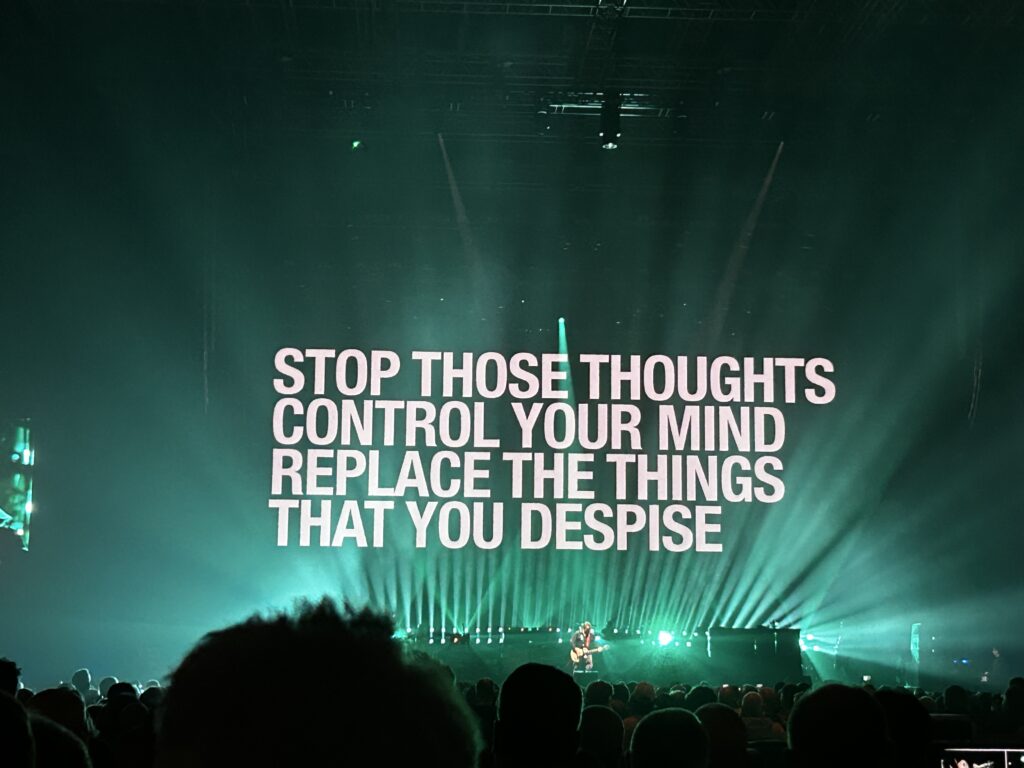
It does much to explain the emotions that inevitably accompanied the announcement of a second Manic Street Preachers / Suede tour – a double header so popular that a massive queue snakes around Birmingham’s Utilita Arena more than an hour and a half after doors apparently opened.
To get the issues out of the way first, the Utilita is not a good venue. Designed by someone who woefully underestimated its capacity, it is underserved by the bridges that connect it to the far side of the canal, has limited queuing space outside, and is a veritable maze of doors and corridors inside, making it difficult both to get in and to navigate around. Something made all the more irritating when the queue inexplicably grinds to a halt at 7:35 PM, just as Suede are due to start. Does any of this spoil the night? No, of course not; but given the not inconsiderable fees the venue commands, it could certainly do better.
Back to the plot.
We arrive just in time for Suede’s third song of the night, and we’re immediately thrown into the heady days of the mid-90s with a blazing Trash. Yet this is no mere exercise in nostalgia, and the band perform what was once a cri de cœur into something both celebratory and ruminative. It is this relationship with their older material that has helped to ensure that Suede’s second act has been so impressive, amassing considerable praise and resulting in a series of acclaimed post-reunion albums. Moreover, their stage presence, always visceral, has been refined to a razor-sharp point that owes far more to the ferocity of punk and the dark glam of Bowie than indie.
From Brett Anderson’s constant shape throwing to the arcing feedback that pours from the stage between songs, it’s a performance that, while touching on the anthems of our youth (Animal Nitrate, We Are The Pigs, Saturday Night), rages through a brace of tracks from Antidepressants, including the title track and a particularly belligerent Can’t Get Enough, which is delivered with enough firepower to evoke the first flushes of youth.
Of course, with Coming Up celebrating its 30th anniversary there’s a decent showing of tracks from that album, with Filmstar and Beautiful Ones joining the aforementioned Trash and Saturday Night. However, lest you be tempted to imagine those singles prop the night up, you only have to look at the band’s delivery of (and the audience’s reaction to) the likes of She Still Leads Me On to see that the new material more than holds its own against the anthems of our formative years.
Suede have achieved the damn near impossible. Reuniting after a lengthy break, they’ve clawed their way back to the top in an industry grown increasingly cold and indifferent, crafting albums that not only speak to their fans from the early years but which, miraculously, have captured the imagination of a whole new generation. What a way to open the show!
Arguably the tougher prospect, for all that the Manic Street Preachers have a wealth of gold in their singles collection, they were always that little bit spikier, quirkier, and somewhat more mercurial than their peers.
For their partisan fans, this is part of the appeal, but for a mainstream audience, the zigzagging from the stadium hard rock of Generation Terrorists to the cathartic beauty of This Is My Truth, via the snarling, grungy Gold Against The Soul, the glorious Everything Must Go and the cold post-punk of The Holy Bible, is bewildering to say the least. Leaving aside that soaring voice, tracks like the glibly cerebral Motorcycle Emptiness, for example, and the harrowing Die In The Summertime could well have been produced by another band entirely; and the Manics have rarely rested upon their laurels from one album to the next.
As a result, tonight’s set offers untold riches for the faithful, and more than a few head-scratching moments for everyone else. It’s absolutely wonderful, of course, underscoring the unflappable self-confidence of a band whose fourth single asserted You Love Us and, as a lifelong fan, the evening blazes past in what feels like a matter of nanoseconds.
The set opens with an emotionally charged Motorcycle Emptiness, remaining in the 90s (“where we feel safe”) with a heroic Everything Must Go, a brilliant single that, while somewhat overshadowed by its more famous sibling, remains a powerful entry in the band’s canon. It’s a great start, but the night really takes it up a gear when James unveils Little Baby Nothing, which has fans smiling and waving their hands in the air in delight. While it’s hard not to miss Traci Lords’ indelible vocal, James handles it brilliantly and it’s just amazing to hear the band continue to explore their legacy rather than simply lean on their most well-known pieces.
From there, the band dash left and right. Kevin Carter (complete with Gavin Fitzjohn on trumpet) sounds as spikily brilliant as ever, while You Stole The Sun From My Heart is greeted like the hard-riffing anthem it is, the massed voices of the crowd frequently threatening to overpower the band.
Following a brief nod to Critical Thinking with a widescreen Decline And Fall, we shoot back to Send Away The Tigers for a lovely Your Love Alone. It’s delivered with brio by James, reminding us both what a remarkable vocalist he truly is, and just how many excellent singles the band unleashed past what many might consider to be their classic period.
Things calm down a touch as Nicky straps on an acoustic guitar for a scuffed Hiding In Plain Sight (complete with Bring The Dancing Horses intro). His voice may not be the strongest, but he’s come into his own in recent years, and the track nicely plays to his strengths. He then takes a moment to introduce James, before the full band return for a wonderful No Surface All Feeling. A highlight of Everything Must Go, it emerges from a brief Total Eclipse Of The Heart and proceeds to rip out the audience’s collective heart, providing the perfect counterpoint to a rousing Design For Life, which has the entire arena singing as one.
An acoustic interlude has long been part of the set and tonight we’re treated to James’ renditions of Ocean Spray (a beautiful and understated tribute to his late mother) and The Everlasting, the latter exploding into life for its climactic solo.
From there, the band take us on a helter-skelter ride to the finale. A none-more-G’n’R Slash ‘n’ Burn ramps up the cowbell and leaves a few fair-weather fans scratching their heads. Autumnsong is another highlight from Send Away The Tigers, while a cover of Blondie’s Union City Blue nods to the band’s roots.
However, if Slash ‘n’ Burn confused the unwary, then it’s a monumental Die In The Summertime from the band’s pivotal Holy Bible that has fans in raptures and everyone else wondering if the stage has been hijacked. A blistering tribute to Richey’s enduring brilliance (“we may be only three on stage, but we will always be four” says Nicky), it tears through the arena like the November wind that encircles the venue.
Of the final two songs, little needs be said and you probably already know what they are. A snotty You Love Usis both a massive singalong and a wonderful nod to the band’s early impulses to be the biggest band in the world. In contrast, the gorgeous, understated If You Tolerate This Your Children Will Be Next just seems to gain greater emotional heft with each passing year and it has emerged as a stately masterpiece that perfectly closes the night.
It marks the end of a wonderfully scattershot set that takes in the gamut of the band’s career and, while it may not exactly deliver what the audience think they want, the band ensure that it does deliver what they need. The result is a performance that acknowledges the hits, explores the darker recesses of the band’s career, and reinforces the band’s continuing presence as a creative force. Catharsis has never felt so communal.