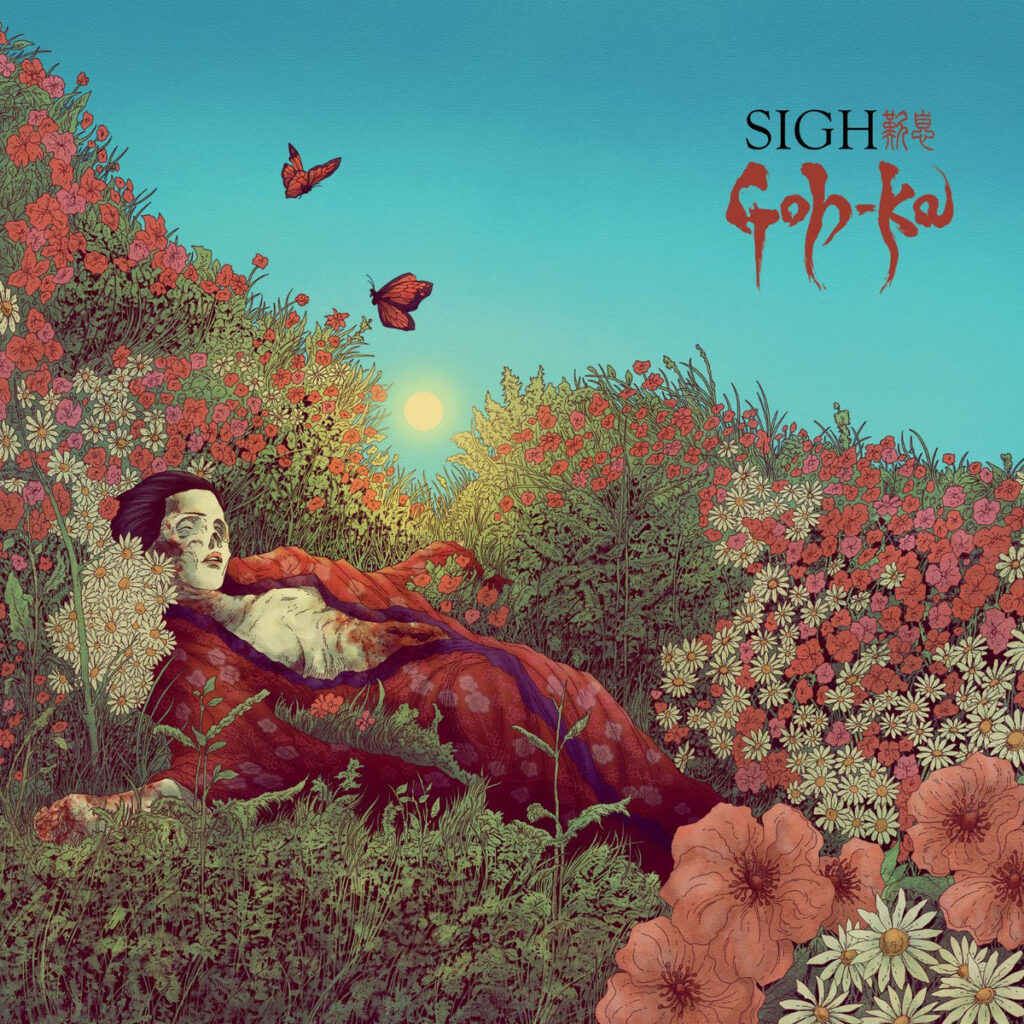
There has always been something otherworldly about Sigh. From the artwork to their deeply original take on black metal, the band have carved out space in a genre that, all too often, can rely on tropes in order to be perceived as authentic. Now back with their first album of original material since 2022’s Shiki (the band’s last release being a reworking of 2007’s Hangman’s Hymn), Sigh once again push the boundaries with Goh-ka, an eleven-track double album that finds the core band joined by Frédéric Leclercq (Kreator) on bass, Mike Heller on bass and, on Unputenpu, Mikael Åkerfeldt on lead guitar.
The album opens in typically epic fashion with Kuso-shi 1,2, and 3, a nine-minute exploration of hazy 80’s-style synth, mid-tempo metal, Japanese folk, and black metal vocals. The result, certainly at the outset, is rather as if someone had fed King Crimson and Celtic Frost through the primitive circuits of a SNES and yet, for all that it’s gloriously atypical, it’s also strangely addictive – the more so when the warble of a Hammond organ emerges to pull the whole thing further prog-wards, the band nodding to Opeth and Tangerine Dream as they hurtle down their own path, utterly oblivious to what anyone else might think. This is genuinely unique music and, while some of black metal’s touch points may exist within its DNA, there is so much else to unpack, that musicologists will be arguing over the band’s influences for years to come.
It’s followed by Jigoku-Zoshi 1: Unkamusho, a short and direct track that emerges from an off-kilter Latino rhythm to explode into shards of metallic fury. It acts as something of a palette cleanser on the way to the lovely Anzenshokon, which owes as much to Howard Shore, Black Sabbath, and Genesis as it does to anything from the extreme metal firmament, although it does have moments of white-hot fury woven into its fabric. Nevertheless, an expressive, dynamic track, it keeps the listener guessing as it slowly unwinds over the course of some six-and-a-half minutes.
The sequel to the opening track, Kuso-shi 4,5, and 6, returns us to the avant-garde explorations of its predecessor. A truly kaleidoscopic piece of music, it contains the same wild-eyed spirit that drove the progressive bands of the 70s to experiment with everything from jamming knives into their keyboards to household objects as they sought out new ways of expressing themselves. The result is an expansive piece and yet, for all that it throws a number of sonic curveballs at the listener, it never loses sight of melody or rhythm, thus keeping you utterly hooked.
Following the brief and necessary segue that is Shoso, Opeth’s Mikael Åkerfeldt pops up to lend a hand on the explosively unpredictable Unputenpu. With the wheezy keys of the mellotron floating through the mix and a jazz-inflected lead at its core, it still finds the band latching on to a bruising riff, and it’s definitely one to turn up loud, if only to cover the sound of you singing along somewhat giddily to the melodic chorus.
Once more showing just how wide their influences can be, Sigh offer up a still-more cinematic track in the form of Jinmenjushin, which spends almost a minute exploring similar territory to (James Bond composer) John Barry before suddenly traversing into more traditional black metal territory, albeit with a touch of Therion’s operatic fare woven into the chorus.
Perhaps the album’s most traditional extreme metal moment, Jigoku-Zoshi 2: Tokatsujigoku is a blazing reminder of just how potent Sigh can be when they choose to nod to their roots. Built around an icy riff, it is pure Celtic Frost worship.
Two short pieces follow, both around the two-minute mark. First there’s the mellifluous folk of Kushukankyo, and then the eerie ambience of Kuso-Shi 7. Together, they advance the album towards the closing, 11-minute epic that is Kuso-Shi 8 and 9 / Mettaijakujo.
As might be expected, this final piece gathers all the threads scattered across the album to create an emotionally charged and genuinely climactic finale to an album that delights in confounding expectations. Symphonic in its sweep, it takes in biting riffs, scabrous vocals, punishing drums, and moments of sublime beauty, leaving the listener genuinely sorry when they are forced to return to reality at its conclusion.
A genuinely artistic endeavour, Goh-ka has that same pioneering spirit found among avant-garde enthusiasts and the progressive giants. There is so, so much within the album to unpack and yet, for all that the music frequently pushes at the boundaries of what is possible, the band never lose sight of their place within the realm of extreme metal, nodding to their roots without compromising their need to move beyond them.
This is one of the most adventurous, experimental, and wonderfully unique albums I’ve heard this year and it shows that, more than thirty-five years in, Sigh have lost none of their ability to surprise or delight. 10/10