If you’ve spent any time with alt-country band the Long Ryders, then you’ll know that their music fizzes with energy. So much so that even the band’s pre-reunion material, recorded between ’83 and ’87 still feels fresh and innovative today. Whack up the volume and you’ll hear the likes of The Black Crowes, The Meat Puppets, and Wilco all scribbling notes in their copybooks, and with good reason.
And, much like the music his band makes, frontman Sid Griffin similarly fizzes with enthusiasm, both for the band’s new album (High Noon Hymns) and for their storied history. Moreover, talking to Sid is like talking to a musical encyclopaedia, as he frequently flies off on tangents, often grabbing albums down from his overflowing shelves. It makes for a fascinating, multifaceted interview, in which he not only demonstrates an enduring passion for the music he makes, but a genuine gratitude to the fellow artists, engineers, and producers who helped to make The Long Ryders into the force that they are.
My starting question is that you did an interview back around 2016, I think, when you said that, at that point, that you didn’t really think the Long Ryders would play together again. To what extent did finding the path to writing new material pave the way for you to return to the stage?
I didn’t think we’d record again and then some people offered us a tour and it was just [throws his hands up in mock resignation] “Oh hell”.
So, we did it and it was successful, but I didn’t think we’d record again.
Then, we made an album called Psychedelic Country Soul, about six or seven years ago and, on the official UK American charts, on Amazon UK and across a lot of Western and Central Europe, on whatever humble Americana charts they have in those territories, it was the number one album.
So, in the relatively limited genre of Americana, having a number one album spurred us to keep going. So, we made three albums and two EPs in the ‘80s and we’re going to do three albums, and we put out a live EP, so we’ve bookended what we did in the 80s with what we’ve done since we reformed 20-some years ago – it’s the same amount of work.
And I think, once we had that number one record, it really focused our minds. We just couldn’t believe it was number one, so…
And I’ve got screenshots to prove this; I’m not just whistling Dixie. It just proved that we could do it. It was nice. We’ve made three albums now, since we reunited, and we’re going to knock it on the head, I think.
In a few years, we’re going to put out a career anthology of everything – the best of everything – tour behind that and that’ll probably be it, no more.
When you think about your music, going right back to the ‘80s, it has a visceral edge you don’t necessarily associate with Americana and it seemed to influence a lot of bands that followed, from R.E.M. and The Black Crowes to bands like the Meat Puppets. When you came back with that album, do you think that’s part of the reason why people were able to latch on to the sound – that it had become more familiar territory than it was in the ‘80s?
Yeah, in the ‘80s, we were arguably the first band to do any kind of amalgamation of Sex Pistols, Clash, Ramones, with country and western sounds, like the Flying Burrito Brothers or Gram Parsons or Hank Williams or whatever. The first… there was Jason and the Scorchers or the brilliant first album called Sundown by Rank and File, but those were more like shots in the dark (if you’ll allow me to say that).
We were the first time that a band had consciously tried to mix this potion up and Steve McCarthy – our guitar player – is not and was not a rock ‘n’ roll guitar player. He was influenced by Clarence White (Byrds Untitled), Tony Rice (lead guitar) Doug Watson (Lead guitar) … many people hadn’t heard this B-bender stuff before.
Being the first, in many ways, was enjoyable, pioneering, and I’m proud of it. But, in many ways, I think if we’d come later, we’d have been more successful. Johnny Black, a great rock writer (I think he’s in Wiltshire now), wrote a sentence I loved. He said, “Long Ryders are the perfectly right band at the perfectly wrong time. Had they come seven years earlier, they’d have been famous. Had they come five years later, they’d have been famous. But they came right in the teeth of synth pop…” And I won’t go into any more but, yeah, right band, wrong time. That’s just the way it is.
But I do love your initial premise. For instance, Jeff Tweedy, who I just saw the other night with Wilco; and Nels Cline, a guy I used to work with at Rhino Records; and Jay Farrar were at a place, I think it was called Euclid Records in Illinois. Anyway, we did an instore there and they told me later that they formed Uncle Tupelo – they were in a punk band a la Black Flag – and they told me later that they formed the first Uncle Tupelo after being inspired by seeing Long Ryders in their shop, it blew their minds.
So, we had a great influence, I don’t deny that. The people that know about us worship us and swear by us and I thank everyone of them for their support but, yeah, it was right band, wrong time.
It’s an exciting mix and, again, I grew up with bands like Meat Puppets, and they were the first band I heard with that sort of sound. And it’s not a sound I’d have put together but it just fits. And, while prepping for this interview, I was going back through my collection and it occurred to me that even tracks like Mr Soul, even in its acoustic incarnation, is so much heavier than you at first realise.
I agree. It’s funny about the Meat Puppets. Back in the day, around ‘81–’82, I had a roommate called Eddie Flowers. He was this big fanzine guy on the circuit in LA. And Eddie and I were talking about what would happen (because I was in a ‘60s punk band, a garage band called The Unclaimed) if you mixed straight country and western and mixed it with punk rock music. And we were always laughing, because no one would ever do that, right? And this is me, the guy that sort of invented it with the Long Ryders. We just couldn’t believe you could take straight Hank Williams, Lefty Frizzel, Kitty Wells, and mix it with punk. It was an absurd idea. This is from the guy that did it about eighteen months later! [Laughs]
And Eddie came up, one afternoon, with the phrase “cowpunk”. Because we were discussing what to call it and we came up with “shit-kicking punk” and we called it “country punk” and we called it “Pashville” and “Punkville” and all this kind of stuff, and Eddie looked at me and he goes [exaggerates southern accent] “cowpunk!” And we laughed for like three minutes.
And then, in like two years, everybody and their brother was using the phrase cowpunk. I’m convinced Eddie Flowers thought of it that day, in around 1981 in LA.
But, going back to your question, I laughed at it! But to come to the point (for once in my life), Stephen McCarthy walked into the rehearsal room to join what would be the Long Ryders – there was just myself, a bass player called Barry Shank (who split) and our drummer, Greg Sowders, who’s still with us today. And we needed another guitar player or keyboard player or something – we didn’t want to be a trio.
Stephen, he plays rock ‘n’ roll well, but it’s not where his heart is. And where his heart is (as I said earlier) is that Clarence White, Tony Rice B-bender, Jason Isbell and Brad Paisley – that kind of thing. And so, I thought, right there at rehearsal, “why are we making this guy play sort of punkish distorted guitar?”
I got him to clean his sound up, have a little overdrive and play that [imitates country riff] all that country and western stuff. It was the best decision I ever made and the best thought I ever had… From the guy who, eighteen months earlier, was making fun of it! The same guy!
I love it! That kind of spontaneity, that kind of happy accident is what makes music so exciting. You weren’t trying to follow anything; you weren’t trying to follow in people’s footsteps. You were drawing on the disparate talents of the people in the room. That’s amazing.
Yes! And we wanted to be different. The thing is, there was this period in LA where so many of the bands, when you saw them walking down the street, you knew what they played, like heavy metal or bar-chord punk (like Johnny Ramone, I call it bar chord punk because he makes the bar-chord E or A and he goes up and down the fretboard).
And that’s all fine. But we wanted to be different. And that’s kind of why, when Stephen played country and western, I kind of grasped that. A punk rhythm section and a punk attack and the craziness of punk… But the country and western themes, and the scales of country and western guitar – that twanging, popping, chicken pickin’ thing.
It was a great idea, but it was a crazy idea!
At first, people didn’t know what to think of us. They did not know. And I’m sure I had people tell me, besides the Uncle Tupelo guys witnessing us in Illinois in around ’82–’83, I’m sure for a lot of our audience in late ’81, ’82, early ’83, it was the first time they ever heard a song like I’m gonna tap the desk [sings it].
I’m sure it’s the first time they heard two guys singing in harmony and [sings the riff] all that kind of stuff.
And it was… at first, people didn’t know what to do with it. And, of course, now there’s the phrase alt-country in every pop magazine in the world. There’s the phrase Americana in every magazine in the world. And even the phrase cowpunk. But, when we started, those phrases did not exist.
I’ve always loved the term Americana. It’s so simple and yet incredibly evocative of open landscapes and the sound and the imagery combine in a way that very few genres do.
Yes! And what’s interesting about Americana is that music knows no border. Which is why… Peter Green is English and he’s got three strikes against him… well, not strikes, but three things that complicate his career: he’s English, and England is not basically the home of the blues; he’s Caucasian; and he’s Jewish. And we don’t associate – the lost tribes of Israel have their own music, believe me, they have their own spiritual music and their own music from the Middle East – but I guess, because he suffered, he was impoverished, and he’d had a tough childhood, a guy like Peter Green can get into the blues. And (in my opinion) he’s one of the few that can play blues as well as any African American from Chicago, New Orleans, or Kansas City.
My point here is that it helps when you play a music like blues or country and western to be from, like, impoverished America. To play reggae, it helps to be from the Caribbean, right. To play the uilleann pipes, it helps to be of Celtic heritage, right? It helps. But the beautiful thing about music is that you don’t have to. You can play the uilleann pipes and not be a celt. You can play blues and be a Caucasian from England. Oddly enough France and Italy have big blues scenes, so figure that!
Music doesn’t understand borders. There’s French rap and people are going to kill me if they’re French, but I find it pretty funny. When we play in Paris, Bordeaux, and Toulouse, you’re walking down the street, the guy’s car windows are down, and you hear him rapping in French. And, to me (and no offence to anybody) it’s hilarious. But that’s the beauty of music – you don’t have to be from the States to rap, you just have to mean it in here [gestures to his heart]. And that’s what I love about music. It might help to be from Chicago or South-Central LA to rap, it might help, but you don’t have to be.
That’s the beauty of music. And that’s how the two guys at Euclid Records could swap from being in a Black Flag punk band to being in Uncle Tupelo.
And then, there’s our old opening act. I don’t know, probably around the year you were born, there was a band called Mister Crowe’s Garden. They all had short hair and they sounded very R.E.M. I even have their cassette. About three years later, a manager said “You guys are good but you’re not great. I want to change your name to The Black Crowes, I want you to grow hair, wear bell bottoms, and do a little more jamming.”
So, they went from being a short-haired, early R.E.M.-ish thing to just being this southern-rock-groove-of-Otis-Redding-meets-the-Allman-Brothers, and why not?
Music doesn’t respect borders. They exist, but you can shapeshift like you’re in the fifth dimension. That’s what’s beautiful about it. That’s how… ‘cause Stephen and I are Southern guys born and bred and country and western music, I had it all around me in Kentucky. Literally, just up the street at a tavern. There were gigs there all the time. Our drummer, Greg, who’s still with us today, he’s an LA suburbanite. He’s not a ground zero country and western guy. And yet he got the shuffle, he got that immediately. Music, it goes right across borders.
Andy Kershaw, the late DJ, he told me (much to my amazement) that country and western was very popular in places like Colombia and Ecuador when he visited there and my friend Michael Eble, who’ll be thrilled to be mentioned in an interview, he’s a normal person and not in the record industry – he’s from Niger and he says you wouldn’t believe how big country and western is in Niger. Like you’ll turn on the radio and there might be a Merle Haggard song. And they have their own Central African music, duh! Of course. But he says that, not so much blues, not so much rock ‘n’ roll but country and western. So, music goes right across borders.
I totally agree and, you know, when you see bands like Sepultura bridging heavy metal, primarily a very western genre, and then taking it into the jungle and interpolating those very heavy, Brazilian vibes. Stuff like that is so interesting and, maybe in this era of the internet, one of the few positives is maybe a growth of that kind of cross-cultural communication.
Yeah, I think that there are two things that you can do to really hit a number of hot spots. One of them, I got from this guy called Joe Boyd, who was the producer for Nick Drake and Fairport Convention and all that kind of crowd; Joe Boyd said, “anytime you take post-World War II popular genres and mix them together with some foresight and aesthetic thinking, you get something interesting.” You know, like The Byrds and “folk-rock”. The Fairport Convention’s first album is very much Americana and he told them, “Look, why are you doing these sort of American-style songs like you’re Jefferson Airplane or the Byrds?”
So, he told them, on the second and third album, to do more of those Cecil-Sharp-style songs with those electric instruments. And then you get the great Sandy Denny and Richard Thompson era of Fairport Convention.
It’s an interesting point and I do think, as Joe Boyd said, “when you mix two genres and they’re not a clash, they’re a blend.” They’re a blend, Phil.
And the second thing that always works, in my opinion, is you do a genre of music in the classic style. You do jazz like the Marsalis Brothers – they look like they’re from the 1950s with coats and ties and they play respectful jazz, and they touch all those buttons. You can play blues like you’re Albert King straight down the line and that always works for the sons and daughters of Stevie Ray Vaughan that are out there like the Tedeschi Trucks Band and all that kind of stuff. Or Wayne the Train Hancock, a modern Hank Williams kind of guy.
A lot of Bluegrass bands now, there’s so many young people out there. Like Molly Tuttle or there’s this young guy called Billy Strings, and they’re both just mindbogglingly good. Any time they do straight Bluegrass, it’s fantastic. And they also have pedal boards on stage, they go off on these (well, Molly Tuttle doesn’t so much), Billy Strings gets kinda out there with like 9-minute versions of songs and it proves my point – as Joe Boyd said, you mix two things successfully, you’ve got something interesting going on. Or you’re just pure as the driven snow in that genre and that appeals to all the people who, for example, if they like Mod, they like Small Faces and The Who; or people who like reggae, like Bob Marley or Toots and the Maytals kind of thing. That’s the kind of thing I’d tell anybody who didn’t know what to do in a band.
There’s another element to this, but you’ve got Ed Stasium, someone who has worked with The Ramones and Soul Asylum, so someone who’s maybe a little outside of the Nashville, Tennessee paradigm?
Well, you know, Ed started out in a band called Brandywine that opened up for Rod Stewart and the Faces on their first American tour. He had the experience of being a great guitar player and a touring musician.
On the other hand, he got tired of that and, as early as 1969, he was working for Tony Bongiovi, and all those cats in New York. And, from there, his career just grew and, then from 1969 to 1972, he had mixed Midnight Train to Georgia by Gladys Knight and the Pips. Bones Howe and the Gang had recorded the track and Gladys Knight and the Pips recorded the vocals.
And they went home and Ed thought “this is my chance!” And the guy we’re talking about now, Ed Stasium, without permission took it upon himself, all by himself, to mix that track overnight. So, when they came in the next day, he was asleep in the chair and they said, “Ed, you didn’t go home?” And he goes, “no!”
So, they asked what he stayed for and he told them that he’d mixed the song! And they said, “OK, let’s hear it and, if it’s any good…”
So, they played it twice and Bones said, “it’s a hit!” and they kept his mix!
And so, Ed’s been around since Midnight Train to Georgia, that’s a classic song! And it’s an example of what I just said. It’s written by a country and western songwriter named Jim Weatherly and it was called Midnight Plane to Houston [sings the original cut]. It was a country and western song, and exactly like I said earlier, The Pips changed it into an R’n’B thing, and they had a hit with it.
So, Ed’s been around Donkey’s years. And when you’re talking about music, like I’ll mention what The Beatles did on a track on something Brian Wilson did, he goes “it’s this” (he’s a very technical guy) … “well, it’s this; and they put that there, and they put that there, and this goes over here…” You get it, you know. [Realises something] Oh, he also did Phil Spector sessions, and I asked him how All Things Must Pass sounds so incredible and he explained to me that Spector doesn’t just put guitars all at the same level, they’re layered behind one another in the mix, so it’s not just some clutter of 32 guitars that sound the exact same thing.
That [sings] on My Sweet Lord, for example, it’s a dozen or whatever guitars but there’s one at, say, 10 on the mix level, another at 9.5, another at 9, and so it goes. It’s just amazing, and that’s what a guy like that brings to the table. And that’swhy we’ve used him for four of our six studio albums. He’s just amazing.
I love the collaboration between a band and a good producer. If you’ve got someone who knows their stuff and, again, across genres, they can bring such amazing new elements to the music. And when they hear something in your music that, perhaps, you’ve never heard, they’re a vital extra ear.
I agree. And we’ve had a lot of plus and minuses in our career but the one thing I will say is that we never had a bad producer. If we screwed up, it was as much our fault as anybody’s. Not many people know and perhaps shouldn’t even care but, when R.E.M. were signed to IRS, Stephen Hague, the British synth-pop guy was to produce the first record. And they went and did sessions and, you know, they did X amount of tracks and the band said “no, we’re not doing this anymore. No offense on a personal level, Stephen Hague, but you don’t understand what we’re on about. It should be Peter Buck’s arpeggio guitars and this wonderful rhythm section, and me (Michael Stipe) mumbling [if you’ll allow me to use that phrase, Michael] indecipherable lyrics, like [sings] da da da da,” you know, singing.
But, yeah, we never had that problem. We had Earl Mankey, who worked with Brian Wilson, did our first EP. We had the legendary Henry Lewy, who worked with the Flying Burrito Brothers and Joni Mitchell, for about eight albums. He did Van Morrison’s Common One, that’s a classic album. He did a couple of Barbra Streisand albums; and we would have worked further with Henry Lewy, but we went to England to record the next record and that kind of severed our relationship with him for a while. But I don’t know, we’ve never had a bad producer. Ed’s been the best of the bunch, but we never had a bad one.
And the reason I got our new album out, I mean I’m proud of it of course (ta da!) Ed was doing something and I said “you know everything, Ed, you know absolutely everything. There’s a young lady doing engineering…” and he said “oh, just to keep on top of modern stuff, I brought in Nicole Schmidt, and Nicole was working up at, I think, Record Plant West in LA. It’s the one where Dylan did Planet Wave, wherever that one is. So, anyways, we worked with this great engineer, Nicole Schmidt, because Ed said that he wanted to stay on top of every modern piece of outboard gear.
So, we had an incredible team, Phil. We’re not going to do another studio album we don’t feel. We’ve done enough, there’s other things to do in life, so we’re going to end on this high note – and I think it is a high note, I’m very proud of it – and it just shows the kind of guys we’ve worked with.
Ed’s like my father, who was a scientist, and you’d ask him something and he’d explain it. And sometimes you’d ask him something about the planets or using chemicals, and he’d say, “I don’t know,” which I love. He’d say, “I don’t know, but I’ll find out, son.”
I really love that in guys. And Ed’s like that, “I don’t know, but we’ll figure it out.” Ed doesn’t say “no”, that’s what I’m trying to say. Ed doesn’t say, “no, we can’t.” I hate “no, we can’t.”
There’s something unique in the musical community where these professional relationships often become friendships because you have so much trust in one another. You mentioned your photographer there as well, and it’s a good point because everyone who comes into the orbit of a band, from photographers and engineers to producers and videographers, they’re so important to what you become.
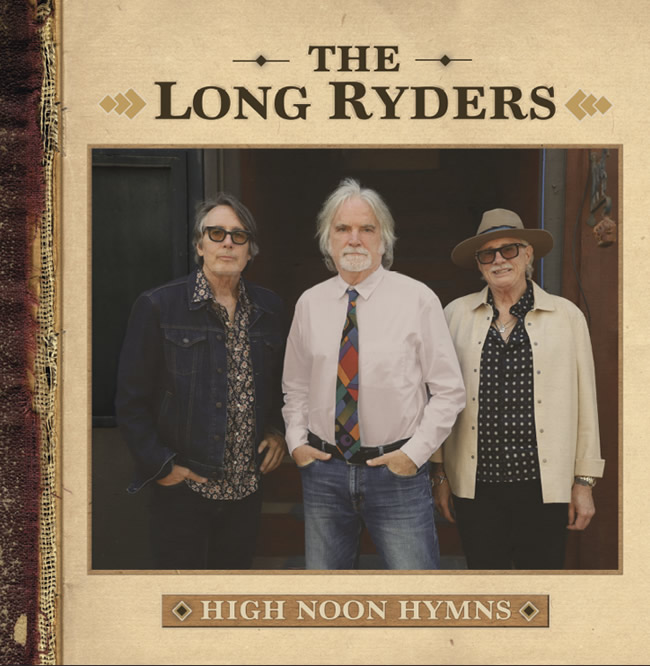
I agree. And it’s funny because Henry Diltz, I met – he did a tonne of Joni Mitchell covers and The Byrds reunion, for their Asylum record, and I think he did four of the first six Eagles’ records. I met Henry in ’84 and he’s been taking my picture with the Long Ryders since February or March ’85. He took our picture for this… these [gestures to the album cover] are Henry’s photographs and actually, Ed Stasium took some too. It’s like a family.
And we use the same road crew every time. And, because we’re not full-on, 100% Long Ryders every day, because I have a family and our drummer, Greg Sowders, is a big publishing mogul at Warner Chappell in LA. So, we do about nine weeks to twelve weeks a year touring. And we do three weeks here and four weeks there.
And what I’m trying to say is that it’s a family coming together and it reminds me of something I read as a boy and which I didn’t understand in the 70s. The Beach Boys had made this comeback – they’d been squaresville for a while – and they made this comeback in America, and Carl Wilson said… he was asked if he hated touring, and Carl said, “no, I love touring. When touring is going well, it’s almost like the Beach Boys are standing stock still and the rest of the world is coming to see us.”
And so many times at gigs, old friends are there, and I know exactly what he means. We’ll go and play Brighton, and we know who’s going to want to come backstage and say “hi”. And I mean this in a nice way. And I go and play upstate New York, and I know who’s going to come and say “hi”. And, in the Boston, Massachusetts area, I know who’ll say “hi”. We’re playing Vancouver, Canada, next June (get your tickets now), and I know friends in Vancouver who are going to be there. So, it’s a wonderful way to physically stay in touch with people that you’ve met, and they’re scattered to the four winds. It’s just a wonderful blessing.
I love the fact that the new album cover looks like a kind of photobook. And I know you said this is the last record, so was that your intention?
It wasn’t my idea. Our albums (and this is the most name-dropping interview ever), but our albums… this cover is done by the great Geoff Gans, who’s Bob Dylan’s artwork guy for the last 35 years. And I’ve known Geoff for years, but I didn’t know him well until recently. And this is all Geoff Gans’ idea. So, if you like Bob Dylan’s album covers, here you are, here’s another kind of thing from the same guy. Geoff is a genius. It does look like an old family photo collection.
But the thing you can’t see from there is (and I don’t know if it’ll be this way forever), is this


















I can only think of a couple of bands offhand that have done that, Pink Floyd did it, I think, with one of their albums… and possibly a Rolling Stones.
Yeah, Rolling Stones had one, and Jackson Browne. And we’re missing one… oh, Déjà vu by CSNY had a really dramatic one, and I’m sure there are more. And it does cost more money, but it’s like eh, what the hell?! We’re trying to make an artistic statement. Lester Bangs had this quote I always liked, and he said, “never trust an entertainer who, whatever their act is – music or juggling or they’re a thespian on the stage – never trust an entertainer who more or less has “send money” tattooed on their forehead!”. You like Kiss, great, that’s your privilege, but they have “send money” tattooed on their foreheads.
A lot of these show-biz-y people that are popular now, the sort of sons and daughters of Harry Styles and Madonna; you know, the lights go on and dancers come out, that is a “send money” tattooed on their forehead kind of act. And I don’t feel smugly superior to them, because they’re more popular than we are, they can laugh at me all they want. But I do feel very different from them. We’re not trying to do everything possible to make money here, we’re trying to make an artistic statement. And the fact that we have a lovely cult following that allows us to live out a rock ‘n’ roll fantasy twelve weeks out of the year is fantastic.
And I think what you’ve said in interviews before, and I wholeheartedly agree, is that you don’t get into rock ‘n’ roll now to make money. It’s something you do for the love of it, especially because listening is now for the select few who want to buy CDs or records and invest in listening… because everybody else is kind of passive… if you’re listening on Spotify, you probably don’t even know what you’re listening to!
Yes yes! There are certain gigs, and it doesn’t matter what kind of music you like; you could be a Swifty, but there are certain gigs where a person can enter the room and think I’m with my tribe. I went to see Otis Rush in Chicago, and I saw him just up the street because I live here in London now (I married a Welsh girl). And I felt, if you know who Otis Rush is and you like blues, you’re my friend. Everyone in that room was my friend. Stephen McCarthy, our guitar player whom I keep mentioning, he had me come to Richmond about eight years ago for The Byrds, oh I think I have a copy of it here, hold on! [Disappears into his collection] Oh no, this isn’t it, this is The Byrds at Monterey! You know, they put out a Sweetheart of the Rodeo album, where they played it live, and so that’s what I was reaching for… Anyhow, long story short, when we went to that thing it was McGuinn and Hillman playing the Sweetheart of the Rodeo album, with like Byrds hits at the end, backed by the Marty Stuart band, this country and western guy, Steve and I were looking around and he said to me “we’re in the right place”. Because, you know, Sweetheart of the Rodeo is not To Pimp a Butterfly, it’s not Sgt. Pepper. It is not the last Beyonce album where she’s the cowgirl trying to do the country and western rap thing. It was a niche album that now is considered a classic. But it’s not even a gold record yet. Fifty years later and it’s still not a gold record. Steve looked at me and he said, “we’re in the right place. Anyone in this audience tonight, you could talk to ‘em about music.” I felt that was a genius thing to say, and it meant a lot to me then and now. I thought, I’m in a room with my tribe, if you follow me, Phil.
Absolutely.
Whereas, if I went to a heavy metal gig, I like some (a very little bit of) heavy metal. Actually, I like a bit of Van Halen and stuff like that. Arena rock, corporate rock, heavy metal, I don’t really get it, and I would have felt alien going to a big basketball court to see so many of the popular bands. But the beautiful thing about music is you can go and anyone at the gig is your buddy. Male or female. What would my mother have said? “Short or tall, fat or skinny, Jew or Gentile, atheist, agnostic, or de-vout (my mother’s very southern) that is your friend.” And she’s right, it’s true.
I know we’re very short on time, but yeah – we went to a Jimmie Vaughan gig last year and, in this tiny little club, he brought out Eric Clapton. And the wave of recognition and love that went through the room. Moments like that are so special to bands. Is that part of why you went out to do Native Sons top to bottom?
Yes! So many people wanted us to do it and I felt guilty in a way, Phil, because Paul Weller (whom I greatly admire), he said, “all these bands go out and do the 40th anniversary of this and the 50th anniversary of that, they should raise their game!” And I thought, “well, easy for you to say, you have a career and a sales base!” But yeah, we went out and did the Native Sons album, and we had the most marvellous time. And we did it in order, which we’d never done before, and we did three songs we’d never played before on stage. So, it was just so fantastic. Every night was fun and God! Yeah, it brought the tribe together.
And my last question, you’re off out in support of this record, so will this be it?
No, there’ll be a collection after this – our entire career of like two or three LPs and two or three CDs – but this is the last studio album.
Thank you so much for your time, it’s been really interesting and I really appreciate it.
I enjoyed it!