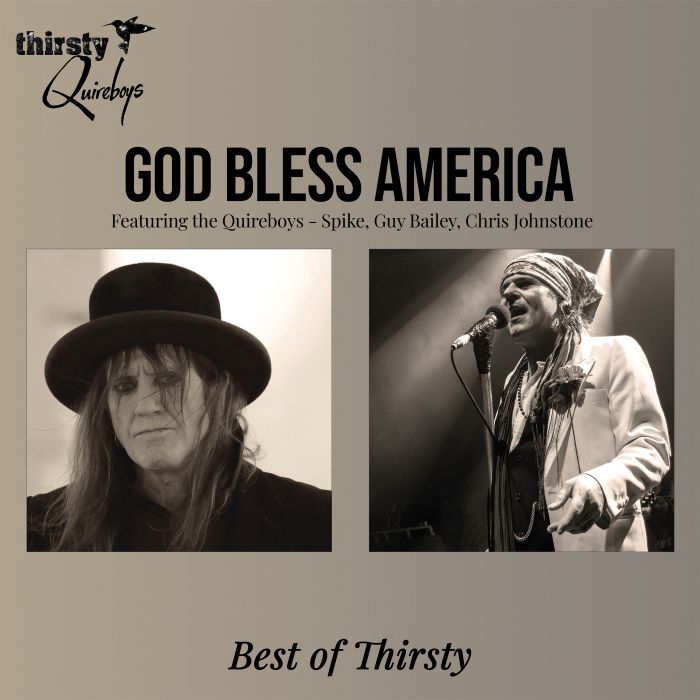
Formed in 1984, the original Quireboys (Spike, Guy Bailey, Nigel Mogg, and Chris Johnstone) raised hell throughout the late 80s and early 90s before disbanding in 1993. Although the band would reform in 2001, it was with a new line up, and The Quireboys went through a number of iterations before Spike, Bailey, and Mogg reconvened in 2022, a short-lived reunion that ended tragically with the death of Bailey in 2023.
A tribute to their fallen friend, The Thirsty Quireboys is a reworking of material recorded by Guy under the guise of “Thirsty”, a side-project he concocted with Russian poet Irina D. Originally intended to be much narrower in scope, with Spike entering the studio to sing a single track (1-10, 7 and Possibly 6), he identified so closely with the music that he ended up working with pianist Chris Johnstone and producer Chris Kimsey on a full-length compilation that included new vocals and remixed cuts from across the three albums that make up the Thirsty catalogue. The result, billed to The Thirsty Quireboys, is a bluesy, soulful, and deeply emotional album titled God Bless America – Best Of Thirsty.
The album opens with the slinky, raw-throated 1-10, 7 and Possibly 6, which finds an early Aerosmith vibe locked away within the track’s serpentine slide guitars and shuffling beat. It’s a strong start to a diverse album. Take the glorious Flawless, which sets Spike’s whiskey-soaked rasp against gospel backing vocals, the resultant track providing a nod to the dusty blues of Tom Waits via The Rolling Stones – it’s an absolute gem and it’s easy to see why those involved became so hooked on the project.
The title song juxtaposes a lovely ramshackle blues with some of the album’s hardest-hitting lyrics, relating as they do the tragic tale of Rosemary Kennedy, who was forcibly lobotomised in a barbaric operation that saw the surgeons forcing her to keep singing God Bless America, only ceasing their bumbling incisions when she stopped. She was left broken, locked away, and almost entirely incoherent for the rest of her life. A subtle, understated track, it conveys horror through its deft interpolation of the titular song’s melody, and it leaves you with a lingering sense of unease which is not entirely dispelled by the ferocious, ascending riff of Mercury, this latter track boasting an absolutely stunning vocal performance from Spike.
The album gets back to a more laid-back vibe on Albertos, which recalls the surf rock of The Tornadoes with its woozy, trem-washed chords and heavy-on-the-toms percussion. Then there’s the dark soul of White, which opens on a twitchy, Latin beat, dry stabs of guitar underpinning a naked soul vocal that recalls the Stones at their peak, although it soon segues into a melodic, slide soaked blues chorus that stands as one of the album’s most memorable moments.
A simple rocker, Libertine is short and to the point but lacks the licentious spirit that the title suggests. The follow up,Donnie To Sonny, however, is a great track, which combines semi-spoken-word vocals with a woozy, surf vibe that just seems to hover in front of the speakers rather than emerge from them. With an emotionally charged vocal that sounds like Tom Waits channelling Bob Dylan, it recounts the real-life tale of Joe Pistone and Sonny Black (a story previously captured in the film Donnie Brasco), and it finds The Thirsty Quireboys at their best.
The ramshackle spirit of the Stones is resurrected on Chaos, which opens with Guy reciting a few lines from Bunyan’s Pilgrim’s Progress, before Spike enters with the great opening line “I am chaos, pleased to meet you”, tastefully echoing the opening to Sympathy For The Devil. With great backing vocals from Lynn Jackman, it’s a cracking tune with some absolutely stellar guitar work sprinkled across it like gold dust. It’s followed by a brief digression – Solar – which, with its whip-crack drum opening (courtesy of Squeeze drummer Simon Hanson), and spoken-word vocals is more akin to poetry set to music than a rock song, Guy’s dreamy guitars providing a suitably evocative backdrop.
It’s back to business as usual with Orlando, which has a cocky strut to it; a feeling only strengthened by the deft application of bone-dry harmonica in the introduction, paving the way for Spike’s gritty, soulful vocal. With a simple, addictive chorus, it’s the sort of track you can imagine Guns ‘n’ Roses penning had Izzy stuck with the band. Things get even more soulful on Even Keel, a svelte little track that comes to a surprisingly abrupt end. The album then wraps up with Black, a piano-led coda that quietly closes the shutters on this lovely tribute.
A beautifully rendered and deeply respectful evolution of Guy Bailey’s original songwriting with Irina D, God Bless America – Best Of Thirsty is a touching tribute to a fallen friend that boasts remarkable performances and, while there is an inevitable sense of loss, there’s also a sense of joy in this final collaboration that gives the album its vital character. Soulful, bluesy, and deeply memorable, God Bless America – Best Of Thirsty is a remarkable record indeed. 9/10


1 thought on “The Thirsty Quireboys – God Bless America – The Best Of Thirsty Album Review”