After twelve years, German death metal merchants Endseeker are bringing their career to, um, an end and, in keeping with their dedication to their craft over the years, they are wrapping things up with a five-track EP, featuring brand new tracks and… a David Hasslehoff cover?!
You can read our thoughts on the excellent new EP here. In the meantime, we caught up with guitarist Ben to discuss the band’s dissolution, the awesome dynamic at the heart of Coffin Born, and the band’s final plans.
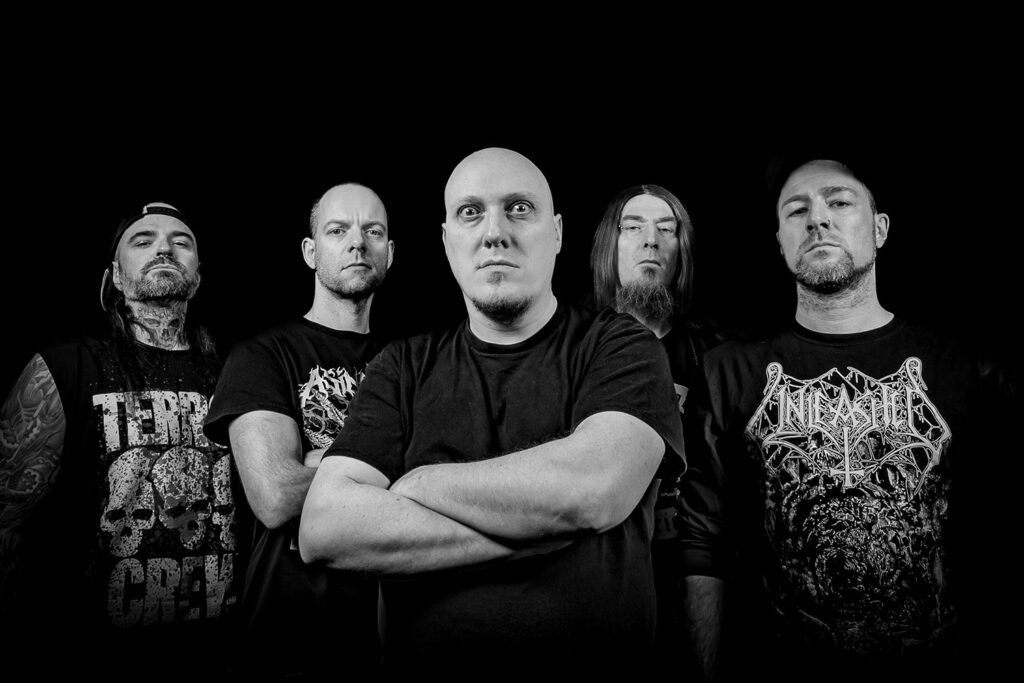
The first thing that I’d like to address is that you’re bringing Endseeker to an end after twelve years. I think we all know that, as musicians, it’s getting harder and harder to exist as content creators and musicians and tour bookers all rolled into one; much more so even than twelve years ago – is that part of the reason that you’ve made the decision to wrap things up on your own terms at this point?
To some degree, probably yes. I mean it’s like… you know, it’s a bit of everything. There’s a certain amount of exhaustion after twelve years. We pushed a new album out every two years or a record, not necessarily an album, which is a lot of work. And we were playing as much live as possible in relation to our work life and shit. And, yeah, it was a twelve-year grind, and you reach a point where you question yourself, like, “where’s this going from here? Is there anything new coming up for us in the future, is there any growth or any new stuff to conquer?”
And then you realise maybe it’s all said and done and that you risk repeating yourself or losing motivation to a degree where you put out half-assed shit. And we never wanted that to happen, so we thought it was maybe time to make a cut here. We’ve had twelve amazing years and a consistent line up, which is pretty rare, I think. And we achieved more than we ever thought we might be able to. It’s a good point in our lives to call it quits.
And yeah, as you said, the content creation, the pressure from social media, it’s all part of it, you know.
It’s interesting because, for me, there’s a tension between everything that you’ve just said – the fact that it is really hard work (and a lot of what you have to do is behind the scenes and I don’t think fans necessarily see that); but the flip side of that is that the band becomes your identity over a long period of time. So, having the courage to say goodbye to that must have been quite difficult. Did you as a band come to this realisation together, or has it been a slower process do you think?
Well, it doesn’t come over night. At the end of 2024, we played a show in Dresden, and we decided after that to take a year off from playing live. We’d played live, at that point, for ten years straight and everything, all our private lives, was stepping behind the band. We were planning vacations with our families and stuff and always looking at the band schedule and where the festivals were. So, everything was planned around the band. So, we decided to take a year off to have time for other stuff, for real life. Because the band is just a tiny part of it and not as big a part as people might think.
Then, during 2025, we realised we really enjoyed this amount of free time and flexibility and spending time with our families and stuff. So, we sat down, had a dinner and a long conversation and, at the end, we realised that that was it. It was a good exit.
Then we decided how we would do it. We considered one last album or quitting immediately and, finally, we decided upon an EP. It was how we started and it’s not as stressful as a full album. It’s way easier to just write an EP. I mean, we wrote more songs than are on the EP, but we just picked the best ones in our opinion and threw them on there.
There’s something really exciting about an EP. The format doesn’t seem as popular now, but there’s something cool about an EP because it’s kind of… well, not only is concise but it also enables bands to try something a little different that sits outside, perhaps, of their full albums. And, as you say, there’s that synchronicity of starting and ending with an EP – it feels more like a farewell gift to fans if that makes sense.
Sure! And, like you said, EPs used to be pretty popular in the past and I guess my favourite Entombed record of all time is the Hollow Man EP. It’s just amazing. Or Metallica, the Garage Days thing, that was fucking amazing. There are so many great EPs, and they seem to have disappeared for the most part. But, seeing as we’re an old-school death metal band and we’re fairly old guys [laughs] we’re allowed to put out an EP.
And also, an EP takes a lot of pressure off you because it’s not chart relevant. So, you’re not asking if it sells better or worse than the last. It doesn’t count, so it’s just a fun thing to do.
I know that, in a previous interview (I think promoting Global Worming) you said you weren’t a political band, and you asked fans not to over interpret lyrics… and so, I’m immediately going to over interpret a lyric! The first single that you bought out, The Enemies of Peace, both lyrically and in terms of the video with its subliminal flashes of certain world leaders, it does feel like, in an era of division the lyrics have become a little more pointed than they were, or was it the fact that this is a final hurrah, and you felt free to say everything you needed to say at this point?
Well, we had some political songs before. On Mount Carcass, we had Merciless Tide and Count the Dead. Count The Dead was dealing with all those Black Lives Matter protests and all the police brutality and I think Trump was president at that time as well, right? [Laughs] And Merciless Tide was about all this conspiracy crap going on concerning the COVID pandemic, which divided societies up until now, I think. It was the kick off point for a lot of the trouble we’re dealing with today.
And then, on Global Worming, the whole Global Worming thing is just a metaphor for other existential crises of a global scale. And there are some other songs on there as well.
I mean, we’re human beings, so we have a political opinion and, as artists, we use our tools to express our feelings about stuff that really bugs us, as well as all the goofy death metal shit – you know, the horror content that’s pretty typical for death metal bands. But, from my understanding, the death metal origins are in punk music, which was super political, and there are so many political bands… I mean Bolt Thrower is a political band. All they do is sing about war, which is a political instrument… and they’re punks. They’re fucking crust punks, those guys.
So, yeah, I don’t think that excluding politics from art is a good idea. It just goes hand in hand.
I whole heartedly agree. But, at the same time, you mentioned the pandemic and, since the pandemic, it feels like the division and the anger (especially on social media) seems to have become much worse. People seem much more willing to express violent opinion openly and I think that can be concerning for bands operating in this field – the backlash that you can receive.
True. True. I mean, when you step into discussions on social media or whatever you really have to be careful what you say because it’s a fucking minefield because everyone’s going crazy and they’re offended immediately. So, we just completely avoid that. We never get into political discussions on social media, we don’t comment on stuff, we don’t react to certain comments. We just let our music speak for itself.
And, I mean, when you take Enemies of Peace, that’s not a hidden message. It’s a pure anti-fascist song. Because I think that fascism is the biggest threat to people at this point and it’s fucking scary. It’s a global thing and who knows where it ends. This is scarier than any horror movie scenario to me.
I think you used the word existential earlier and it does feel like we’re facing an existential crisis at the moment. And it’s important to have songs like that but it’s interesting, the process and discussions that go into creating something that is potentially divisive given the febrile nature of social media right now.
Well, as soon as an artist is afraid of a possible social media backlash on his lyrical content then already something is really wrong. Art is supposed to be free, and it’s also supposed to be controversial. If everybody agrees on everything then extreme music is kind of pointless, isn’t it. Not everybody has to agree with us and it’s up to the people to decide if they still listen to us because they maybe like the music or the non-political songs or whatever; but, if they refuse to listen to us just because we don’t share the same political views that they do, so be it. I don’t want to play for a fascist audience or whatever. I’d rather not play at all. And I express my views because this is the only way that I have to express my views. And if people agrees or if they start thinking about certain things because of our music, fine. If somebody hates us because of our political lyrics then, yeah, fuck off! We don’t need you!
In terms of the music, Enemies of Peace is such a cool, dynamic piece of music. In extreme music, there’s a need for weight and power, but when you’ve got -as you have here – tempo shifts and even doomy elements, I find it makes the faster bits that much heavier. How important is it for you to work on those dynamic elements and does that come from the guitarists in the band or the rhythm section?
So, for the first part, it’s super-important. We, for the last two albums, we did not work too much with tempo shifts within the songs. We basically wrote songs that have the same tempo throughout the whole song, but we might change the feel, switch from double time to half time or whatever. But, this time, we really changed the tempo of certain parts a lot. Which is more back to our roots, like towards the first EP, Corrosive Revelation. We did stuff like that back then; we lost it over the years and then went back to it. So, yeah, it comes all from the guitarists, Yuri and me, because we’re the two guys writing the songs.
We’re not a jam band; we don’t stand in the rehearsal room jamming. It’s more like Yuri and me writing at home. Sometimes we send parts back and forth to get inspiration on songs. But sometimes we also write completely alone and then bring it to the band and work it out in the rehearsal room. This is more the way we work.
Anyway, yeah, I think dynamic is super important, especially as death metal itself has no dynamic in terms of tone. It’s distorted all the time, high gain all the time. So, you have to create dynamic shift through other elements such as groove, tempo, stuff like that.
I love it. It’s like some of those old Autopsy records where it’s hyper fast and then some dirty doom riff kicks in and it’s just brutal! So, yeah, I was so happy to hear that opening track.
[Laughs] Awesome, thank you!
I noticed as well that, on this one, it’s a band production. I know that you brought your long-time collaborator Eike in to do the drums; so, it’s really cool you’ve kept that partnership but, at the same time, is it that you wanted to do this yourselves?
I think in the biography it’s not 100% correctly written. We recorded the drums with Eike, and he was re-amping the guitars as well. So, we recorded the guitars at home, and we gave him all our gear, so he had the chance to re-amp it in the studio in the best possible fashion. And he also did, of course, the mix and the mastering. But we did all the recording except for the drums. We recorded guitars, bass, and vocals at home, and he was working it out then.
So, yeah, this is the first time that we did that. Normally we recorded everything in the studio. But this time, we spent quite a lot of time making the demos and working the demos out in a really detailed way. Then we came to the conclusion that maybe we could use those tracks because there’s no point in going into the studio to play the same again. So, it was a different approach and it was fun, actually, because it gave us more freedom in terms of when and how we work because everyone could just do it at home whenever they felt like it and not taking a week off work to go in the studio and sit there while other guys watch you play.
It can get a bit goldfish bowl, can’t it?
[Laughs] Absolutely, yeah!
I’ve got to ask about the David Hasselhoff cover because it’s a lot of fun and, honestly, it’s interesting to hear that you did it all at home, because it has a really cool, live vibe. But yeah, what made you select that particular song and how did you approach it to bend it to the extreme metal sound?
Actually, we all love this song and seven or eight years ago, we went to a David Hasselhoff concert just to hear him play that song. And, funnily enough, that tour, Garret (the keyboard player for Lord of the Lost) was the live keyboard player for David. So, while we were at the show, I was looking at the stage going “dude, that’s the guy from Lord of the Lost playing the keyboard! He’s the tour keyboard player, cool!”
So, now, during the writing process for Coffin Born, for some reason I threw True Survivor into my Spotify playlist, and I listened through it quite a few times and I thought maybe it could be a good cover song that we could make work and make it really heavy. And the first vocalist that came to my mind to deliver it was Chris from Lord of the Lost because he has such a strong voice and they have this Hasselhoff connection already and we’re both from Hamburg and we know each other, they’re cool guys. And, yeah, I brought it to the boys and asked them what they thought and everybody thought it was cool. And then we asked Lord of the Lost if they want to join us and they said, “hell yeah!”
And here we are, it was good fun and just wait until you see the music video for it, it’s epic! [Laughs]
Are you one of these bands that enjoy doing music videos? You look like you are and I think a great video can really bring an extra dimension to the song, but I also know a lot of bands kind of find it kind of dull and, like, extra work beyond the music.
Sure, it’s a lot of fun. I mean, it’s also my job, it’s what I do for a living, like video production and stuff. So, when we do, like, the normal music videos, which is just live performance or whatever, we shoot it in our rehearsal room and I shoot them, so it’s super DIY and it’s done in three-hours and that’s it. So, we’re pretty efficient on that now.
But then, those other videos for Global Worming, like when we were in those sleeping bags, you know, pretending to be worms and shit. We shot those with Ali, the guitarist of Heaven Shall Burn, who is also a friend of ours, and he has a video production company as well. So, Hell Is Here and Global Worming were shot by him and that was super fun. And also, to get the responsibility away – the direction the vision – and also for True Survivor, we hired someone to do the video. It’s just in the final editing. It’s going to be hilarious; it’s going to be fun. We really enjoy having fun with this medium and using it as an extra layer to deliver whatever you think fits best to the music. It gives a visual impression of your idea of the song, and I think it’s different when you just listen to a song and when you watch it with a video, it’s somehow entertaining.
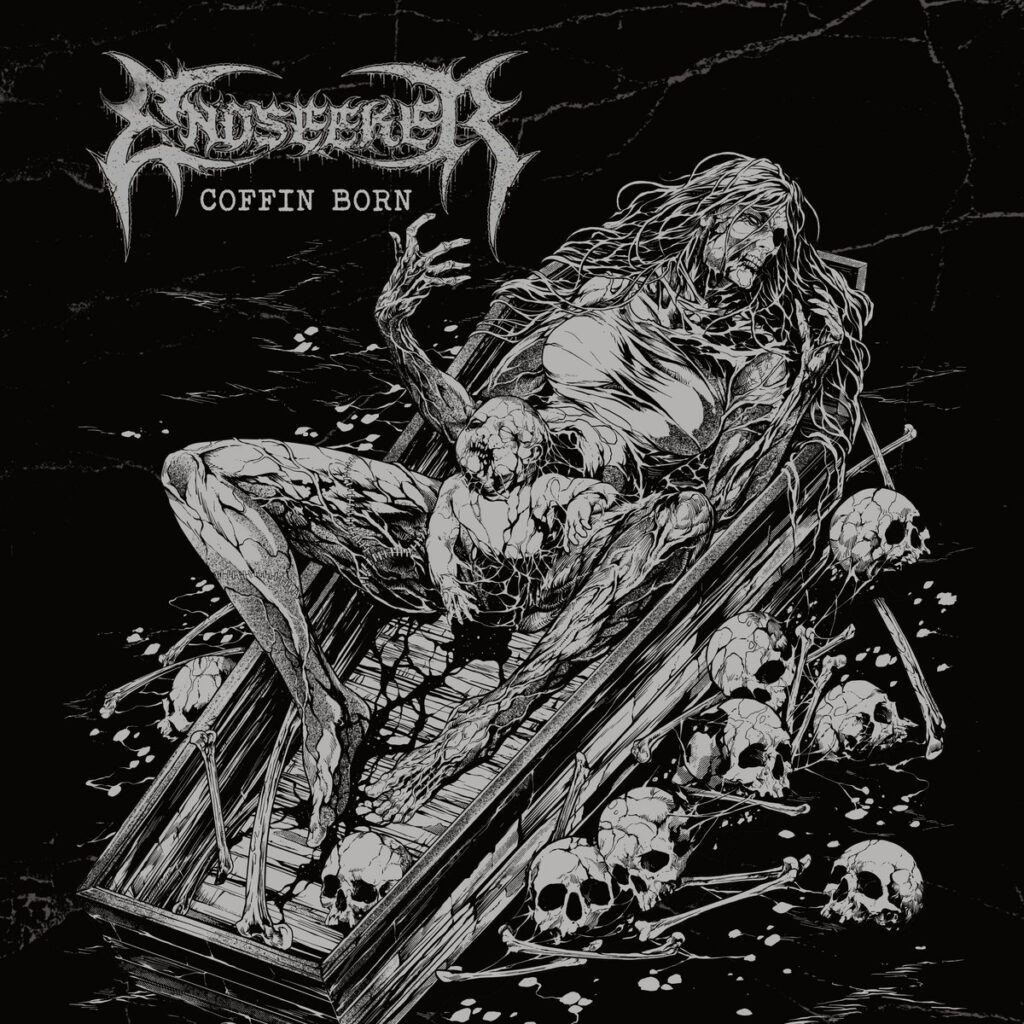
And, of course, the other aspect that’s particularly important for death metal bands is the artwork. And the artwork for Coffin Born is really cool – who did it and how involved were the band in the final outcome?
It’s a guy from Indonesia. We worked with him in the past already. He did a bunch of our merch designs, and he also designed our board shorts, which we sold on our merch (which was a great seller by the way). He’s a cool guy, super-fast, super reliable, and we just gave him the title and a rough idea, like “dude, it’s a zombie baby coming out of a dead woman, you know, make something out of it!”
And he threw over a sketch which was 90% of what the artwork ended up being. So, we fine-tuned it and that was it. I love his style, this cartoon-esque style, but not goofy. It’s always sinister, always edgy. I really like it.
It’s a fine line to walk, I think. It’s trying to be grim but graphic design-y enough that it’s not too grim. It’s a great balancing act to get it right and it’s so exciting when you get a piece of art that accurately captures your music.
Yeah, I think that, except for Mount Carcass, where we had this collage thing going on, which was more like Carcass, we always stayed with this drawing approach. We had this from the very beginning. The first artwork was done by Mark Riddick. Then we had Albert Che, who’s now doing stuff for bigger bands – his career has elevated since then – and, yeah, we always were looking for artists who could do this sketchy drawing, old-school, black and white stuff. That was something we always were attracted to.
You have a bunch of live dates coming up – what’s listed, is that it, or will you keep going a while longer?
No, that’s it. We have a final show in Hamberg on December 12, it’s sold out already, actually, and that’s it. That’s the final thing. We’re not pulling a Slayer move, like, “aaahhh, we may play some festivals…” It’s not going to happen. That’s it. We’ll play this last show and then we retire from this band.