The ‘90s were a strange period for music. Fiercely productive on the one hand, the advent of MTV, a huge market for tastemaking music magazines, and the relative affordability of music, caused any number of bands to burn brightly before fizzling out, usually thanks to over-eager label executives unleashing a marketing blitz before losing interest in their new favourite toy and pulling the funding. This was certainly the case with the likes of the excellent Kerbdog (“the new Nirvana!” screamed the heavily sponsored headlines); Headswim (two excellent albums and then collapse); and NY Loose, who issued one amazing (and remarkably hard-to-find) album, before losing their record deal.
NY Loose ran only from 1994–1997 but they were hardly idle. In that time, they released the excellent Loosen Up EP, various singles, and that one album – 1996’s Year of the Rat. Along the way, their most well-known song, Spit, was featured on the heavily promoted Crow II: City of Angels soundtrack (alongside the likes of Hole, PJ Harvey, Filter, Bush, and White Zombie), and the band toured with Marilyn Manson on his infamous Antichrist Superstar tour.
If the rise of NY Loose appeared meteoric, the band’s collapse was just as sudden and, as singer/guitarist/songwriter Brijitte West recounts, a change of heart at the label led to all support being pulled mid-tour. The band collapsed and, rather than regroup and complete work on an album for which they’d already started writing, a couple of members jumped ship. It is an all-too-common story and particularly tragic in the case of a band who had the skill, the eclecticism, and the attitude to go the distance had their label only held their nerve.
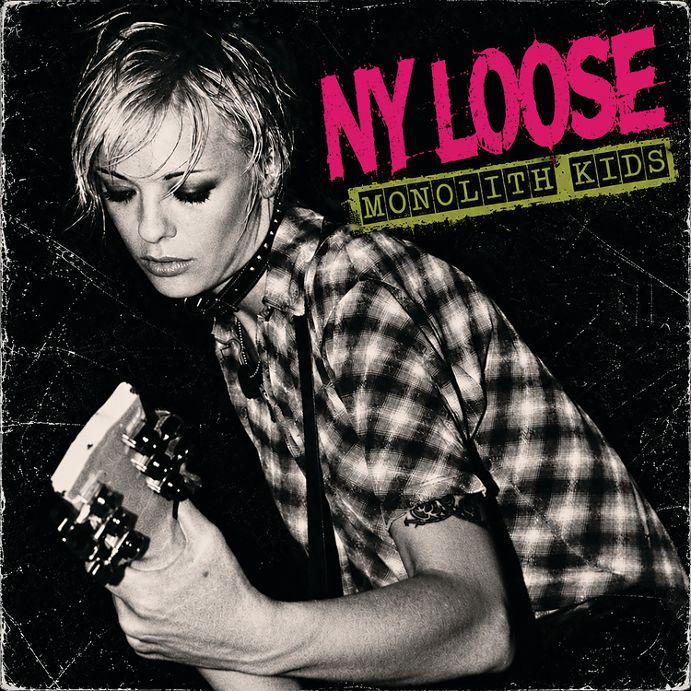
Going some way to wrestle control of the narrative is Monolith Kids, a new compilation that gathers remastered versions of the band’s early singles alongside the Loosen Up EP in its entirety (albeit re-sequenced). For fans of NY Loose, who only ever managed to track down Year of the Rat, it’s an absolute treasure trove of early, rare, and hard-to-find material. For those who missed out the first time round, it’s an essential introduction to a band who deserved so much more.
The album kicks off with the saccharine punk of Monolith Kids, which sits in a weird alternative realm where Lush grew up on the Ramones rather than My Bloody Valentine. It’s a high-energy album opener and a reminder that, while the likes of Spit may have found its way to MTV, NY Loose were cool way before the masses caught on. It’s followed by the scathing Bitch, which pairs a lacerating lyric (“well I guess I’m a bitch, don’t call me a bitch, I guess I’m a bitch if you say so!”) with a grimy rock ‘n’ roll riff that is as much G’n’R as the Sex Pistols. That scuzzy rock energy carries over into Green Light Semaphore, and you’re once again struck by just how timeless it all is, to the extent that this could just as easily have aired on the John Peel show circa 1994 as it could come screaming out of the radio right now, sandwiched between Lambrini Girls and Idles. The key is in the energy, and you can’t help but fall for the warts ‘n’ all recording that captures the band’s personality far more effectively than any quantised, autotuned production could ever hope to do.
Hard rock gives way to overdriven pop on The Luckiest Girl, which sounds like The B52s going toe-to-toe with Belly, the guitar played with just enough jangle to neatly bridge the worlds of pop, indie, and punk. The same could be said of James which, thanks to Brijitte’s snarling vocal, lands with real force.
Perhaps the most surprising track on the compilation is the original version of Spit (later re-recorded for Year of the Rat).With its heavily tremolo-washed guitar, it has a darker, more psychedelic edge than the final take and, while both versions have something to recommend them, you can see why the band moved away from the fizzy chorus toward something harder. That said, Brijitte’s vocal – the perfect mix of insouciance and bite – was already fully formed at the time this was recorded.
Another sonic change is in the air as the album progresses into its second half. With its gritty, staccato riff and disaffected vocal, Fade traces a link between NY Loose and the British indie scene, the band showcasing a sound not a million miles away from the pool in which Blur and Elastica were paddling at around the same time. That same sense carries over intoThe Desperate Hopeful, which lands amidst a flurry of cheap mascara and threadbare feather boas.
One of the highlights of this compilation, The Late 20th Century Blues emerges from an absolutely massive bassline and, while the production can’t quite keep up with the band’s ambitions (witness the way the bass drops out when the riff hits), there’s a looseness to the band’s performance and a melodic depth to the chorus that is irresistible. Better still is the punchy Loosen Up, which juxtaposes Brijitte’s pseudo-angelic vocals against a potent riff.
Underneath all the grit, NY Loose shared Soul Asylum’s penchant for pop melodies, as demonstrated on the ridiculously This Train Terminates Here – a track that should have been a hit, had it only had the means of reaching its audience. The album then wraps up with the ramshackle rock of Cheap Tragedies. One of those songs where the guitar playing feels like it could fall apart at any moment, held together only by a dream of bigger things, and it puts a remarkably human face on a band who, for many, were only known for that one magical album.
It’s easy, from the outside, to look at a band like NY Loose and consider them blessed. They played with Marilyn Manson, turned up on a major soundtrack, and seemingly had all the opportunities for which so many bands attempt to sell their souls. What’s missing from the picture, of course, is that to get there, NY Loose had to fight every inch of the way, working shitty jobs to gather the money to lay down what they could when they could. Much of that struggle was airbrushed from history by a label interested only in the final product and not the journey it took to get there which is, of course, to do the band a massive disservice. Moreover, if most fans never saw the band’s trajectory, they also never fully appreciated what NY Loose lost when it all came unstuck. Listening to these cuts now, it’s easy to appreciate the depth of the heartbreak Brijitte must have felt when it all came undone.
Monolith Kids may not bring NY Loose back but what it does do, and very well, is to give the band the narrative framing they always deserved. Here, amidst the sweat, the spit, the pop melodies, and the rock riffs, you can feel a band struggling to find the identity that many believed to have arrived, fully formed, on Year of the Rat. With a strong remastering job and a sequence that traces the band’s surprisingly eclectic influences, Monolith Kids is a gift for fans and powerful showcase, for everyone else, of what they missed the first time round. 8.5/10